The Euclid Mathematics Contest, organized by the University of Waterloo, is one of the world’s most influential high school math competitions. It holds significant weight when applying to top Canadian universities (like U of T, UBC, Waterloo) and for STEM/economics programs in the UK/US. Renowned for emphasizing “deep thinking over tricks, and strong application,” it is often called the “SAT of Math.”
This guide breaks down the key aspects of preparing for the 2026 Euclid contest across four dimensions: contest features, award structure, question format, core topics, and preparation strategies.
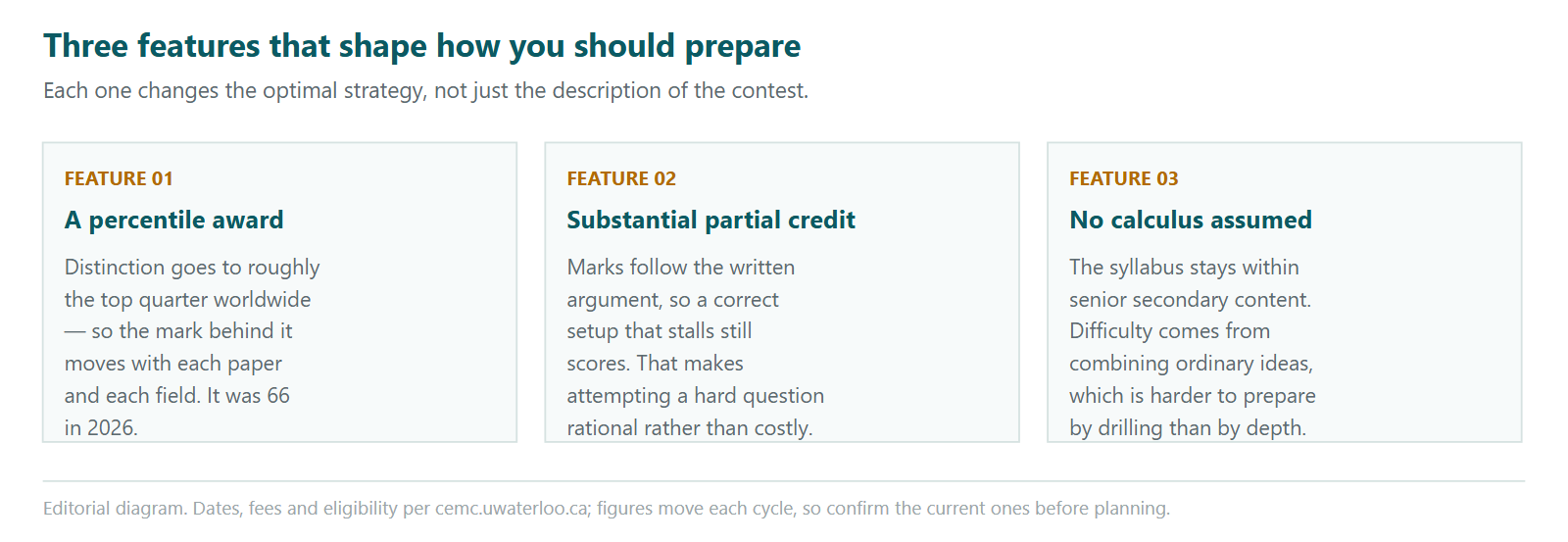
Three structural features — and what each one changes about strategy.
Part 1: Three Distinctive Features of the Euclid Contest
1. Moderate Difficulty to Win Awards (Top 25%)
The award structure is simple: only a Certificate of Distinction is awarded to the top 25% of participants globally.
High Practical Award Rate: Due to high participation and performance levels among Asian students, a Chinese student who scores around 70+ points (out of 100) typically secures a place in the top 25% with stable performance.
Reduced Pressure: The focus isn’t on solving the very last problem but on ensuring zero errors on foundational questions and high scores on intermediate ones. This is more accessible than contests like the AMC12, which requires top 5% to advance.
2. Humanized Grading: Partial Credit Mechanism
For some problems, marks are awarded for the solution process.
Even with a wrong final answer, you can still get 1–3 points for showing key steps (like setting up the correct equation, drawing auxiliary lines, or writing a recurrence relation).
This avoids an “all-or-nothing” trap and encourages attempting problems—always write down relevant formulas or ideas!
3. Limited Scope: No Calculus
The contest only requires mathematics up to Grade 10 level, with no calculus, matrices, or complex numbers involved.
It focuses on logical reasoning, model abstraction, and flexible application rather than the breadth of known formulas.
This makes it suitable for students with solid high school foundations but without extensive Olympiad training.
e.g., 2025 Q7: A combined “Probability + Sequence” problem requiring symmetry simplification and complementary counting.
Part 4: Recent Trends in Problem Design
Trend 1: Integration of Knowledge Areas
Problems requiring cross-domain thinking are increasing.
Solving geometric optimization using algebraic methods.
Analyzing combinatorial structures with number theory (e.g., using modular arithmetic to determine permutation parity).
Combined topics like Probability + Sequences and Geometry + Trigonometry are now common.
Trend 2: Emphasis on Mathematical Reading Comprehension
Problem statements increasingly incorporate real-world contexts (environment, economics, population growth).
The crucial skill is abstracting a mathematical model from the text.
Key Process: Information extraction → Model identification → Mathematical transformation.
Example: 2025 Q8 described “city population growing 5% annually,” requiring recognition as a geometric sequence and building a recurrence relation.
Note: This translation is based on the provided URL content. For the most official and up-to-date information, always refer to the contest organizer’s website. If you’d like help finding past papers or other resources, feel free to ask!
Frequently Asked Questions
Why is the award threshold described as moderate?
Because it is defined by percentile rather than by an absolute standard. Reaching the top quarter of a field of tens of thousands is demanding but achievable for a well-prepared student with a secure school foundation — it does not require the kind of specialised training that an olympiad selection paper does.
What does the marking scheme protect against?
Against a single error wiping out a question. Because marks follow the argument, an arithmetic slip late in an otherwise sound solution costs a mark or two rather than all ten. That is the practical meaning of partial credit, and it rewards students who write clearly enough for the grader to see where the reasoning held.
Does the absence of calculus make it easy?
No — it makes it accessible, which is different. Restricting the toolkit means questions have to get their difficulty from structure rather than from advanced machinery, and structural difficulty is harder to prepare by drilling. The late questions are demanding precisely because no advanced technique shortcuts them.