I. Analysis of the Difficulty of Euclid Mathematics Contest Questions
1. Questions 1-5: Basic Questions
Difficulty: Low
Characteristics:
Mainly examine the understanding and proficient application of basic knowledge.
Questions are designed straightforwardly to test students’ grasp of basic concepts and formulas.
Preparation Suggestions:
Ensure accurate calculations to avoid losing points due to carelessness.
These questions are crucial for scoring; be sure to get all of them right.
2. Questions 6-7: Medium-Difficulty Questions
Difficulty: Increased
Characteristics:
Assess the ability to comprehensively apply knowledge points.
Require mastery of certain problem-solving skills.
Preparation Suggestions:
Improve problem-solving speed and accuracy through extensive past paper practice.
These questions are also an important part of winning awards and scoring in the exam; focus on them.
3. Questions 8-9: Comprehensive Questions
Difficulty: High
Characteristics:
Mixed application of multiple knowledge points, involving geometry, algebra, number theory, and other fields.
Have high requirements for students’ logical thinking ability and step writing.
Preparation Suggestions:
These questions are the key to widening the gap between high scores; strengthen logical reasoning training.
Pay attention to the standardization of problem-solving process writing to ensure each step is well-founded.
4. Question 10: High-Difficulty Final Question
Difficulty: Highest
Characteristics:
The most difficult question in the entire exam.
Has extremely high requirements for the understanding and mastery of mathematical knowledge and problem-solving skills.
Aims to select the top students.
Preparation Suggestions:
Conduct specialized training for such questions to improve problem-solving skills and adaptability.
Cultivate confidence and patience in solving complex problems.
II. Types of Students Suitable for the Euclid Contest
Students with underperforming AMC scores:
If you believe your mathematical ability is beyond your AMC score, the Euclid provides a new opportunity to prove yourself.
Students planning to apply for Canadian universities:
Euclid scores are widely recognized by North American universities, especially the University of Waterloo.
Students who are better at clearly and systematically expressing problem-solving ideas in writing:
The Euclid’s emphasis on problem-solving processes allows you to better showcase your thinking ability.
Scan the QR code to join the exclusive learning community for the Euclid Mathematics Competition, where a wealth of preparation materials and trial courses await you!
Registration for the 2026 Euclid Mathematics Competition is now open! Scan the QR code to receive the registration form!
III. Efficient Preparation Strategies for the Euclid Contest
1. Foundation Stage: Sort Out Core Formulas and Memorize English Terminology
Goal: Ensure proficiency in core high school math formulas and familiarity with English math terminology to avoid language barriers affecting answers.
Methods:
Create formula cards for repeated memory.
Practice describing mathematical concepts and problem-solving processes in English.
2. Question Practice Stage: Classified Practice by Module
Goal: Focus on overcoming geometric proofs and algebraic operations by practicing past papers from the recent 5-10 years.
Methods:
Classify past papers by module and tackle weak links one by one.
Record wrong questions and analyze the reasons to avoid repeating mistakes.
3. Simulation Stage: Timed Full-Real Simulation
Goal: Conduct timed 150-minute full-real simulations to train time allocation and answering rhythm.
Methods:
Review after each simulation exam and adjust answering strategies.
Pay attention to time management to ensure each question can be completed within the specified time.
IV. Benefits of Participating in the Euclid Mathematics Contest
1. High International Reputation and Recognition
2. Important Reference for the University of Waterloo’s Scholarship Awards
3. Enhance Application Competitiveness in Various Professional Fields
Frequently Asked Questions
How do the questions increase in difficulty?
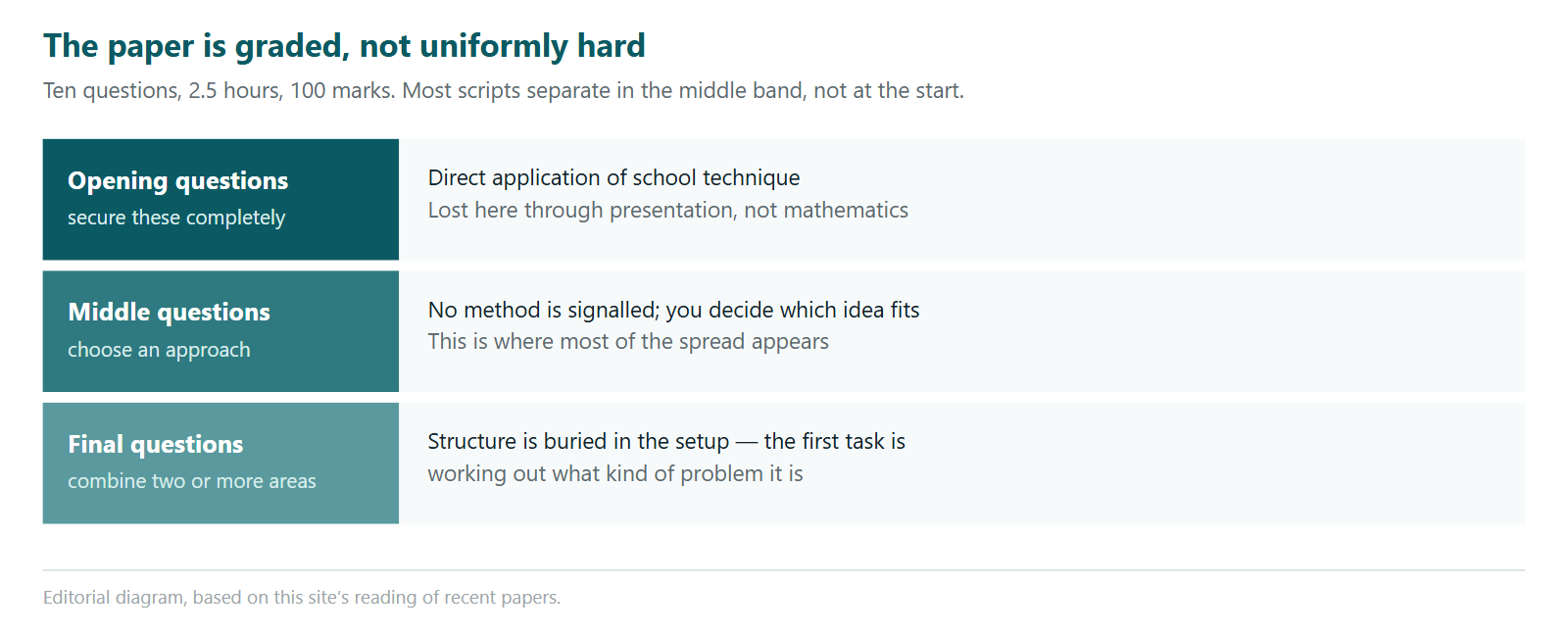
In roughly three bands. The first several test secure curriculum knowledge and straightforward calculation. The middle band requires selecting an approach that is not signalled. The final questions are comprehensive, combining two or more areas and asking for extended reasoning that has to be written out to score.
Which band should most students target?
The first two, completed properly, plus whatever partial marks the late questions yield. That is the shape of most award-winning scripts. Students who plan around the final questions typically lose marks lower down the paper and end up below where their mathematics should have placed them.
Which students find the format suits them?
Those with a solid school foundation and a habit of writing carefully. The paper does not reward speed the way a short multiple-choice contest does — 2.5 hours for ten questions is generous. What it rewards is thoroughness, which is a different disposition and one many strong students have never been assessed on.