I. Euclid Mathematics Contest Registration Guide
Channel 1: Group Registration via School (Preferred)
Canadian local students: Register directly through the math department or competition coordinator teacher at their high school.
Chinese candidates: Many international schools nationwide have been authorized as official test centers, including:
Well-known international schools in cities such as Beijing, Shanghai, Guangzhou, and Shenzhen.
International departments of some key middle schools.
It is recommended to consult the school’s math teacher or competition instructor 2-3 months in advance.
Channel 2: Registration via Authorized Institutions
Our registration service includes one-stop services such as registration, payment, test center arrangement, and score inquiry.
Scan the QR code to get the registration form
Confirmed: Shanghai, Beijing, Shenzhen, Guangzhou, Hangzhou, Chengdu, Changsha
To be confirmed: Hong Kong, Wuhan, Shenyang, Hefei, Fuzhou, Chongqing, Xi’an…
More cities coming soon! For details, scan the QR code to consult.
① Certificate of Distinction (Top 25% globally): RMB 488 scholarship
② Honour Rolls (Top scorers in each region): RMB 888 scholarship
II. In-Depth Analysis of Euclid Mathematics Contest Content
1. Distribution and Trends of Knowledge Points
| Module | Proportion | 2025 Trend | Preparation Focus |
|---|---|---|---|
| Algebraic Operations | 30%-40% | Significantly increased difficulty, focusing on the comprehensive application of functions, exponents, and logarithms | Equation solving skills, function property analysis, exponential and logarithmic transformations |
| Plane and Analytic Geometry | 30% | More complex figure designs, integration of multiple knowledge points | Comprehensive application of circle properties, special properties of triangles, coordinate system techniques |
| Trigonometric Functions | 5%-10% | Stable assessment, focusing on identity transformations | Sum-to-product formulas, double-angle formulas, application of solving triangles |
| Sequences and Series | 5%-10% | May appear as final challenging questions | Recurrence relation solving, summation techniques, identification of special sequences |
| Combinatorics and Probability | 5%-10% | Increasing proportion, scenarios closer to reality | Flexible application of counting principles, understanding of conditional probability |
| Basic Number Theory | 5% | Combined with interesting scenarios such as palindromic numbers | Divisibility properties, modular arithmetic, special number characteristics |
2. Question Types and Scoring
Short Answer Questions
Marked with a yellow light bulb icon next to the question.
Only the final answer needs to be provided.
Usually the first few basic questions.
Scoring Criteria: Full marks for correct answers; no process marks.
Full Solution Questions
Marked with a paper-pencil icon next to the question.
Complete problem-solving processes and logical deductions must be shown.
Usually the last few challenging questions.
Scoring Criteria: Marks awarded by steps; partial marks can be obtained for correct processes even if the final answer is wrong.
III. Four-Stage Scientific Preparation Plan for the Euclid Mathematics Contest
Stage 1: Foundation Consolidation (3-4 months before the exam)
Systematic sorting of knowledge system
Build a knowledge tree based on the six modules mentioned above.
Focus on the two core modules of algebra and geometry.
Create formula cards.
Breakthrough in math English terminology
Compile a list of high-frequency English terminology for the contest.
Read 2-3 original English questions daily to train rapid understanding ability.
Establish associative memory of “terminology-concept-example”.
Speed-solving training for basic questions
Complete 10-15 basic-level English math questions daily.
Goal: Read, analyze, and solve within 5 minutes.
Focus on improving reading efficiency and information extraction ability.
Stage 2: Ability Enhancement (2-3 months before the exam)
Training in complete problem-solving processes
Learn standard problem-solving formats.
Practice writing complete processes starting with simple questions.
Mutual correction to learn excellent problem-solving expressions.
Breakthrough in comprehensive question types
Focus on overcoming comprehensive algebra and geometry questions.
Master common problem-solving strategies:
Number-shape combination method, variable substitution technique, utilization of symmetry, extreme case analysis.
Complete 2-3 sets of comprehensive questions from past papers weekly.
Cultivation of innovative thinking
Study novel question types in past papers from 2020 to 2025.
Learn mathematical modeling ideas to convert practical problems into mathematical problems.
Join online discussion groups to exchange different problem-solving ideas.
Stage 3: Past Paper Practice (1 month before the exam)
Strict mock exams
Complete one set of past papers every Saturday morning (simulating the actual exam time).
Fully follow exam requirements: 2.5 hours without interruption.
Use official answer sheets to practice standardized writing.
Optimization of time allocation
Recommended time allocation strategy:
Questions 1-3 (Basic): 15-20 minutes → Ensure full marks.
Questions 4-7 (Medium): 40-50 minutes → Pursue high marks.
Questions 8-10 (Challenging): 35-45 minutes → Strive for step marks.
Checking time: 10-15 minutes.
Adjust time allocation according to personal strengths and weaknesses.
In-depth analysis of wrong questions
Establish a classified error log:
Conceptual understanding errors.
Calculation mistakes.
Deviations in problem-solving ideas.
Improper time arrangement.
Review wrong questions weekly to identify weak links for targeted reinforcement.
Stage 4: Sprint and Adjustment (1 week before the exam)
Final screening of knowledge blind spots
Quickly review all formulas and theorems.
Focus on reviewing error-prone knowledge points.
Relearn problem-solving ideas for challenging questions in past 3 years’ papers.
Adjustment of exam state
Maintain moderate practice daily (no more than 5 questions).
Adjust work and rest to ensure energy during the exam period.
Prepare exam supplies: Passport/ID card, pencils, eraser, ruler, calculator (compliant model).
Psychological preparation and strategy confirmation
Establish an answering sequence strategy for the exam day.
Prepare psychological plans to deal with challenging questions.
Remember the scoring rules: Step marks are important; write down relevant ideas even if you can’t solve the problem.
Frequently Asked Questions
How does registration work in practice?
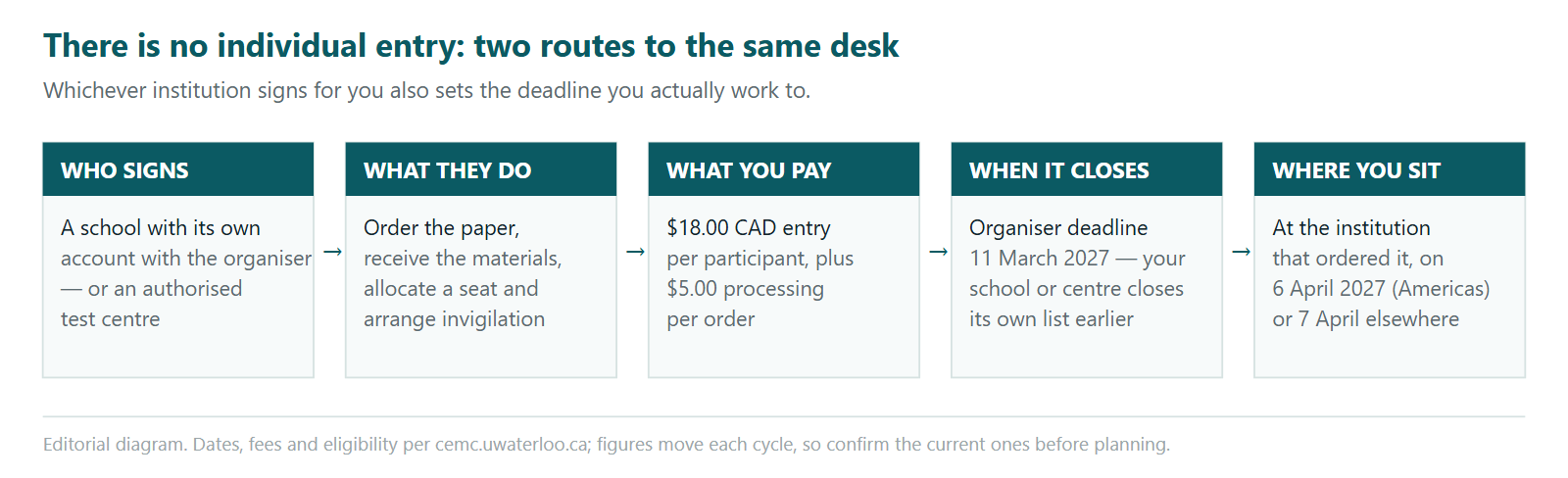
Two channels. If your school holds an account with the organiser, a teacher orders the paper and you sit it at school. If it does not, an authorised test centre registers on your behalf and provides the seat. There is no individual sign-up, so the first thing to settle is which of the two applies to you.
Which channel should a student in China use?
Usually the test centre, since relatively few schools in mainland China hold their own account. Contact the centre early: their internal cut-off falls before the organiser’s deadline, and seats are finite. Confirm the fee, the sitting location and what identification is required at the same time.
What content should preparation cover?
Algebra and functions, geometry both analytic and classical, trigonometry, sequences and series, and elementary number theory, all within senior secondary mathematics. The paper does not assume calculus. Past papers are the most efficient way to cover it — our collected 1998-2026 set is free to claim by scanning the code on this page.