The Euclid Mathematics Contest, organized by the University of Waterloo in Canada, is one of the world’s most influential high school mathematics competitions, often called the “TOEFL of Mathematics.” Its results are directly used for admissions evaluation by top Canadian universities like the University of Toronto, Waterloo, and UBC, and are also regarded by prestigious UK and US institutions (such as Oxford, Cambridge, MIT) as important proof of mathematical ability.
However, many beginners often lose points due to unfamiliarity with the scoring rules. This article provides an in-depth breakdown of the question structure, scoring logic, key pitfalls, and strategies for winning awards, helping you transform from a “pitfall victim” to a “steady score master.”
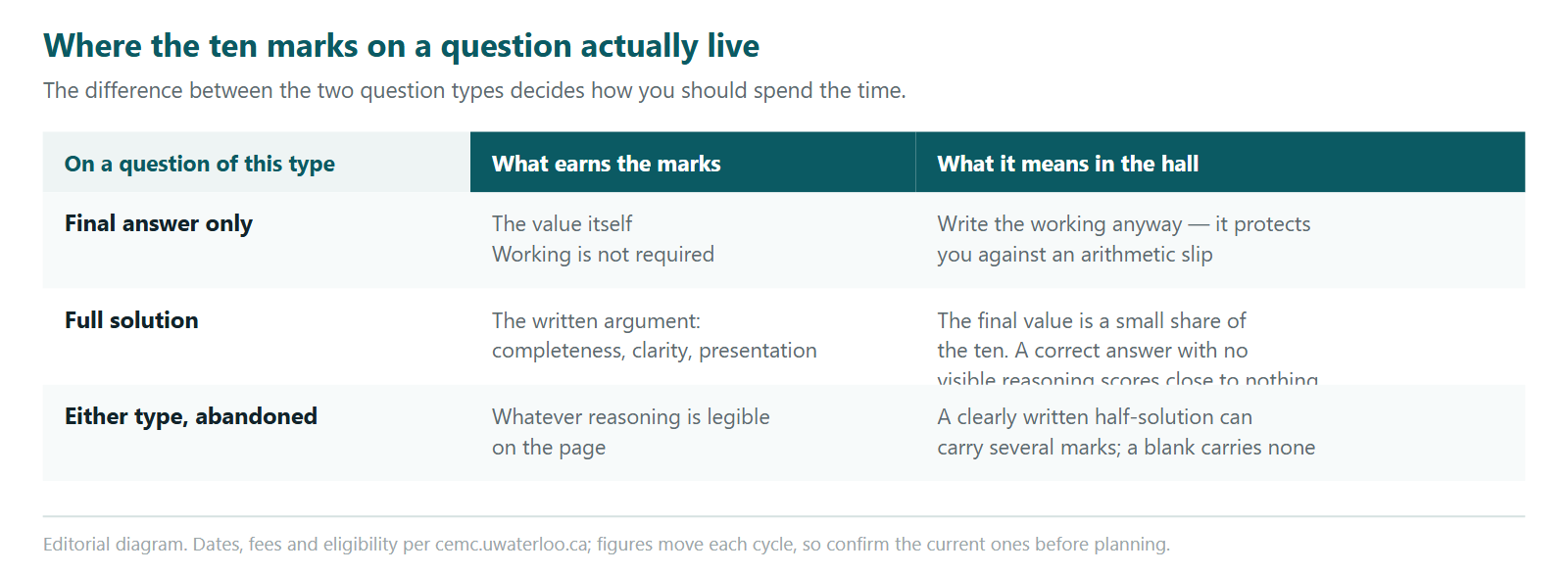
The two question types are marked differently — and the strategy differs with them.
I. Quick Overview of Core Rules for the Euclid Mathematics Contest
Item
Content
Exam Duration
2.5 hours (150 minutes)
Number of Questions & Points
10 major questions in total, each worth 10 points, full score is 100 points
Question Structure
Each major question contains 2–3 sub-questions with increasing difficulty: • Questions 1–7: Foundational questions (70 points) • Questions 8–9: Score-differentiating questions (20 points) • Question 10: The final, most challenging question (10 points)
Language
Full English exam paper (mathematical symbols are consistent with those used domestically in China)
Calculator
✅ Only basic-function calculators allowed (no programming/graphing functions) ❌ Prohibited: TI-89, TI-Nspire CAS, CASIO fx-CG series, etc. Consequence of violation: Use of a prohibited calculator → Entire exam paper is invalidated!
II. Scoring Logic: Why are “Steps More Important than the Answer”?
This is the most fundamental difference between Euclid and domestic competitions!
Core Principle: Process-oriented, steps are scored.
Correct answer + No process → At most 2–3 points (full points possible only for short-answer questions).
Wrong answer + Reasonable steps → Can get 5–8 points (e.g., correct citation of key theorems, complete logical derivation chain).
Completely blank → 0 points (Even with the right idea, unwritten = no points).
Icon Interpretation (Look at the icons!)
Icon
Type
Requirement
Scoring Focus
💡 Yellow Light Bulb
Short Answer
Only the final answer needs to be filled in
Correct answer gives full points (but writing process provides insurance)
✍ Pen Icon
Full Solution
Must write out the complete derivation process
Step marks account for 70%+, clear logic leads to high scores
Practical Advice: Even for “light bulb questions,” write key steps in the scratch work area! Example: “Let x be the unknown → By the Pythagorean Theorem, x² = a² + b² → x = √(a²+b²)” —If the final answer is calculated incorrectly, the steps can still salvage 1–2 points!
III. Three Major Question Modules and Award-Winning Strategies
1. Foundational Questions (Q1–7 | 70 points) — The Lifeline for Winning an Award
Target: Accuracy rate ≥ 80% (i.e., at least 56 points).
Strategy:
Ensure zero mistakes on the first 5 questions.
If stuck on Q6–7, skip and return later.
Time allocation: Complete within ≤ 90 minutes.
Key Insight: Official University of Waterloo data shows the top 25% award cutoff is usually between 65–75 points. Securing 60+ points steadily on foundational questions almost guarantees an award!
2. Score-Differentiating Questions (Q8–9 | 20 points) — The Key to Impacting Top 5%
Characteristics: Cross-module synthesis (e.g., number theory + algebra, geometry + functions).
Common Types:
Proving the general term of a recursive sequence.
Geometry optimization problems (requiring auxiliary line construction).
Discussion on integer solutions to equations (case enumeration).
Strategy:
At least complete the (a) sub-question for each (usually simpler).
Write a clear “Let → Derive → Conclude” logic chain, even if the conclusion is wrong.
3. The Final Challenging Question (Q10 | 10 points) — The Touchstone for Top Contestants
Target: Unless aiming for the global top 1%, can strategically give up on the last two sub-questions.
Techniques:
Try special values (n=1,2) to find patterns.
Write a reasoning framework like “Assume… then…” to strive for process points.
IV. Five High-Frequency Pitfall Avoidance Guides (Lessons from Blood and Tears!)
Pitfall 1: Obsessing Over Difficult Problems, Neglecting the Foundation
Strategy: Secure 70 points first, then go for the extra 20. Not solving the hardest problems does not affect winning an award!
Pitfall 2: Omitting Process, Prioritizing Only the Answer
Strategy: Write steps for all questions, even if it’s just “From the problem statement…”.
Pitfall 3: Bringing the Wrong Calculator, Invalidating Your Score
Recommendation: CASIO fx-82 / TI-30X and other purely computational calculators.
Pitfall 4: Terminology Barriers, Leading to Misunderstanding
Action: Memorize a list of 50 core mathematical terms in Chinese-English before the exam.
Pitfall 5: Leaving Blanks, Losing Points for Nothing
Strategy: For questions you can’t solve, write “Let x be…”, “Assume the function is…”; there’s a high chance of getting 1–2 points.
Frequently Asked Questions
What are the core rules?
Ten questions in 2.5 hours for 100 marks, ten per question, all written by hand. Some questions require only a final answer; the rest are full-solution and marked on the written argument. Approved scientific calculators are permitted while programmable and graphing models are not — confirm the current list with your centre.
Why do steps matter more than the answer?
Because the marking follows them. On full-solution questions the final value carries a small share of the ten marks and the reasoning carries the rest. That design means a correct answer with no visible working can score close to nothing, while a sound argument that stops short of the answer can collect most of the marks.
Where should an award-seeker concentrate?
On the first several questions, completed properly. They carry the bulk of the marks that most award-winning scripts are built from, and the usual way to lose them is presentation rather than mathematics. Securing them fully is worth more than an unbudgeted attempt at the final questions.