Euclid Mathematics Contest Exam Difficulties and High Score Breakthrough Guide — Why “Getting the Answer Right Doesn’t Guarantee Full Marks”? How to Conquer Integrated Problems?
The Euclid Contest, hosted by the University of Waterloo in Canada, is a key academic credential for high school students globally applying to STEM, economics, computer science, and related majors. Known for “emphasizing process, strong integration, and no calculus,” it appears moderately difficult but is dense with pitfalls, posing significant challenges especially for students accustomed to “writing only the answer.”
This article systematically outlines the three core difficulties and provides clear solution step standards + high-frequency topic strategies to help you progress from “knowing how” to “scoring full marks.”
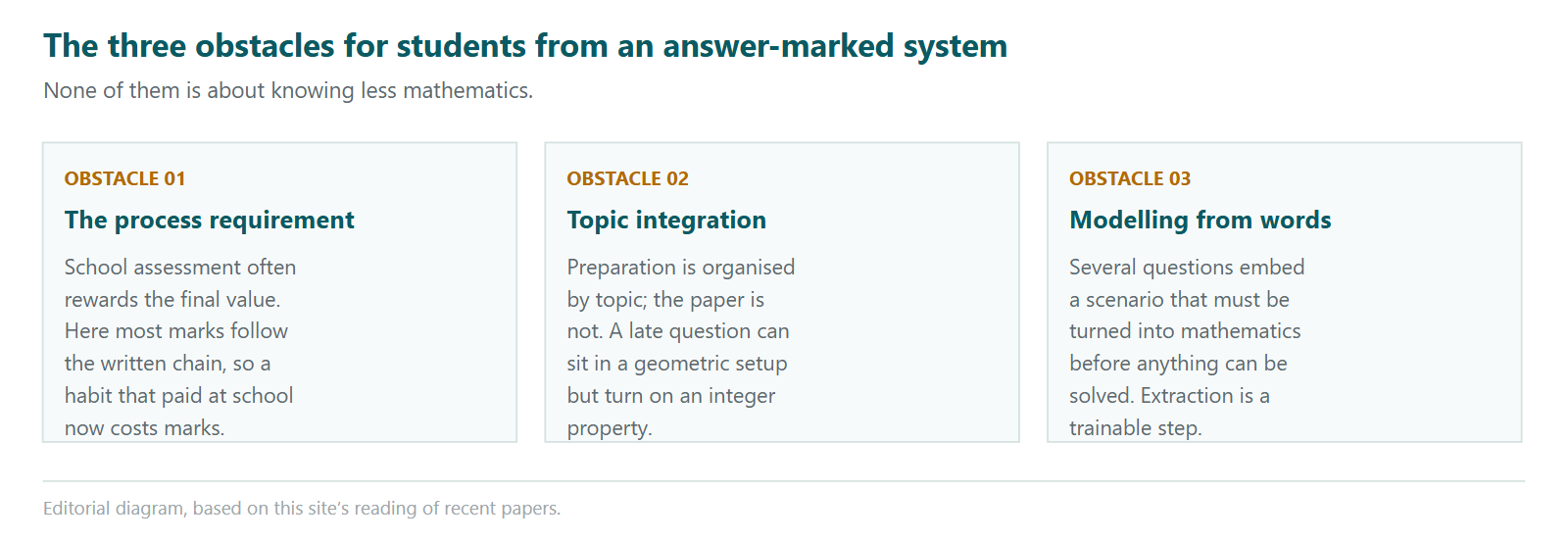
Three obstacles — and none of them is about knowing less mathematics.
I. Three Major Exam Difficulties in the Euclid Contest
Difficulty 1: Extremely High Demand for Solution Steps, Differences in Chinese/English Logical Expression Lead to Lost Marks
Scoring Mechanism: Uses a “Partial Marks” system. Even if the final answer is wrong, points can still be earned for correct key steps. Conversely, a correct answer with no process = zero or low marks.
Typical Mark-Loss Scenarios:
Geometry: Directly writing “△ABC ∽ △DEF” without stating the reason (e.g., AA similarity).
Algebra: Skipping substitution or factorization steps, jumping directly to the result.
Probability: Failing to list the sample space or define events.
Chinese vs. English Thinking Differences:
Chinese habits emphasize “implicit understanding,” while English stresses an “explicit logical chain.”
Must use “Because…, therefore…” structure to clarify causal relationships.
Countermeasure: Write each problem in a “Given → Derivation → Conclusion” three-part format. Key theorems/formulas must be labeled (e.g., “By the Pythagorean Theorem…”).
2023 Q8: Expected value of a random variable → Constructing a piecewise function to find extremum.
Countermeasure: Train “module-switching” ability—when seeing a geometry figure, consider if algebraic variables can be set; when encountering a sequence, consider if divisibility or periodicity is involved.
Difficulty 3: Complex Problem Statements; Mathematical Modeling Ability is Key
Test-takers must first abstract the mathematical structure from the text, then apply tools to solve.
Example (2025 Q7): “A city’s annual population increase is 5% of the previous year plus 2000 people” → Recognize as a linear non-homogeneous recurrence sequence.
Countermeasure: Practice “translating the problem statement”—rephrase the question in mathematical language (e.g., “increase by 5%” → “×1.05”).
II. Euclid High-Frequency Topics and Final Sprint Strategies
Core Data (2025)
Number of participants: 27,092
Average score: 54.8
Top 25% (Certificate of Distinction): ≥68 points
Top 5%: ≥85 points
Top 1%: ≥95 points
Breakdown of Sprint Goals
Target
Strategic Focus
Top 25% (68+)
Get Q1–7 all correct (≈60 pts) + score 8 pts on Q8–9.
Top 5% (85+)
≤2 pts lost on Q1–7 + score ≥18 pts on Q8–9 + earn partial marks on Q10.
Top 1% (95+)
Near-perfect paper, complete solution for Q10.
List of High-Frequency Score-Differentiating Question Types
Combinatorics + Number Theory: Counting with restrictions (e.g., “three-digit numbers containing no digit 5”).
Geometry Optimization: Using symmetry or triangle inequality to find minimal paths.
Recurrence Sequences: Linear/non-linear recurrences, combined with modular arithmetic to analyze periodicity.
Functional Equations: Given conditions like f(x+y)=f(x)+f(y), find the form of f(x).
Frequently Asked Questions
What are the main difficulties for students from an answer-marked system?
Three. The written-process requirement, which is unfamiliar if school assessment rewards the final value. The degree of topic integration in later questions, where no single module solves the problem. And the modelling demand, since several questions embed a scenario that has to be turned into mathematics before anything can be solved.
Why does knowledge integration cause so much trouble?
Because preparation is usually organised by topic and the paper is not. A late question may sit inside a geometric configuration but turn on an algebraic constraint or an integer property. Students who have revised each area separately can know every component and still not see which combination unlocks the setup.
What actually fixes the modelling weakness?
Practice on worded problems specifically, with the extraction written down. Before solving, list what is given, what is asked, and what notation you will use. Doing that explicitly is slow at first and quickly becomes automatic, and it converts the most commonly lost marks on the paper into secure ones.