The Euclid Mathematics Contest, organized by the Centre for Education in Mathematics and Computing (CEMC) at the University of Waterloo, Canada, is one of the most stable and widely recognized competitions in the North American STEM application system. For students planning to apply for majors like mathematics, computer science, or engineering, systematic preparation for the Euclid can significantly enhance application competitiveness and effectively cultivate rigorous mathematical thinking and communication skills.
I. The Unique Advantages of the Euclid
1. Stable Question Style
Not biased or weird: Question difficulty is moderate, focusing on understanding and application of fundamental concepts.
Clear direction for effort: Systematic training can significantly improve scores, avoiding the ineffective “massive drilling” effort found in competitions like the AMC.
High long-term recognition: The University of Waterloo and its partner institutions highly value Euclid scores, having a decisive impact, especially in applications for CS and engineering programs.
2. Suitable for the “Typically Excellent Student”
Not exclusive to geniuses: Compared to the IMO or AMC12 AIME, the Euclid is more suitable for students with stable school grades and clear logical thinking.
Clear goal: Achieving a Certificate of Distinction (top 25%) can significantly boost an application, rather than pursuing an extremely rare top award.
II. The Euclid’s Difficulty Stratification and Scoring Strategy
The full paper consists of 10 major questions, totaling 100 points, with a 150-minute exam duration. The difficulty stratification is very clear:
| Difficulty Segment | Q1–5: Foundational | Q6–8: Core | Q9–10: High Difficulty |
|---|---|---|---|
| Characteristics | Core high school knowledge. Focus is on communication and logical completeness. | Integration of multiple knowledge points. This is the part that requires the most systematic training. | Embodies comprehensive ability and modeling proficiency. Determines the score ceiling. |
| Goal | Ensure all correct, solidify the foundation. | Breaking through this segment is key to entering the top 25%. Master common models and problem-solving techniques. | Strive for partial points, demonstrate higher-order thinking skills. |
Key Point: Most students lose marks not because they “can’t solve the problems,” but because they “can solve them but fail to secure the deserved scores.”
III. What Truly Creates Gaps is the “Partial Marks”
The Euclid is a classic process-oriented scoring competition. The grading criteria focus not only on the final answer but also on:
Completeness of derivation: Each step must have its basis.
Clarity of key steps: Especially where theorems are applied.
Adherence to mathematical communication norms: Correct symbol usage, clear logic.
Common Reasons for Losing Marks:
Correct idea but skipped steps.
Correct conclusion but no stated reason.
Improper decomposition of integrated problems, leading to a cascade of errors.
IV. Why is Winter Break the Key Window for Euclid Preparation?
1. Continuous, Systematic Training Time
Winter break has a relatively lighter academic load, allowing for continuous, uninterrupted training. This aids the transition from “knowing how to calculate” to “knowing how to write,” raising the overall performance floor.
2. Targeted Breakthroughs and Past Paper Practice
Review of high-frequency key/difficult topics: Focused revision of knowledge modules that appear repeatedly.
Partial marks and writing standard training: Transforming “correct ideas” into “full scores.”
Breakthrough in the core Q6–8 difficulty segment: Concentrated training on the question types and models most likely to create score gaps.
Past paper practice × Grading perspective review: Correcting solution communication from the standpoint of the marking standards.
A Systematic Euclid Winter Break Training Course
Course Highlights
Systematic review of the high-frequency key/difficult knowledge system.
Specialized training on partial marks and writing standards.
Systematic breakthrough for the core Q6–8 difficulty segment.
Past paper practice with a grading perspective review.
Who is this course suitable for?
Students with good in-school mathematics grades.
Students with an AMC foundation or who missed the AMC.
Students planning to apply for STEM directions like mathematics/computer science/engineering.
Students aiming to steadily reach the top 25% or higher in the Euclid.
Personal Assessment and Goal Setting
Before starting systematic training, a comprehensive personal Euclid preparation assessment is recommended to determine if competing is suitable, where the target score range lies, and how to allocate training focus.
Consulting Specific Course Arrangements
Feel free to inquire for specific course arrangements and personalized advice to ensure a more efficient and orderly preparation path.
Frequently Asked Questions
What makes this contest a good fit for a solid but not exceptional student?
Its scope and its marking. The syllabus stays within senior secondary content with no calculus assumed, so the material is familiar. And partial credit is substantial, which means a student who sets up a hard question correctly and stalls still scores. Both features favour steady competence over contest specialisation.
Why is a long break the right time to prepare?
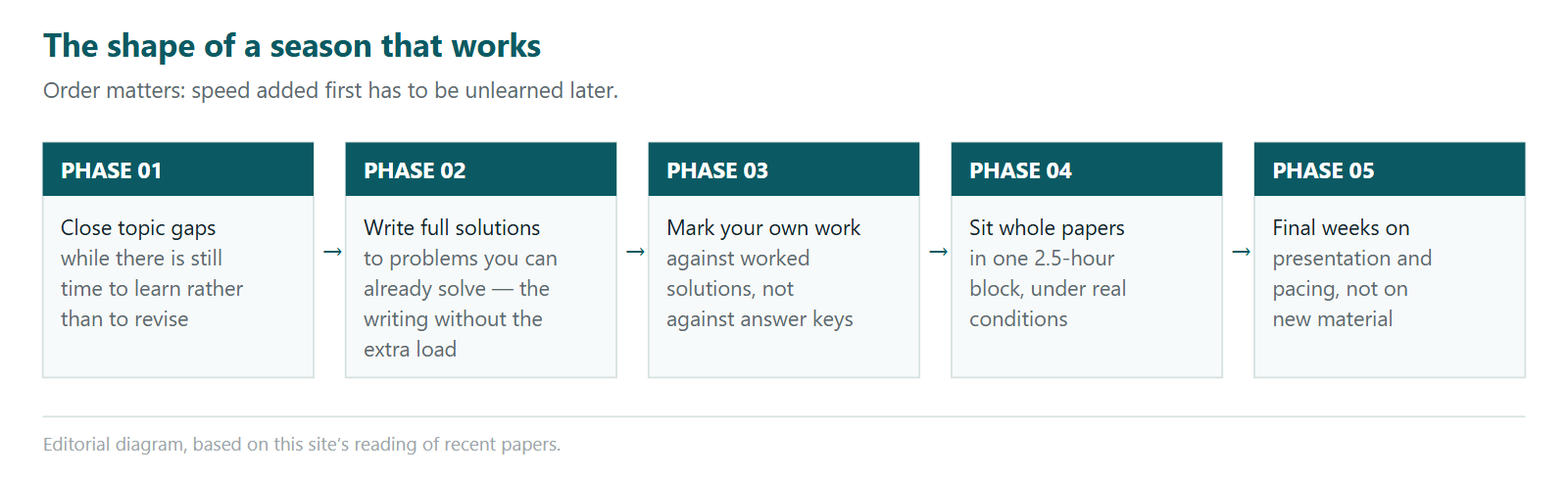
Because the work that moves a score needs uninterrupted blocks — sitting a whole paper and then marking it properly takes two or three hours, which term time rarely offers. A break also arrives early enough that discovering a topic gap is still useful information rather than a problem.
How should the questions be triaged?
Secure the earlier questions completely first; they carry the bulk of the marks most award-winning scripts are built from. Work the middle band deliberately. Attempt the last questions within a fixed time budget, writing down whatever reasoning you have. That ordering is what turns competence into a score.