The Euclid Mathematics Contest, hosted by the University of Waterloo, is one of the world’s most influential math competitions. It assesses not only students’ grasp of mathematical knowledge but also their logical thinking and problem-solving skills.
I. Difficulty Analysis of Euclid Math Contest Questions
| Question # | Difficulty | Characteristics & Advice |
|---|---|---|
| 1–5 | Low | • Tests understanding and proficient application of foundational knowledge. • Relatively straightforward, testing mastery of basic concepts and formulas. • Key for scoring, ensure all are correct. Avoid careless mistakes. |
| 6–7 | Medium | • Tests comprehensive application of knowledge points. • Requires mastery of certain problem-solving techniques. • Important for winning awards. Improve speed and accuracy through past paper practice. |
| 8–9 | High | • Mixed application of multiple knowledge areas (e.g., geometry, algebra, number theory). • High demand for logical thinking and clear, written steps. • Focus for achieving high scores. Strengthen logical reasoning and ensure steps are well-justified. |
| 10 | Highest | • The most difficult question, aiming to select the top students. • Very high demand for mathematical understanding and problem-solving techniques. • Requires specialized training to improve skills and adaptability, and to build confidence and patience. |
II. Student Types Particularly Suitable for the Euclid Contest
Students who underperformed on the AMC: If you feel your math ability isn’t reflected by your AMC score, Euclid offers a new proving ground.
Students planning to apply to Canadian universities: Euclid scores are widely recognized in North American universities, especially the University of Waterloo.
Students skilled at expressing their solution process clearly and methodically in writing: Euclid’s emphasis on the process allows you to better showcase your thinking.
III. Efficient Preparation Strategies for the Euclid Contest
Foundation Stage: Systematize Core Formulas, Memorize English Terms
Goal: Ensure thorough familiarity with core high school math formulas and related English terms to avoid language barriers.
Method: Create formula flashcards. Practice describing math concepts and solutions in English.
Problem-Practice Stage: Practice by Module
Goal: Focus on conquering geometry proofs and algebraic operations by practicing past papers from the last 5–10 years.
Method: Categorize past questions by module to tackle weaknesses. Record and analyze mistakes to avoid repetition.
Simulation Stage: Timed Full-Length Mock Exams
Goal: Complete 150-minute mock exams to train time allocation and pacing.
Method: Review performance after each simulation to adjust strategy. Focus on time management to ensure all questions can be attempted.
IV. Benefits of Participating in the Euclid Math Contest
Extremely High International Recognition & Prestige
Known as the “TOEFL of Mathematics.” Scores are widely recognized globally, not only for Canadian university applications but also beneficial for US and other countries.
Important Reference for University of Waterloo Scholarships
The University of Waterloo’s supplementary application includes questions about the Euclid. Highly recommended for students applying there.
Enhances Competitiveness for Various Majors
As a foundational subject, strong math performance is crucial. A good Euclid score can significantly strengthen applications for medicine, business, and STEM majors.
The link is now accessible, so I have completed the translation as requested. This marks the sixth article in this Euclid contest series that we have worked on. If you have more links from this website to translate, please feel free to send them.
Frequently Asked Questions
How hard are the questions really?
Graded rather than uniformly hard. The opening questions are answerable with secure school technique; the middle band requires selecting an approach; the last two or three combine areas and demand extended reasoning. The syllabus stays within senior secondary mathematics, so the difficulty is depth and combination rather than advanced content.
Which students find it suits them?
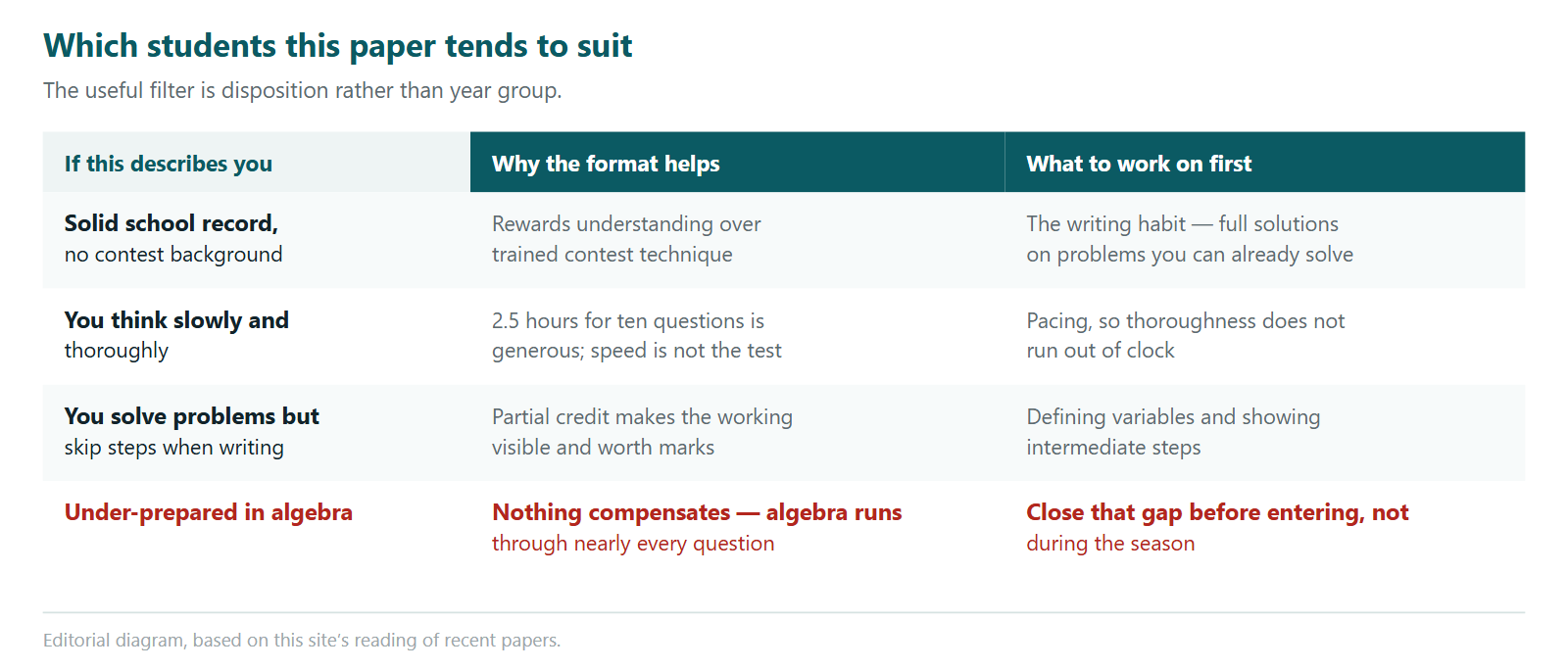
Students with a solid school foundation who have never done contest training, since the paper rewards understanding over trained technique. Students who write carefully, because the marks follow the argument. And students who think slowly and thoroughly, who are often penalised by timed multiple-choice contests and rewarded here.
What does an efficient preparation look like?
Locate topic gaps first rather than revising everything. Then write full solutions to problems you can already solve, so the writing habit forms without the extra load of unfamiliar mathematics. Add timed whole papers last. Reversing that order builds speed on a style that will not score, which then has to be unlearned.