Recently, the results, cut-off scores, and honor roll recognitions for the Euclid Mathematics Contest have been fully announced. While contestants are busy checking their scores, comparing them with the cut-off marks, and confirming whether they have received an honor, the contest organizing committee has once again stressed important reminders about exam integrity and score validity. Because the Euclid exam consists entirely of short-answer and full-solution questions, every paper goes through rigorous manual grading. Any unusual patterns in answering can be easily detected by experienced graders, which may lead to scores being flagged as suspicious or even directly canceled. Furthermore, the appeal process is extremely difficult. It is particularly important to note that the organizing committee does not accept individual score appeals from students; all requests for a score review must be submitted through the student’s school as a unit, which makes any personal remedy even harder. Therefore, understanding which behaviors can cross the “red line” is crucial for every participant.
The organizing committee has made it clear that integrity is the cornerstone of the Euclid Contest, and it calls on everyone to take the exam honestly and provide honest answers. The following seven categories of behavior are considered high-risk and can “lead to score cancellation.” Whether intentional or unintentional, every participant should take these as a serious warning.
1. Having seen leaked questions or answers before the exam, with traces of suspicion in the solution process
If a contestant has seen leaked questions, reference answers, or complete solutions through irregular channels before the exam, they will often leave unintentional traces in their writing. For example, the solution path may be highly identical to the official answer yet lack a natural derivation process, employ unconventional shortcuts beyond normal reasoning, or use phrasing consistent with the leaked materials. Once the grading panel discovers such signs suggesting “prior access to the test content,” the paper will be flagged as abnormal and face the severe consequence of score cancellation.
2. Severely skipping steps and combining multiple steps into one to arrive directly at the answer
The Euclid Contest values not only the final answer but also a complete and clear logical reasoning process. If a contestant frequently merges multiple key steps and jumps directly from given conditions to the final result without showing intermediate derivations, calculations, or arguments, it is easy for the work to be judged as not completed through independent thinking. Such “step-skipping” behavior raises the grader’s suspicion that the contestant may have reproduced a stripped-down solution provided by someone else or referenced external materials, leading to further review or even score cancellation.
3. Severe inversion of performance between easy and difficult questions
A normal exam performance typically follows a gradient where easier questions have a higher success rate, and difficult ones have a lower success rate. If a paper shows an abnormal inversion — for example, losing many points on basic, easy questions with frequent errors, yet scoring near-perfect marks on highly challenging, deep-thinking problems — this extreme contrast will be seen by manual graders as a clear anomaly. The organizing committee often suspects the involvement of proxy test-taking, selective copying, or advance targeted preparation of only the difficult problems.
4. Answering steps identical to those of other students, especially on difficult problems
On high-difficulty full-solution questions, the thought process, writing habits, and detail handling of each contestant are almost never entirely identical. If graders find that different contestants’ solutions to difficult problems show highly identical derivation steps, intermediate variable settings, or even the same slip of the pen and correction marks, it will be directly determined as collaboration during the exam or mutual copying of answers. It must be emphasized that this “identical” refers not just to the same final answer, but to a striking similarity in the entire reasoning chain and writing format, which is extremely suspicious on high-discrimination difficult problems.
5. Incorrect solution steps but a correct final answer
In a math exam, a “wrong process, right result” is a classic red flag. If a contestant’s derivation contains clear logical errors, calculation mistakes, or conceptual misapplication, yet miraculously arrives at the standard correct answer at the end, it easily raises suspicion that the answer was obtained through other means and steps were forcefully pieced together, or that someone else’s result was applied without independent completion. Such papers where “steps do not match the answer” will undergo priority review, and once it is confirmed that the work does not reflect the contestant’s own ability, the score will be canceled.
6. Abnormal accuracy — answering all attempted questions perfectly and leaving the rest completely blank
If a paper shows that the attempted questions are all perfectly correct with precise answers and flawless steps, while the unattempted questions are left entirely blank, this extreme “all or nothing” pattern is also considered abnormal accuracy. It may suggest that the contestant prepared only some of the questions in advance, or obtained answers to certain questions during the exam, while possessing no ability to solve the remaining problems. Such clear signs of “selective mastery” become important grounds for invalidating the scores.
7. Repeated erasing and rewriting on the paper, yet ultimately achieving a high score
Making some corrections during an exam is normal, but if the paper exhibits extensive signs of repeated erasing and rewriting, and the question ends up receiving a very high score, it will attract scrutiny. The grading panel may suspect that the contestant erased and matched answers while copying, or used irregular means to swap in correct answers later, covering up initial incorrect writing. This contrast between a “messy process” and a “high-score result” is also very likely to trigger the score cancellation procedure.
In general, because of the strictness of its manual grading, the Euclid Mathematics Contest has an exceptionally high ability to discern the authenticity and independence of solutions. The above seven points, while appearing to be specific behaviors, all point to one core principle — the exam paper must truthfully reflect the contestant’s own independent mathematical thinking and problem-solving ability. Once grading reveals any anomalous signs that go against this principle, the scores will enter the cancellation process. And since the appeal channel is only open to schools, with no direct communication between individuals and the organizing committee, this means prevention is far more important than remediation.
Scores and honors are valuable, but integrity is the foundation for going far and steady on the academic path. I hope all participants will compete with their true ability, present their thinking with clean and complete solutions, and stay away from any answering method that could be viewed as suspicious.
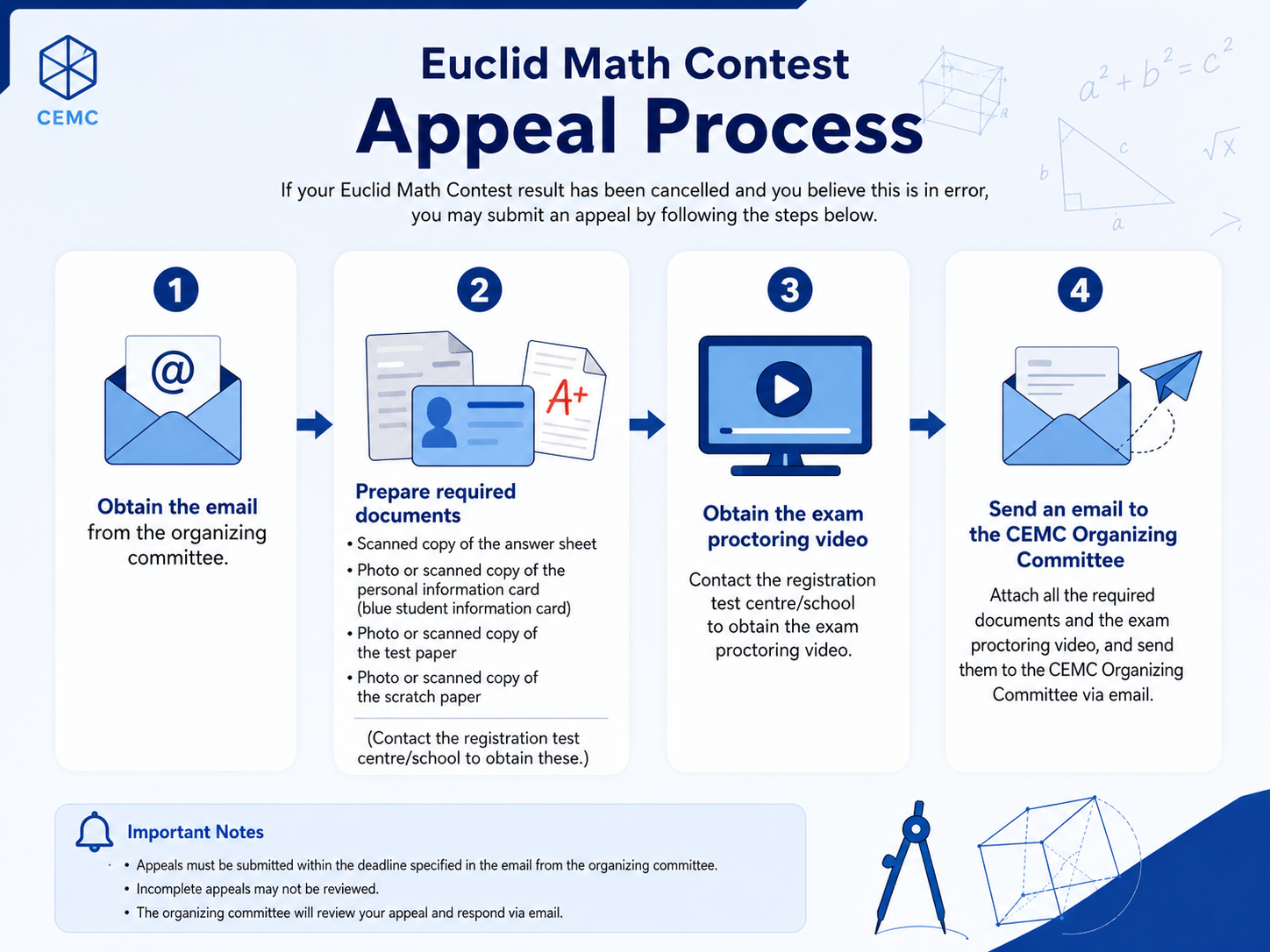
Appeal Process:
Obtain the email from the organizing committee.
Scanned copy of the answer sheet, photo or scanned copy of the personal information card (blue student information card), photo or scanned copy of the test paper, and photo or scanned copy of the scratch paper (contact the registration test centre/school to obtain these).
Exam proctoring video (contact the registration test centre/school to obtain).
Send an email to the CEMC Organizing Committee.
Frequently Asked Questions
What kinds of answer-sheet problems can cost marks after the paper is written?
Administrative ones, mostly: work written outside the marked area, pages out of order or unlabelled, illegible corrections, and identifying details left incomplete. None of these are mathematical errors, and all of them are avoidable. They matter because a grader can only award what they can find and read.
How should corrections be made during the paper?
Cleanly. A single line through the abandoned work and a clear restart is easier to mark than heavy scribbling or overwriting, and it also protects you if the abandoned route turns out to have been partly right. Leave the crossed-out work legible rather than obliterating it.
What should a student check before handing the paper in?
That every question attempted has its number clearly marked, that no work is stranded on an unlabelled page, that each solution ends with a stated conclusion, and that the identifying information is complete. This is the cheapest review on the paper and it protects marks that were already earned.