Every April, thousands of high school students across Canada and increasingly around the world sit down for two and a half hours to tackle one of the most respected mathematics competitions in North America: the Euclid Mathematics Contest. Organized by the Centre for Education in Mathematics and Computing (CEMC) at the University of Waterloo, the Euclid is far more than just a math contest. For students pursuing studies in computer science, engineering, mathematics, or any STEM field, it can be the single most important academic event of their high school career.
In this article, we explore everything you need to know about the Euclid Mathematics Contest: its history, format, topics, scoring, scholarship opportunities, and how to prepare effectively.
A Brief History
Named after the ancient Greek mathematician often called the Father of Geometry, the Euclid Contest has been organized by the CEMC since the 1980s. The CEMC itself was founded in 1980 at the University of Waterloo with a mission to promote and strengthen mathematics and computer science education across Canada.
Over the decades, as the University of Waterloo grew into a global powerhouse for computer science and mathematics, the Euclid evolved from a regional competition into a nationally recognized benchmark for identifying top-tier STEM talent. Today, it draws tens of thousands of participants from across Canada and from international schools worldwide.
Why the Euclid Matters
Unlike standardized tests such as the SAT or ACT, which rely heavily on multiple-choice questions, the Euclid requires students to write out full, logical, step-by-step solutions. This tests not only mathematical knowledge but also the ability to communicate complex ideas clearly, a vital skill for university-level STEM education.
Because the contest is standardized across all participants, it serves as a powerful equalizer. A student from a small rural high school and a student from an elite private academy are judged on the exact same 100-mark scale. This objectivity is why Canadian universities place such significant weight on Euclid scores.
Exam Format at a Glance
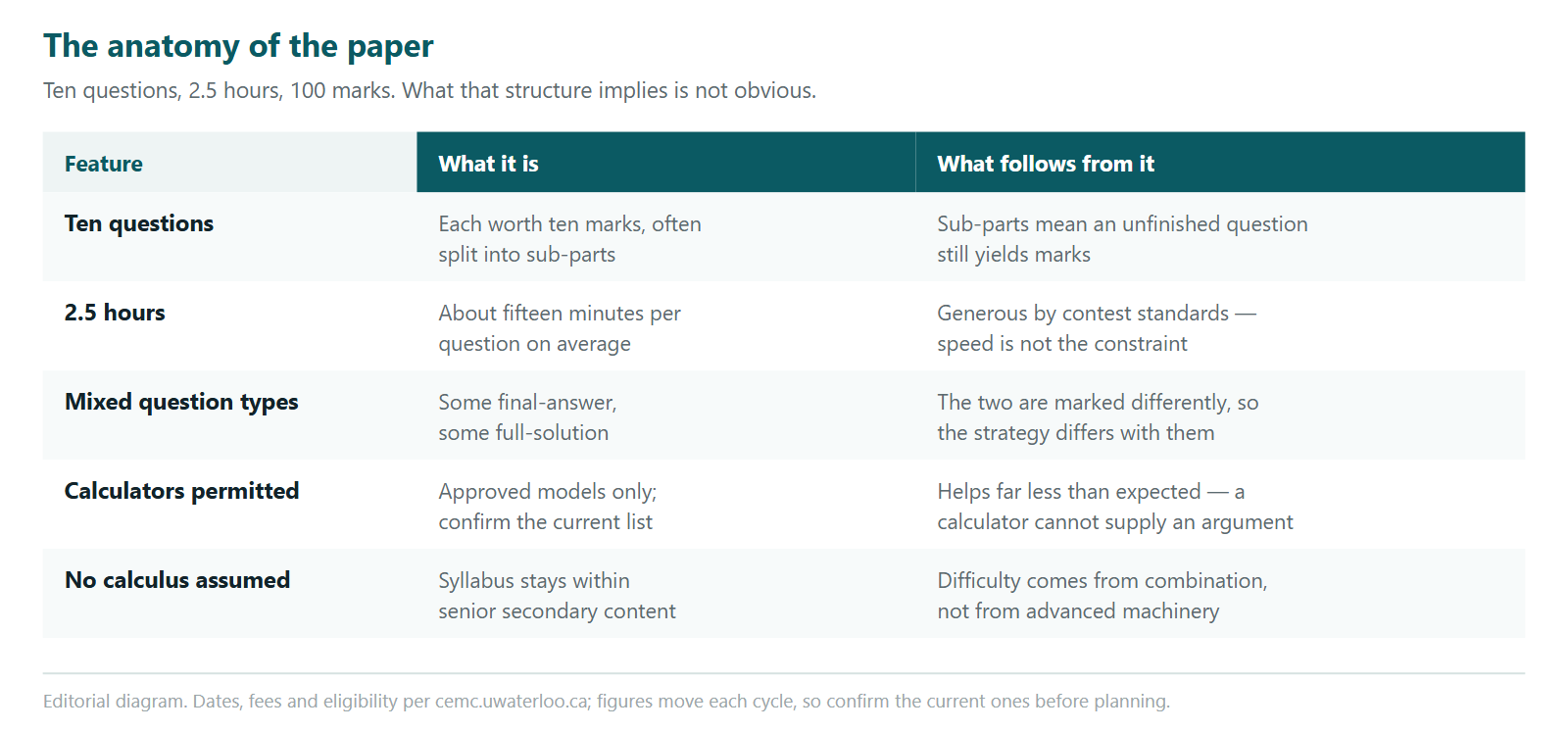
Duration: 2.5 hours
Number of Questions: 10 questions, each broken into multiple sub-parts
Total Marks: 100
Mark Distribution: Individual questions range from 5 to 15 marks
Answer Style: Full written solutions are required
Timing: Held annually in April
Eligibility: Primarily for Grade 12 students, though younger students may also participate
Topics Covered
Algebra
Polynomials and factoring
Exponents and logarithms
Sequences and series (arithmetic and geometric)
Systems of equations
Inequalities
Functions
Polynomial functions and transformations
Exponential and logarithmic functions
Function composition and inverses
Rational functions
Geometry
Coordinate (analytic) geometry
Circles and triangles
Vectors in two dimensions
Properties of geometric figures
Optimization problems on the Cartesian plane
Trigonometry
Trigonometric ratios and the unit circle
Trigonometric identities
Solving trigonometric equations
Applications in geometric contexts
Number Theory
Divisibility rules
Prime numbers
Modular arithmetic
Properties of integers
Combinatorics and Probability
Counting principles
Permutations and combinations
Probability calculations
Scoring and Results
Honor Roll: Students who achieve exceptionally high scores are named to the Euclid Honor Roll.
Certificates of Distinction: Awarded to students in approximately the top 25% of participants.
School Results: Schools receive aggregate results to showcase academic excellence.
Impact on University Admissions
University of Waterloo
For the University of Waterloo, the Euclid is essentially a mandatory requirement for admission to the Faculty of Mathematics (Computer Science, Pure Mathematics, Statistics, Actuarial Science) and the Faculty of Engineering.
Waterloo calculates an Admission Average combining a student’s Grade 12 top-six average with their Euclid score. For competitive programs like Software Engineering or Computer Science, students generally need a Euclid score of 85 to 95 or above to be competitive.
Other Canadian Universities
University of Toronto may consider Euclid scores for math-intensive programs
University of British Columbia recognizes strong Euclid performance
McGill University values Euclid scores for competitive programs
Western University considers Euclid results for admission and scholarships
Scholarships and Financial Awards
Euclid Scholarship: The University of Waterloo offers specific entrance scholarships based on Euclid scores.
President’s Scholarship of Distinction: Valued at $2,000 to $5,000 or more. Typically requires a score of 90+.
David Johnston Scholarship: For the top 10-20 scorers nationally, covers full tuition for four years.
Faculty-Specific Awards: Dozens of additional entrance scholarships in the Faculty of Mathematics.
Ontario Scholar Status: Top scorers receive a $1,000 grant from the provincial government.
Registration: How to Sign Up
Individual students cannot register directly. Participation is organized through schools.
School-Based Registration: Your school’s math department must register via the CEMC portal.
What to Do: Speak to your math teacher or guidance counselor as early as January or February.
Deadlines: Schools must finalize registration by late February or early March.
International Students: Schools outside Canada can also register by contacting the CEMC directly.
How to Prepare: A Strategic Approach
1. Master the Core Curriculum
Ensure deep understanding of polynomials, sequences and series, analytic geometry, trigonometry, combinatorics, and logarithms.
2. Practice Past Papers
The CEMC publishes past contests and official solutions. Work through exams from the last 5-10 years under timed conditions.
3. Focus on Mathematical Communication
Show all your work clearly
Explain your reasoning where appropriate
Use clear notation and define variables
4. Master Time Management
The first 4-5 questions should take 30-45 minutes. Do not get stuck on a single question.
5. Aim for Partial Marks
Attempt earlier sub-parts of difficult questions. Securing these marks is essential for a score of 80+.
6. Attend CEMC Workshops
Check the CEMC website in February and March for free preparation workshops.
Contest Day Checklist
Pencils, erasers, and a ruler
An approved calculator
Your school-issued exam materials
A good meal beforehand
Where to Get the Papers
Past papers 1998–2026: this desk keeps a collected set — the contests, answer keys, and worked solutions for many of the years. Scan the code on this page to claim it; there is no charge. Rules, dates and results: confirm against the organiser’s own announcements before you plan around them.
Final Thoughts
The Euclid Mathematics Contest is more than a test. It is a rite of passage for students with aspirations in STEM. Whether you are aiming for Computer Science at Waterloo, Engineering at Toronto, or simply want to challenge yourself, the Euclid offers an unparalleled opportunity to demonstrate your analytical abilities.
Start preparing early, practice with real past papers, and remember: in the Euclid, how you communicate your solution matters just as much as the answer itself. Good luck!
Frequently Asked Questions
What is the format in brief?
Ten questions in 2.5 hours for 100 marks, each question worth ten and broken into sub-parts. Some ask for a final answer only; the rest are full-solution and are graded on the written argument for completeness, clarity and presentation. Calculators of approved models are permitted.
Which topics are covered?
Algebra including polynomials, exponents and logarithms; sequences and series; systems of equations and inequalities; functions and their graphs; analytic and classical geometry; trigonometry; and elementary number theory. All of it sits within senior secondary mathematics, and the paper does not assume calculus. The difficulty comes from combination rather than from advanced content — a late question will typically pull two of those areas together and leave you to notice which idea unlocks the setup.
How is it different from the tests students already sit?
The SAT and similar tests reward recognising an answer quickly among options. This paper requires producing the reasoning, which is a different task and rewards different preparation. Students who prepare for it the way they prepare for a standardised test usually find that their score does not reflect what they can solve.