The Euclid Mathematics Contest, hosted by the Faculty of Mathematics and Computer Science at the University of Waterloo, Canada, is one of the world’s most influential high school mathematics competitions. Renowned for its high academic standards, strong university preparation alignment, and direct reference value for University of Waterloo undergraduate admissions, it is hailed as the “SAT for Mathematics” and the “Golden Ticket for Canadian Science and Engineering Applications.”
This article will systematically analyze the Euclid Contest’s format, question type distribution, difficulty gradient, and award structure, and provide a phased preparation strategy to help you progress from building a strong foundation to achieving high scores, effectively preparing for the April 2026 exam.
I. Basic Euclid Contest Format
| Item | Description |
|---|---|
| Organizer | University of Waterloo (CEMC), Canada |
| Exam Format | Written exam (paper-based or computer-based, depending on the test center) |
| Exam Duration | 2.5 hours (150 minutes) |
| Number of Questions | 10 multi-part questions, each containing 2–3 sub-questions |
| Total Score | 100 points (10 points per question, awarded based on step-by-step solutions) |
| Answer Requirements | Short answer + Full solution: Must write out the complete reasoning process; answers alone receive no points. |
| Exam Language | English (Draft work may be in Chinese, but final answers must be in English) |
Key Features:
The first 5 questions are foundational, the last 5 are advanced, with difficulty increasing progressively.
The final challenging questions (#9–10) often involve Olympiad-level thinking, distinguishing top students.
High weightage for step-by-step solutions: “Write whatever you can solve” to earn partial marks.
II. Six High-Frequency Core Question Types (Based on the last 10 years of past papers)
Euclid questions cover core areas of high school mathematics. The following six types appear almost every year:
| Question Type | Core Content | Approx. Score Contribution | Student Challenges |
|---|---|---|---|
| 1. Logarithms & Exponents | Rules of operation, change of base formula, exponential equations | ≈15–20 points | Confusing logarithm properties, neglecting the domain of definition |
| 2. Functions & Equations | Polynomials, quadratic functions, solving equations, function graphs | ≈15 points | Omitting case discussions, incomplete solutions |
| 3. Analytic Geometry | Line/circle equations, distance formula, calculating intersection points | ≈10–15 points | Calculation errors, unclear geometric meaning |
| 4. Trigonometry | Simplification, proving identities, solving trigonometric equations | ≈10–15 points | A weak area for most students, confusion with formulas |
| 5. Sequences & Series | Arithmetic/geometric sequences, recurrence relations, summation techniques | ≈10 points | Difficulty modeling recurrences, limited summation methods |
| 6. Circle Geometry | Power of a point theorems, tangent properties, angle relationships | ≈10 points | Difficulty constructing auxiliary lines, rigid application of theorems |
Trends:
In recent years, there has been an increase in comprehensive cross-module questions, such as “using trigonometry to solve geometric optimization problems” or “sequences combined with function iteration.”
III. Question Difficulty Gradient Analysis (Layer 10 Questions)
| Question # | Difficulty Level | Skills Required | Target Score |
|---|---|---|---|
| 1–5 | Foundational | Mastery of high school curriculum knowledge + basic computation | Goal: Perfect score (50 points) |
| 6–8 | Intermediate | Flexible application + multi-step reasoning | Goal: 6–8 points per question |
| 9–10 | Advanced | Innovative thinking + Olympiad techniques | Goal: Secure part (a) marks (2–4 points per question) |
Key to Winning Awards:
Securely score 70+ points on the first 8 questions, and strive for partial marks on the last 2 questions → Total score 80+ = Top 5% globally!
IV. Award Structure and Value
| Award | Description | Value |
|---|---|---|
| Certificate of Distinction | Awarded to the top 25% globally. | Important credential for applications to Canadian universities like Waterloo, Toronto, UBC. |
| Honour Rolls | Three lists: Canadian Official, Canadian Unofficial, International. | For international students, being named on the list is proof of top-tier mathematical ability. |
| Contest Medal | Gold medal awarded to the top student at each school. | Highest honor within the school. |
| Plaque + Cash Prize | Top 5 in Canada: $500 CAD; Ranks 6–15: $200 CAD. | Restricted to Canadian official candidates only. |
Value for Higher Education:
University of Waterloo: Euclid results are directly used in admissions evaluations for Engineering, Computer Science, and Mathematics programs.
UK/US Universities: Can serve as supplementary material demonstrating academic ability in STEM fields (especially beneficial for students without AMC scores).
Global Recognition: Complements contests like AMC12 and AIME, showcasing rigorous mathematical literacy.
Euclid Math Contest registration is now open! Scan the code to inquire about Agent Registration (agency registration) details!
Scan the code and send [Grade + School + Curriculum System]
Free access to past papers and solutions (1998-2025) + Essential Formulas + Categorized Question Banks!
Categorized Exercise Booklets + Competition Preparation Books
Frequently Asked Questions
Which question types recur every year?
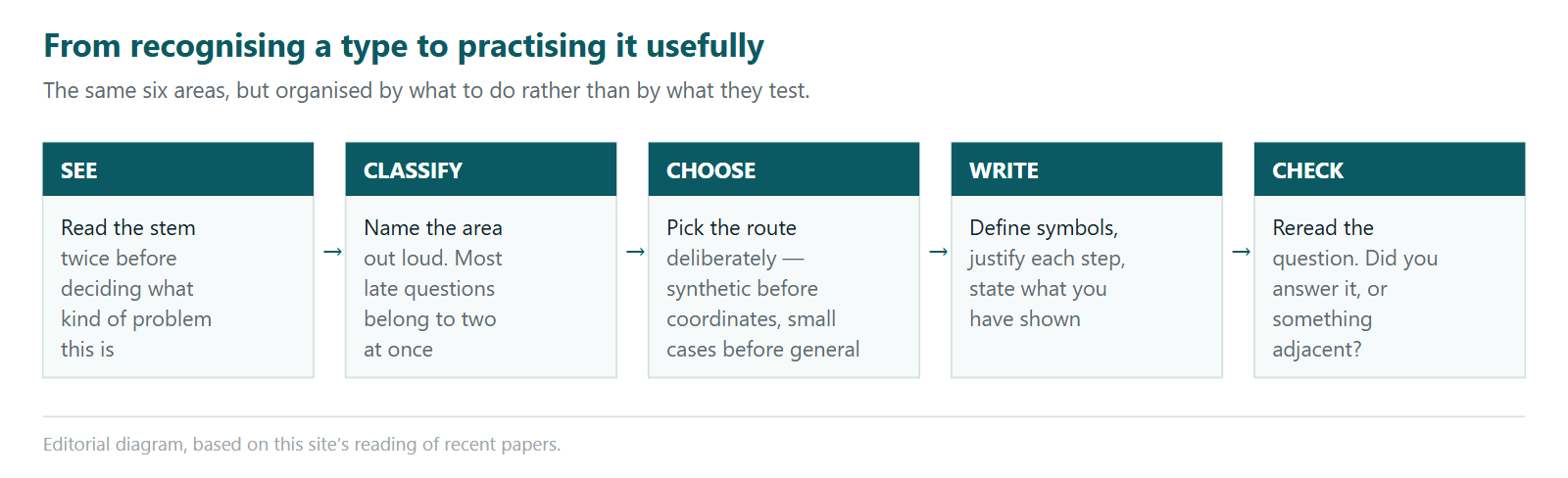
Six areas dominate: algebraic manipulation and equations; functions and their graphs; sequences and series; analytic and classical geometry; trigonometric relationships; and elementary number theory. Recognising which of these a late question belongs to is often the whole difficulty, because the setup deliberately does not announce it.
Does knowing the recurring types make preparation easier?
It makes it more efficient, not easier. Knowing that number theory appears every year tells you not to skip it, which matters because school courses barely cover it. What it does not do is let you prepare by pattern-matching — recent papers have deliberately altered familiar setups so that a memorised method no longer fits directly.
Where should a student start among the six?
Algebra, because it runs through nearly every question and a weakness there caps everything else. Then geometry, which is where scripts most often diverge and where drawing your own diagram pays immediately. Number theory deserves a dedicated block precisely because it is the one area most students meet for the first time in a contest.