The Euclid Mathematics Contest is an international high school mathematics competition organized by the University of Waterloo in Canada. Renowned for its high academic standards, strong connection to university admissions, and significant weight as a reference for undergraduate admission to the University of Waterloo, it is often called the “TOEFL of Mathematics.” This article will detail the registration methods, core advantages, difficulty range, and phased preparation strategies for the Euclid Contest, helping you efficiently prepare for the April 2026 exam.
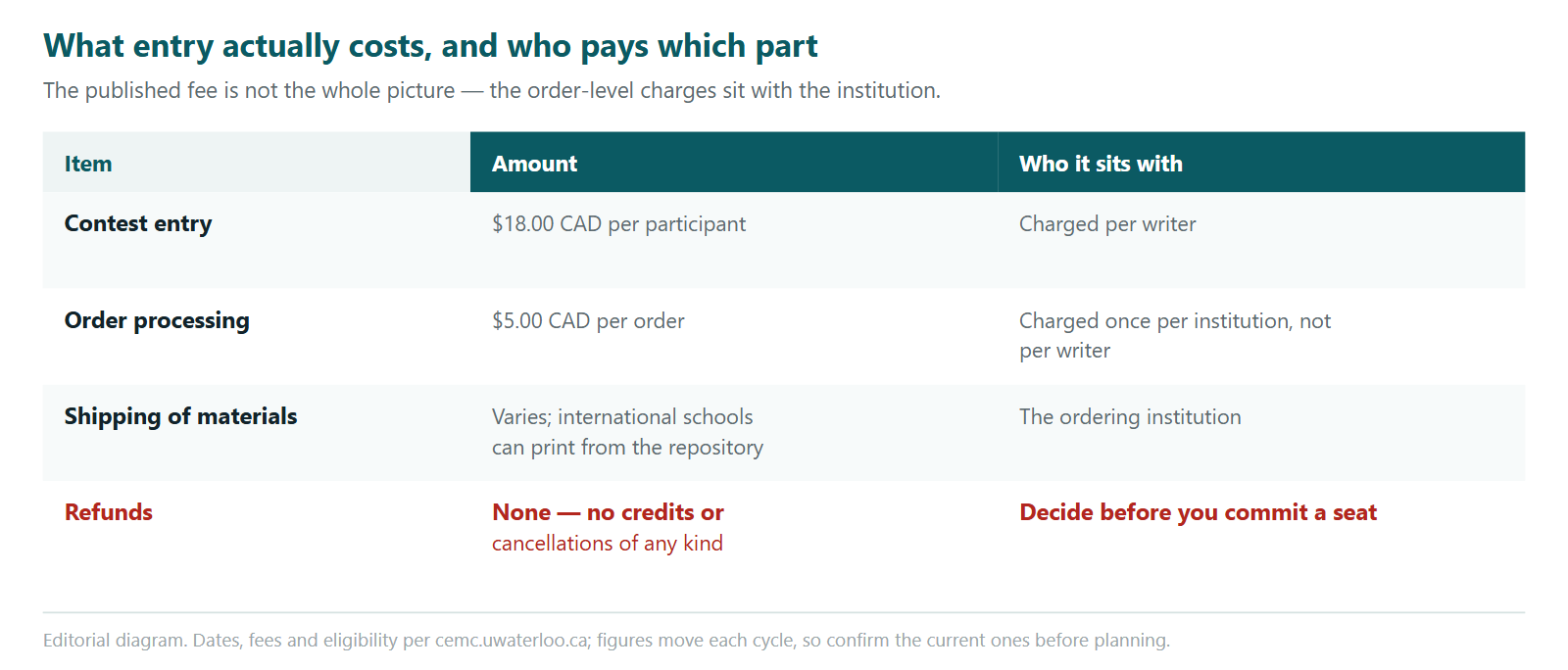
I. Euclid Contest Registration Methods
1. School Group Registration
Eligible Participants: Students whose schools are official Euclid in-person test centers.
Process: Registration is organized and completed uniformly by the school. Individual self-registration is not supported.
Suggestion: Directly consult your school’s math teacher or the teacher in charge of competitions for details.
For Canadian local students: You can register directly through your school.
2. Agency Agent Registration
Eligible Participants: Students whose schools are not Euclid contest test centers.
Process: Register through an authorized agency partnered with the contest.
Suggestion: Contact a teacher at a relevant agency for consultation and to obtain registration eligibility.
We are an official authorized test center and can provide agent registration services.
II. Why You Must Choose Euclid?
1. Canada’s “TOEFL of Mathematics,” Highly Recognized by Elite Schools
Reference for North American University Admissions: Excellent results significantly enhance competitiveness when applying to top institutions like the University of Waterloo, University of Toronto, UBC, and McGill University.
High Global Recognition: Especially suitable for students without AMC scores, serving as supplementary academic material for STEM pathways.
2. Direct Link to Scholarships
Priority for University of Waterloo Entrance Scholarships: High-scoring students have opportunities to receive substantial scholarships, achieving “advancement and funding through competition.”
3. Moderate Difficulty, Excellent Value
Focus on Logical Thinking: Unlike some competitions that emphasize knowledge beyond the syllabus, Euclid places greater importance on logical thinking, problem-solving steps, and mathematical expression.
Easy to Score with Systematic Training: With systematic preparation, most students can achieve impressive results, making it suitable for the majority of high school students aiming for a Sprint.
III. Euclid Difficulty Range and Benchmarking
1. Overall Difficulty Positioning
Ranges between AMC10 and AMC12, significantly lower than AIME, slightly harder than the later part of AMC10, and easier than the challenging final problems of AMC12.
Difficulty Curve: Gentle at the start, steep later, with a “cliff-like” rise:
Questions 1–5: “Gimme questions” – attainable with a solid foundation.
Questions 6–8: “Turning point” – require flexible application of in-class knowledge.
Questions 9–10: “Master zone” – test Olympiad-level thinking and technique.
2. Knowledge Scope
Covers core high school mathematics areas: Algebra, Geometry, Number Theory, Combinatorics, Functions, Trigonometry, etc.
No calculus/linear algebra, but the depth of exploration into fundamental concepts and module integration far exceeds the standard curriculum.
Typical Question Types: Exponential and logarithmic operations, solving functions, analytic geometry, trigonometric simplification, recursive sequences, circle geometry problems, etc.
IV. Euclid Preparation Guide: Phased Guide
Phase 1: Foundation Building
Quickly Scan Knowledge Points:
Core Resource: Past papers and solutions from the University of Waterloo official website.
Task: Quickly review core high school math Knowledge Points, ensuring no knowledge blind spots.
Practice First 8 Questions of Past Papers:
Goal: Master the logic of basic question types, improve accuracy in reading problems.
Task: Intensively practice the first 8 questions of past papers from 2015-2020, while memorizing essential math English vocabulary.
Create a Categorized Error Log:
Mark Error Causes: Such as unclear concepts, calculation mistakes, unclear problem-solving Thinking, etc.
Focused Breakthrough: Conduct Special Topic training for weak modules (e.g., constructing auxiliary lines in geometry).
Phase 2: Skill Enhancement
Focus on Comprehensive Question Types:
Target Questions: Questions 6-9 of past papers.
Method: Refine core models like substitution method and case analysis to form General problem-solving approaches.
Tackle Difficult Modules:
Focus on Conquer: Difficult areas like Number Theory and Combinatorics.
Task: Combine practice with similar problems from other contests to enhance problem-solving ability in complex scenarios.
Standardize English Solution Steps:
Requirement: Ensure clear derivation to avoid losing process points.
Structure: Write solutions following the “Given → Reasoning → Conclusion” format.
Phase 3: Final Sprint (March 26 – Before Exam)
Full-Length Mock Exams to Adapt to Pace:
Task: Use past papers from the last 5-10 years for timed mock exams (150 minutes), simulating exam conditions.
Time Allocation: Aim to complete Questions 1-7 within 90 minutes, leaving sufficient time for the challenging final problems.
Strategy to Maximize Points on Final Problems:
Priority: Tackle the first two sub-questions of Question 10.
Task: Organize your Thinking and list relevant formulas, striving for every possible point.
Review and Optimize Exam Strategy:
Check Against Scoring Guidelines: Correct issues with solution steps and time allocation.
Optimize Strategy: Adjust question order and time management based on mock exam performance.
Euclid Mathematics Contest registration is in full swing! Scan the QR code to inquire about Agent registration details!
Scan and send [Grade + School + Curriculum System]
Get free access to past paper solutions (1998-2025), essential formulas, and categorized question banks!
Categorized question booklets + preparation materials
Frequently Asked Questions
What are the two ways to register?
Through a school that holds an account with the organiser and orders the paper itself, or through an authorised test centre that registers on your behalf and provides the seat. There is no individual sign-up route. In mainland China most writers use the test-centre route, because relatively few schools hold their own account.
Why choose this contest over the alternatives?
Because of what it certifies. The result is externally set and marked to a published standard, and it evidences something a multiple-choice contest cannot: whether a student can build and communicate a mathematical argument. For applicants to mathematics-heavy programmes, that is a more specific claim than a grade average makes.
How should preparation be phased?
Three phases. Review the core topics quickly to locate gaps rather than to relearn everything. Then work past papers properly — full written solutions, marked against worked solutions rather than answer keys. Finish with timed whole papers. Our collected 1998-2026 set is free to claim by scanning the code on this page.