Papers from 1998 to 2026, free to claim
This desk keeps a Euclid past-paper collection running from 1998 to 2026, free to claim. Each year is the contest as written and an answer key; for many of the years it also carries full worked solutions and the results data that records exactly how hard every problem played.
Files arrive as PDFs you can print and sit cold. The paper’s format and marking scheme are documented on the competition pillar; this page is about using the collection well.
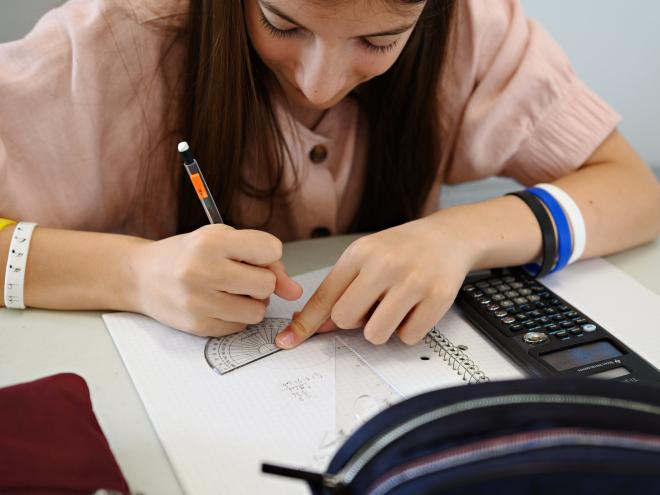
Three documents, one habit
The CEMC states the archive’s purpose plainly — students “review and attempt” real papers — and each year’s entry is a complete practice apparatus in three parts:
The paper exactly as sat — print the PDF and write it cold. The archive exists to teach “the contest format, level of difficulty, and problem solving strategies.”
Complete written arguments, often by more than one route: the CEMC’s 2024 commentary records problem 8 falling to a perpendicular construction and similar triangles for some writers, and to trigonometric ratios for others.
Statistics plus “Comments on the Paper”: world-average marks per problem and the errors graders saw most. The most under-read document in Euclid preparation.
The official tools that pair with the archive are catalogued with the preparation resources.
Difficulty, read off the averages
Every results booklet prints the world-average mark for each problem, out of 10 — so a year’s difficulty is measured, not felt. The shape repeats: an accessible opening, a contested middle, and a punishing finish. Two recent years, in bands:
Sum the columns and you have the year: about 54 of 100 in 2024, about 52 in 2026. Calibrate any practice score against its own year’s booklet before celebrating — or despairing.
A method, not a pile
The archive rewards ritual over volume. The CEMC’s own advice is to begin with the General Preparation Advice document attached to the official preparation material, then work a four-step loop — on this paper, marks are awarded for the writing, not just the answer.
Contest-day conditions, permitted calculators included, are specified in the contest-day guidelines — practice under them from the first sitting.


Skip the hunting — scan and the advisor sends the full 1998–2026 archive, solutions and question banks included, free.
Papers older than about a decade are the hard ones to track down, and they are exactly the ones worth having: the same ideas, tested before the current house style settled. This desk’s collection runs back to 1998, with video walkthroughs for many of the years. The full collection is free to claim below.
The complete archive, free to claim
Every paper the official index no longer lists — plus the desk’s standing offers for 2027 writers.
1998–2026 past papers, free — contests, solutions and categorized question banks.
9.9 RMB trial lesson — one full placed lesson before any course decision.
2027 registration service — an authorized test-centre seat, paperwork handled.
488 / 888 RMB scholarships — desk-registered writers reaching Distinction / honour rolls.
Scan to claim on WeChatFive questions about the past papers
How do I get the full 1998–2026 past-paper set?
Scan the code on this page to reach the desk on enterprise WeChat and the whole set comes back in one chat: the contests, answer keys, worked solutions for many of the years, and the results data behind each paper. There is no charge.
Are past Euclid papers available in French as well as English?
The archive carries an English–French toggle, but many Euclid entries are flagged “available in English only.” Where a French version exists it sits in the same yearly entry; where it does not, the English paper is the paper.
Can the Problem Set Generator make Euclid practice sets?
No. The CEMC’s Problem Set Generator builds custom sets only from past Gauss, Pascal, Cayley and Fermat contests. For the Euclid, the official equivalents are the topic problem sets in the preparation material — and the archive itself.
Are Euclid papers from before 2016 still available?
Yes — the pre-2016 papers sit in this desk’s 1998–2026 set, and they are the years most students never get to see. Claim the set above and they come with it.
How should I mark my own practice sittings?
Against the worked solutions, the way graders would: award partial marks for correct reasoning, and judge each full solution on completeness, clarity and presentation. Then read that year’s “Comments on the Paper” for the typical errors — the marking scheme itself lives on the competition pillar.