In the landscape of mathematics competitions, the Euclid Contest, organized by the University of Waterloo, stands as a significant highlight on the resumes of many prospective international students, thanks to its rigorous emphasis on written solutions and high academic recognition.
Faced with such a prestigious competition, many students and parents find themselves torn: “Should we ‘get a head start’ in Grade 10 when the academic load is relatively lighter, or wait until Grade 11 when our knowledge is more complete before ‘making a sprint’ for a gold medal?” This is a strategic decision that involves both academic planning and psychological balance. Today, we will provide an in-depth analysis of the logic behind choosing your competition timing from three dimensions: knowledge preparation, the logic of application enhancement, and psychological readiness.
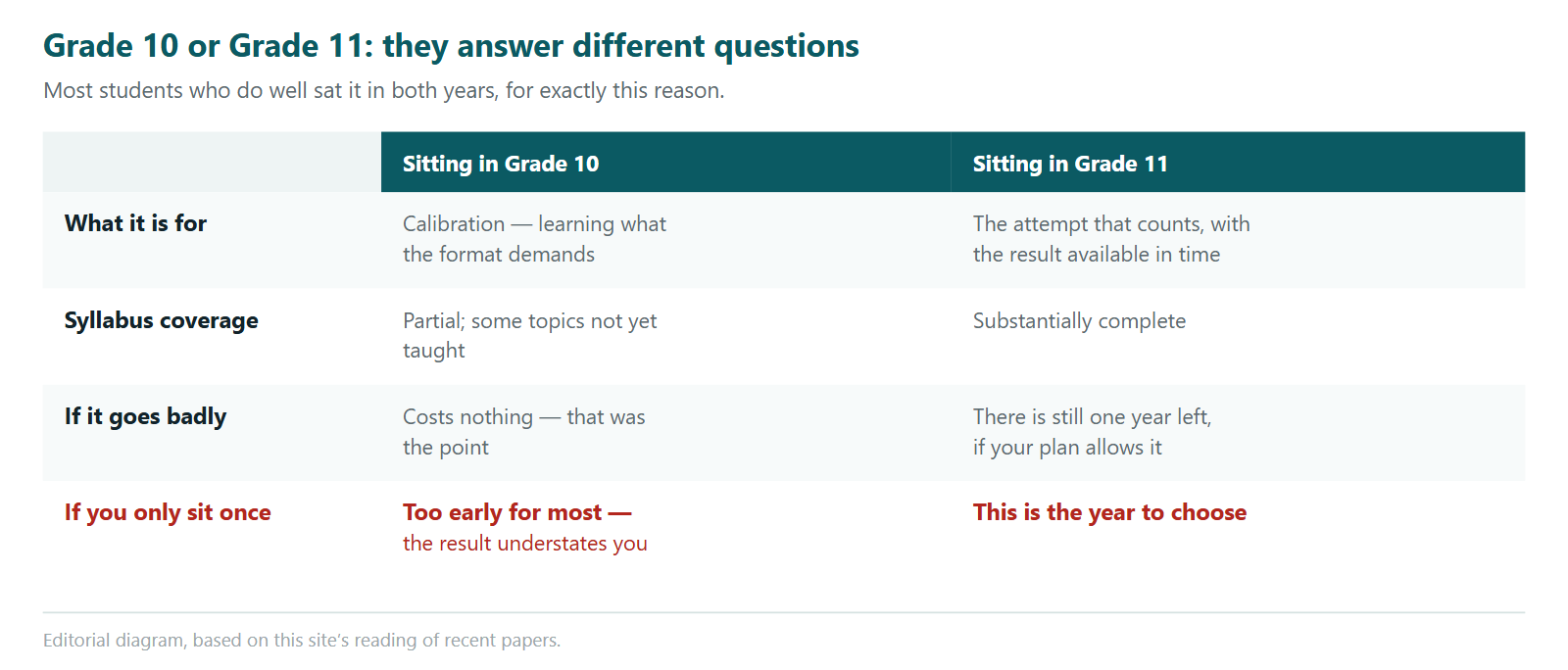
I. The Decision Logic: Grade 10 vs. Grade 11
1. Taking the Competition in Grade 10: The “Early Mover” Advantage
For students who have extra capacity, taking the Euclid in Grade 10 offers unique strategic advantages:
- Building Foundational Thinking: The Euclid tests the deep application of high school mathematics knowledge. Grade 10 is a critical period for establishing mathematical models and rigorous argumentation. Through preparation, you can push yourself to break free from the inertia of “rote problem-solving” and learn how to standardize the writing of mathematical proofs.
- Creating a “Buffer Zone” for Mistakes: If you do not achieve your desired ranking (such as the global Top 25%) in Grade 10, you still have a second chance in Grade 11. This “double insurance” strategy can significantly ease psychological pressure.
- Synergy with Schoolwork: The Grade 10 mathematics curriculum overlaps significantly with Euclid content. By reinforcing your learning through competition problems while studying functions, geometry, and trigonometry, you can noticeably boost your confidence in school mathematics.
2. Taking the Competition in Grade 11: The “Sprint” Strategy
For most students, Grade 11 is the “golden period” for taking the Euclid:
- Complete Knowledge Base: By Grade 11, you will have covered most of the core topics in high school mathematics, making you more comfortable when dealing with number theory, combinatorics, and complex algebra problems.
- Peak Application Profile: The application season typically begins in Grade 12. A gold medal or high ranking achieved in Grade 11 can serve as the most compelling academic endorsement on your application materials. The award is achieved closest to the application date, showcasing your most “current” academic abilities.
- Focused Energy: Grade 11 is often a peak period for extracurricular projects. Participating in the competition at this time allows you to better combine it with research projects and standardized tests, creating a well-rounded academic profile.
II. Core Considerations: Are You Ready to Compete?
Regardless of which grade you choose to compete in, you must ensure that you have crossed the following three “thresholds” before registering:
- Algebra Proficiency: Are you proficient in function graphs, logarithmic operations, and complex algebraic identities? Approximately 40% of the Euclid questions are closely related to algebra.
- English Argumentation Skills: This is often overlooked by domestic students. Can you write clear derivation steps in fluent English (e.g., “Let A be…”, “Since…, therefore…”)? If you can only calculate numbers but cannot complete the written argumentation, you will not be able to score high, even if you know all the concepts.
- Time Management and Pace: The Euclid exam lasts 2.5 hours, which is a significant test of endurance. Before deciding on your timing, be sure to complete a set of past papers to assess whether you can calmly finish the entire exam.
III. Differentiated Planning: Strategies for Different Goals
Target: STEM Programs at Oxbridge or Top Canadian Universities
Strategy: “Test the waters in Grade 10, sprint in Grade 11.” Take the competition once in Grade 10 to experience the difficulty and question types, and to familiarize yourself with the competition’s logic. Then, go all out in Grade 11, aiming for the global top 5%, using the award to demonstrate your logical reasoning abilities.
Target: U.S. Top 30 Universities, Seeking a Diversified Academic Background
Strategy: “Focus your efforts in Grade 11.” Concentrate your energy on Grade 11, combining the Euclid with the AMC 12 and other research projects to build a cohesive and well-rounded academic portfolio.
IV. Pitfall Avoidance Guide: Advice for Parents
- Beware of “Premature Participation”: Do not compete for the sake of competing. If a child is pushed into the competition without understanding the essence of mathematics, it can easily lead to frustration and diminish their interest in the subject.
- Do Not Ignore the “Process”: The Euclid does not reward “geniuses”; it rewards “rigorous logical thinkers.” When preparing, do not just look at the answers to past papers; study the official “Full Solutions” and learn from their argumentation structure.
- Maintain a Balance with Schoolwork: Competitions are a bonus point, but GPA is always the foundation. If there is a conflict between competition preparation and final exams, be sure to prioritize maintaining a stable GPA.
Frequently Asked Questions
Grade 10 or Grade 11 — which is better?
They serve different purposes. A Grade 10 sitting is calibration: it shows what the format demands while the result carries no weight. A Grade 11 sitting is usually the one that counts, because the student has more of the syllabus and the result lands in time to be used. Many students who do well sat it in both years for exactly that reason.
How do I know if a student is ready to enter?
Three checks. Can they work confidently with functions and their graphs? Can they handle a geometry problem where no method is signalled? And can they write a solution someone else can follow without asking questions? The third is the one most often missing, and it is the one the paper marks hardest.
What should parents avoid here?
Entering for the sake of entering. A student pushed into the contest without the foundation usually gets a discouraging result and learns nothing usable from it. The contest rewards a student who is curious about the problems; it is not a credential that can be acquired by attendance. If the foundation is not there yet, a year of building it is not a year lost.