In the broader landscape of international education and STEM profile building for top universities, the Euclid Mathematics Contest, organized by the University of Waterloo in Canada, has long been recognized as an “academic hard currency” for applications to prestigious institutions in North America, the UK (Oxbridge and G5), and Singapore.
As the new season approaches, a large number of students and parents interested in applied mathematics, computer science, applied physics, engineering, or business are gearing up. However, a core tactical question arises: “The Euclid Contest is open to students from grades 9 to 12. At which grade does participating and winning a specific award offer the highest value and the greatest boost to university applications? How should an average international student structure a long-term preparation timeline to achieve a decisive edge?”
This article will thoroughly analyze the optimal grade for the Euclid Contest from the perspective of strategic application positioning and the development of mathematical thinking, and provide a complete interpretation of a long-term preparation timeline.
I. Strategic Positioning: Which Grade Offers the Highest Value for the Euclid Contest?
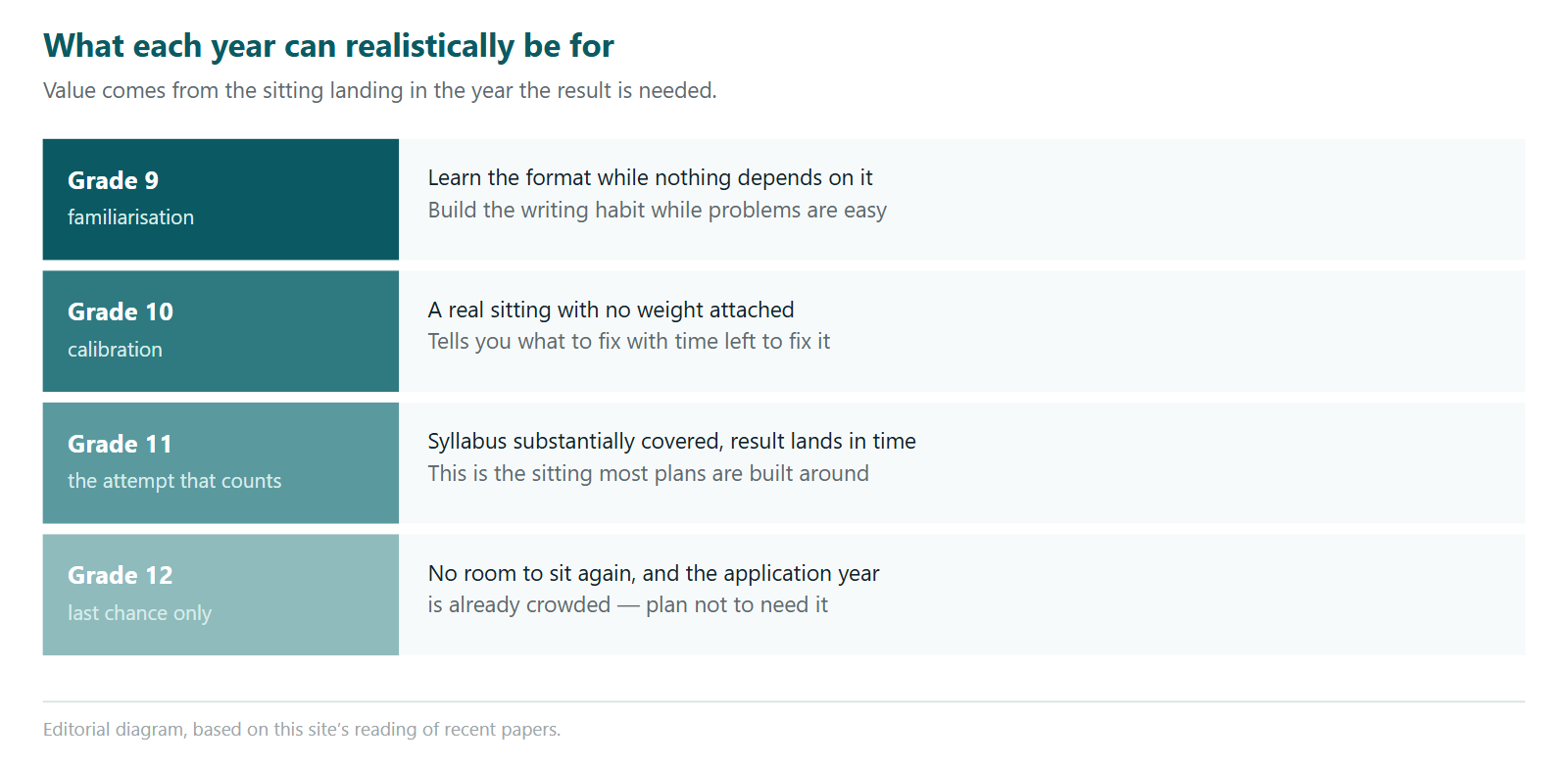
The conclusion is very clear: from the perspective of maximizing application value and overall benefits, participating in the Euclid Contest in Grade 11 (the second year of high school) in April offers the strongest impact and the most perfect strategic timing.
Many parents may wonder: since students learn the most mathematical knowledge in Grade 12, why isn’t Grade 12 the best choice? We can break this down from three dimensions:
Grade 11 is the perfect “seamless Early Application positioning” window: The Euclid Contest is typically held in April each year, with results released at the end of May. By participating in Grade 11 (April) and earning a Certificate of Distinction (Top 25% globally) or an Honor Roll certificate (Top 5% globally), this impressive academic award can seamlessly fit into the Early Decision (ED/EA) and UCAS first-round applications of top universities in the US, UK, and Canada during the first semester of Grade 12 (October-November of the same year).
Grade 12 participation faces an “awkward timing mismatch”: If you wait until April of Grade 12 to participate, results will not be released until the end of May. By then, the Early Decision and Regular Decision (RD) rounds for most top US and UK universities will have long been concluded. The certificate obtained at this point, aside from being useful for regular-round applications or scholarship considerations at the University of Waterloo’s Faculty of Mathematics or Computer Science, will have largely missed the optimal window to boost applications to other Ivy League or Oxbridge institutions.
Grade 10 participation is an excellent “low-risk, high-tolerance stepping stone”: The Euclid Contest allows repeated participation, and only the best score is reported on applications. By entering the contest early in Grade 10 (the first year of high school), even if you do not win a top award, the lack of immediate application pressure allows you to accumulate invaluable experience in a 150-minute real exam setting, providing a perfect buffer and room for improvement for a “final push” in Grade 11.
II. No Last-Minute Cramming! A Long-Term “Dark Horse” Preparation Timeline for the Euclid Contest
The Euclid Contest does not test calculus, but the second half of the paper heavily tests advanced algebra, analytic geometry, and in-depth variations of number theory and combinatorics. To ensure that students at different grade levels can securely secure the foundational 70-point base and aim for the global top 5%, please strictly follow this long-term preparation roadmap:
Golden Long-Term Preparation Timeline for the Euclid Contest
1. Comprehensive “Full-Subject Gap-Filling” to Build a Solid Foundation: 6–8 Months Before the Exam (August – October of the previous year)
- Core Task: Eliminate the “misalignment” blind spots between the domestic public school or standard international curriculum and the Euclid Contest.
- Specific Execution: Spend 15 minutes daily building a core bilingual mathematics vocabulary (e.g., logarithm, sequence, congruence). Focus your efforts on conquering the four major golden areas that are not heavily emphasized in Chinese high school but are consistently tested in the Euclid: basic logarithmic operations, arithmetic and geometric sequence summation formulas, introductory combinatorics, and the hybrid application of the sine and cosine rules in geometric figures.
2. Targeted Phased Practice, Striving for a 100% Conversion Rate on “Questions 1–7”: 3–5 Months Before the Exam (November – January of the following year)
- Core Task: The cutoff for the Euclid’s global top 25% (Distinction) has historically fluctuated between 65 and 70 points. The first 7 questions are intermediate-level foundational problems and form the core base for the average student to win an award.
- Specific Execution: Categorize and retrieve Euclid past papers from the last 10 years, and practice by module, such as “Algebraic Equations,” “Analytic Geometry,” and “Trigonometric Functions”. Every time you get a question wrong, use a red pen in your error notebook to identify: Did I get stuck because I didn’t understand the English problem statement, or did I make a mistake in formula transformation? Ensure that the first 7 questions can be answered accurately and efficiently in the exam, without losing a single mark.
3. Full-Length Timed Mock Exams and Special Training in “Full English Academic Writing Standards” to Maximize Step Marks: 1–2 Months Before the Exam (February – March of the following year)
- Core Task: Adapt to the 150-minute high-pressure exam environment and bridge the gap from “being able to solve the problem” to “being able to write a full-mark solution process”.
- Specific Execution: The second half of the Euclid paper (Questions 8–10) consists entirely of Full-graded (detailed solution) questions, which are graded manually. Errors or omissions in the process will be strictly penalized. Each week, strictly set a 2.5-hour timer for a full, closed-book mock exam. Force yourself to write answers in full English, following official high-scoring templates. Clearly define every new variable introduced, and state the prerequisites for any geometric theorem used. At the same time, develop your time management strategy for the exam: aim to complete the first 7 questions within 60 minutes, leaving a full 90 minutes to tackle the first parts of the last three questions and aggressively pick up step marks.
Frequently Asked Questions
Which grade gives the best return on sitting this contest?
In most plans, the year before applications are written. Sitting it then means the result exists when it is needed and the student has had time to build the writing habit the paper marks. Sitting it earlier is useful as calibration rather than as the attempt that counts, and sitting it in the final year leaves no room to sit it again.
Is there any point sitting it early?
Yes, if you treat it as information rather than as a verdict. An early sitting tells you what the format actually feels like, which questions you can start, and how your writing holds up under time. Those are hard to learn any other way, and they are much cheaper to learn in a year when the score does not have to carry weight.
How long does a serious preparation run take?
Plan across a school year rather than a term. The topics can be covered in months; the habit of writing a complete argument takes longer, because it has to survive time pressure. A common shape is topic work through the summer and autumn, whole timed papers through the winter, and the final weeks spent on writing rather than on new material.