For Canadian high school students planning to apply to universities, the Euclid Mathematics Contest holds a status equivalent to the “provincial exam” or “college entrance exam” of the mathematics world. Since it is officially hosted by the University of Waterloo, its results are highly regarded in STEM applications across North America and globally.
So, why is the Euclid a must-take for Canadian high school students? And what level of school-level math foundation is actually required? This article provides an in-depth analysis.
I. Why Do Canadian High School Students View the Euclid as a “Must-Have”?
If you are studying in a Canadian high school, especially aiming for top-tier universities, taking the Euclid is not just about winning an award—it is about securing an “admission ticket” to prestigious institutions.
1. A “Strong Admission Indicator” for the University of Waterloo’s Faculty of Mathematics and Faculty of Engineering
The University of Waterloo’s Computer Science (CS) and Engineering programs are dream destinations for students worldwide.
- Admission Weight: The university explicitly recommends that students applying to the Faculty of Mathematics and CS programs take the Euclid.
- Scholarship Opportunities: Euclid scores are an important reference for the University of Waterloo’s entrance scholarships. If your score places you in the global top 25% (Distinction) or even on the Honor Roll, your admission chances increase exponentially.
2. Compensating for Grade Inflation
In recent years, Canadian high school grades have generally been high, leading to “grade inflation.”
- Differentiated Competition: When everyone has a Grade 12 math score of 95+, a top 5% Euclid certificate instantly proves that your mathematical logic far exceeds that of your peers. It provides admissions officers with a cross-regional, standardized academic comparison metric.
3. Background Enhancement for the University of Toronto and Other Top Schools
Although the Euclid is hosted by Waterloo, it is also highly recognized by the University of Toronto (UofT), McGill University, and Ivy League schools in the United States. It demonstrates that a student has the potential to handle challenging university-level math courses such as linear algebra and calculus.
II. What School-Level Foundation Is Required to Take the Euclid?
Many students worry that they have never participated in Olympiad training and lack a sufficient foundation. In fact, the Euclid’s problem design is very “approachable”—it aligns closely with the Canadian high school curriculum system (such as Ontario Curriculum) while elevating the application of concepts.
1. Core Knowledge Base: Aligned with Grade 11–12 Courses
Approximately 90% of the Euclid’s test points are covered in the following Canadian high school math modules:
- Grade 11 Functions (MCR3U): Logarithms, function transformations, arithmetic and geometric sequences, basic trigonometry.
- Grade 12 Advanced Functions (MHF4U): Polynomial equations, advanced trigonometric identities, function composition.
- Grade 12 Calculus & Vectors (MCV4U): While the Euclid does not directly test calculus, the concept of vectors is very helpful when solving the final geometry problems.
2. Foundational Requirements: Who Can Participate?
- Students with 85+ in Grade 11 Math: If you can handle Grade 11 Functions with ease, then the first 6 questions of the Euclid are essentially no challenge for you.
- Basic Logical Writing Ability: The Euclid is a long-answer format contest that requires you to write out solution steps in English. If you perform well in the “Thinking” and “Application” sections of your school math courses, you already have the potential to compete.
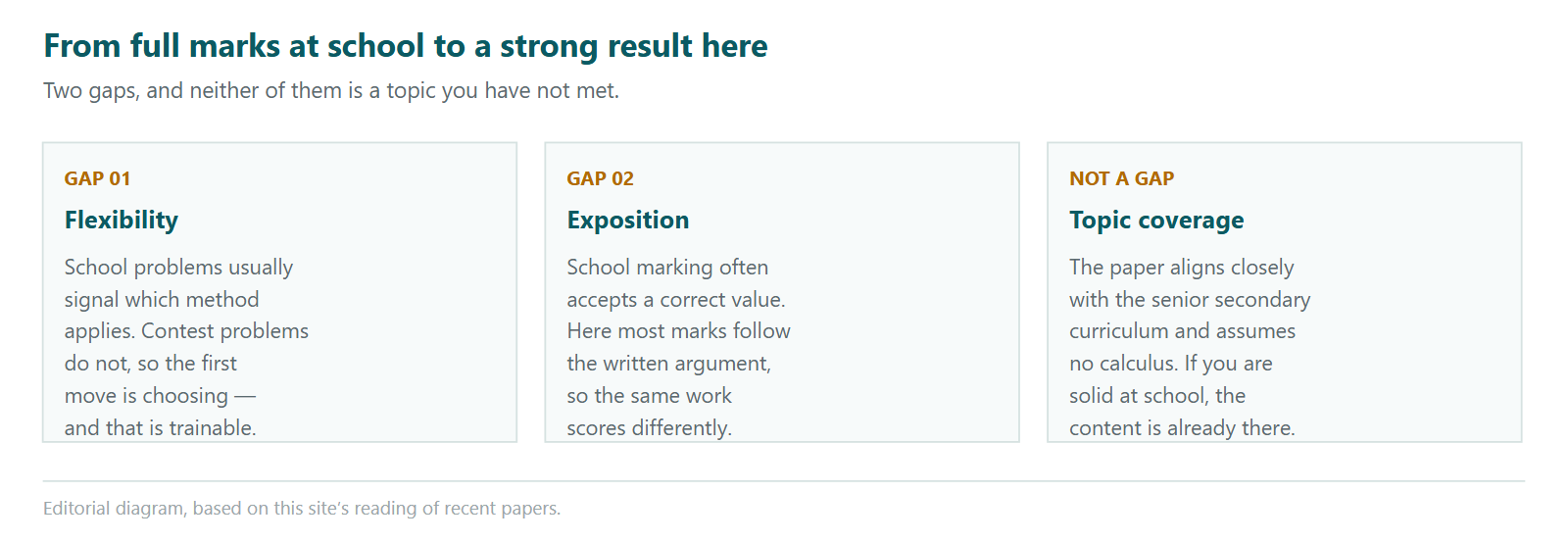
III. From School Math to the Euclid: Two Hurdles to Overcome
Even if you score 100% in school math, without targeted training, it is difficult to achieve a high score on the Euclid.
1. Flexibility in Thinking
School math focuses on “applying formulas,” while the Euclid focuses on “deconstructing problems.”
- Difference: For example, in analytic geometry, school math might only ask you to find the equation of a circle, whereas the Euclid might combine circles with polygons and probability in a composite problem.
2. Professionalism in English Expression
The last three full-solution questions of the Euclid have strict requirements for mathematical writing in English.
- Pitfall to Avoid: Many Canadian high school students are used to writing only the final answer. However, on the Euclid, even if the answer is correct, without rigorous logical connectors and derivation steps such as “Therefore,” “Since,” and “Assume,” you will lose a significant number of marks.
IV. Preparation Advice: A “Three-Step” Plan for Canadian High School Students
1. Knowledge Alignment (October–November): Fill in the gaps. On top of completing MCR3U, preview the logarithm, trigonometry, and polynomial chapters in MHF4U in advance. These are high-frequency test points in the middle-section problems (Questions 4–7) of the Euclid.
2. Targeted Breakthrough (December–February): Logic training. Practice foundational number theory (congruence, divisibility) and permutations and combinations—topics that are less covered in Canadian high school textbooks but are essential in the contest.
3. Past Paper Review (March–April): Timed simulations. Conduct 2.5-hour full-length mock exams, focusing on how to standardize the solution process for Questions 8–10 and strategically earn step marks.
Frequently Asked Questions
Why do Canadian school students treat this contest as standard?
Because it is set by the same faculty many of them are applying to, and because it tests the curriculum they are already in rather than a separate olympiad syllabus. That combination makes it unusually legible to admissions readers in Canada: the result is a checkable data point about a student’s mathematics that arrives from outside their own school’s grading.
What school-level background is enough to enter?
The paper aligns closely with the senior secondary curriculum, so a student who is solid in functions, trigonometry, logarithms and sequences already has the topic base. What is usually missing is not content but style — the contest asks for open-ended reasoning written out for a reader, which few school courses assess directly.
What is the gap between strong school marks and a strong result here?
Two hurdles. The first is flexibility: school problems usually signal which method to apply, while contest problems do not. The second is exposition, because most of the marks follow the written argument rather than the final value. A student scoring full marks in class can still lose most of the available marks by writing the way class rewards.