As the registration deadline for the first half of 2026 Euclid Mathematics Contest approaches, high school students around the globe are gearing up for this grand mathematical competition. Hosted by the University of Waterloo in Canada, this contest is hailed as the “TOEFL of the mathematics world,” widely recognized for its high value, rigorous assessment standards, and rich challenges that attract countless math enthusiasts.
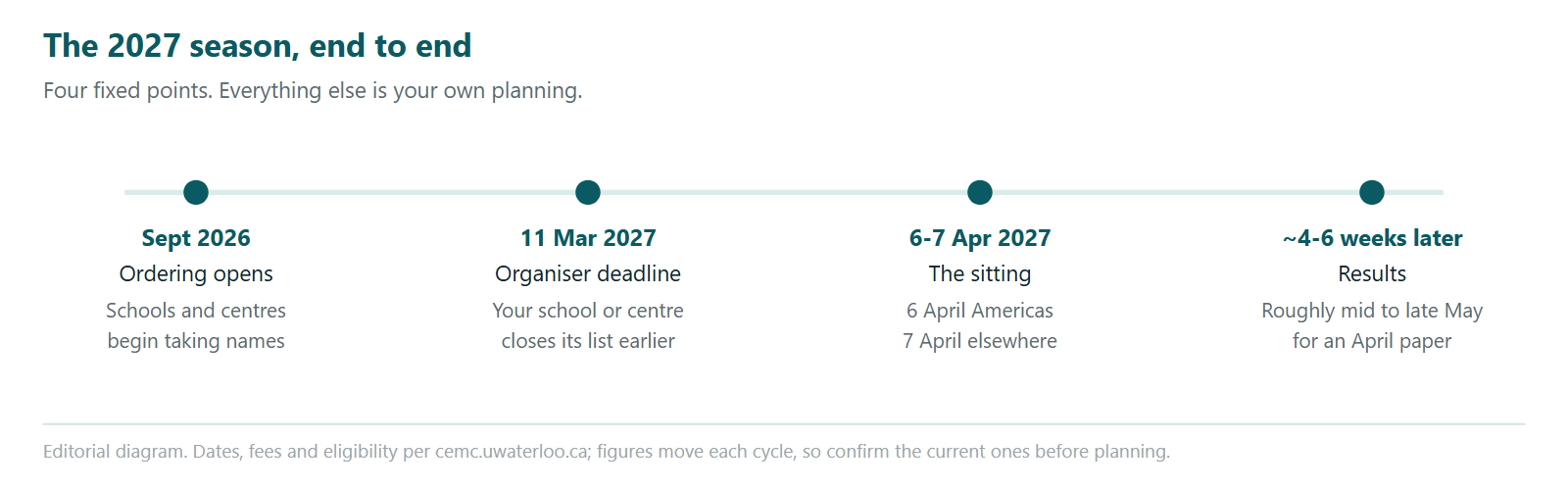
I. Basic Contest Information (2026 Season)
| Item | Details |
|---|---|
| Organizer | CEMC, University of Waterloo, Canada |
| Registration Deadline | March 11, 2027 (Schools are advised to complete registration 1–2 weeks in advance) |
| Exam Date | • North & South America: Tuesday, April 6, 2027 • Other Regions (including China): Wednesday, April 7, 2027 |
| Exam Format | In-person paper-based exam (organized by authorized test centers) |
| Exam Duration | 2.5 hours |
| Question Types & Scoring | 10 short-answer questions, total 100 points. • Some questions contain (a)(b) sub-questions. • Must write the complete solution process (answers alone receive no points). |
| Score Release | 5–6 weeks after the contest (expected mid-to-late May 2026) |
II. Suitable Participants
Students with Clear Goals:
Planning to apply to Canada’s Top 5 universities (U of T, UBC, McGill, Waterloo, McMaster).
Intending to apply to the University of Waterloo’s Faculty of Mathematics, Computer Science, Engineering, Actuarial Science, or Business School.
Aiming to compete for undergraduate scholarships through contest scores (Waterloo has specific scholarship thresholds for Euclid scores).
Students Seeking Background Enhancement:
G10–G12 students wanting to add a high-value academic credential to their applications for UK, US, or Canadian universities.
Students with a solid math foundation (equivalent to domestic Grade 12 / Canadian Grade 12 level) but who have not participated in high-level contests like AIME.
Students Seeking High Value for Effort:
Compared to AIME (average score only 4–5/15), achieving 75+ in Euclid is more attainable, and its recognition in Canada is extremely high.
III. Exam Content and Weight Distribution
The Euclid contest’s knowledge points are highly stable, focusing on core high school mathematics + logical expression:
| Module | Proportion | High-Frequency Topics |
|---|---|---|
| Plane Geometry & Analytic Geometry | ≈35% | Triangle properties, circle power theorems, finding area using coordinate method, vector applications, proving proportional divisions |
| Algebraic Operations | ≈30% | Solving equations, inequalities, function properties, sequences (arithmetic/geometric), polynomials (factoring, relationship between roots and coefficients) |
| Permutations, Combinations & Probability | Always tested | Basic counting principles, probability models (often combined with Number Theory/Algebra, appearing in Q5–Q10) |
| Trigonometry | ≈1 question | Trigonometric identity transformations, solving triangles (an advantage area for Chinese students) |
| Number Theory | 1–2 questions | Prime numbers, GCD/LCM, modular arithmetic, Diophantine equations (often appear in Q9–Q10) |
| Functions & Logarithms | Interspersed | Inverse functions, composite functions, logarithm change of base formula |
Exam Characteristics:
Does not test Calculus, Complex Numbers, or Solid Geometry.
Emphasizes writing the process: Even if the final answer is incorrect, a clear logical process can earn partial marks.
Strongly comprehensive in challenging problems: Q8–Q10 often integrate 2–3 modules (e.g., “Sequences + Number Theory,” “Geometry + Algebra”).
IV. Question-Specific Answering Strategies (Breaking Through the 10 Questions Step by Step)
Q1–Q4: Basic Questions (Goal: All Correct)
Characteristics: Direct application of formulas, calculation-focused.
Strategy:
Intensify speed training, aim to complete the first 4 questions within 10 minutes.
If English reading is challenging, familiarize yourself with question stems from past papers (last 5 years) in advance and accumulate high-frequency expressions.
Q5–Q7: Intermediate Questions (Goal: Score 70%+)
Characteristics: Require simple modeling or case discussions.
Strategy:
Sub-questions are independent: If you can’t solve (a), you can skip directly to (b).
Avoid brute-force calculation: Complex equations must have a clever solution (e.g., symmetry, substitution, factorization).
Write clearly and normatively: Even if you get stuck, write down the given conditions and your attempted approach.
Q8–Q10: Challenging Problems (Goal: Grab Process Points)
Characteristics: Highly comprehensive, require deep thinking.
Strategy:
Priority: Ensure accuracy on the first 7 questions before tackling these.
Write down key steps: E.g., “Let the common ratio be r,” “From the Pythagorean theorem we get…”.
Time allocation: Spend ≤15 minutes per question. Stop if time is exceeded and go back to check basic questions.
Frequently Asked Questions
What are the headline facts for the 2027 season?
The paper is written on April 6, 2027 in North and South America and April 7, 2027 elsewhere, China included. The organiser’s ordering deadline is March 11, 2027, with an entry fee of $18.00 CAD per participant plus a $5.00 processing charge per order. Confirm current figures before planning, since they are set per cycle.
Who is the intended field?
Students in their final years of secondary school, though the organiser notes that motivated students in lower grades are welcome to write. In practice the best fit is a student who has covered functions, trigonometry, sequences and analytic geometry and who is applying where mathematical reasoning forms part of the case.
How should the ten questions be approached?
In three bands. Treat the opening questions as marks to be secured completely rather than quickly, since presentation errors there cost marks already earned. Work the middle band by choosing an approach deliberately. Attempt the last two or three only after the rest is safe, and write down partial reasoning rather than leaving them blank.