Geometry and number theory each have their own guide on this site. The block that quietly decides more scripts than either is the algebraic middle: functions, sequences, logarithms and trigonometry. CEMC publishes the format of Euclid but not a topic syllabus, so nobody can honestly hand you an official weighting. What follows is our own reading of the archive we compile, plus what the structure of the paper forces you to do.
CEMC names the topic areas but publishes no weighting, and three things follow
What CEMC does publish about Euclid is precise: ten questions, “a mix of final answer only and full-solution”, 2.5 hours, a score out of 100. What it does not publish is a syllabus with percentage weightings by topic. If you have seen a table claiming that algebra is some exact share of the paper, that number was invented by whoever wrote the table. Ours would be too, so we are not going to write one.
Three practical consequences follow.
First, your topic plan has to come from papers, not from a list. CEMC names eight topic areas in its own preparation material, but to see how the algebraic block actually behaves you have to work through a span of years and notice what recurs. That is one of the arguments for training on a deep archive rather than the most recent handful of papers — a topic that appears twice a decade will simply be invisible to you if your practice covers three years.
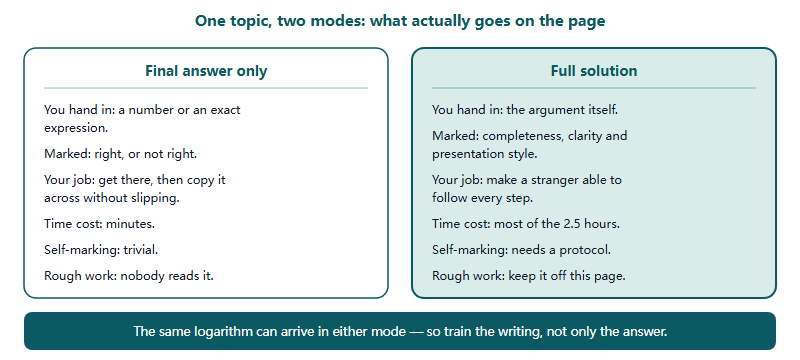
Second, the same topic appears in two different modes. Because part of the paper is final-answer only and part is full-solution, a logarithm question can arrive as a box wanting a number, or as a page wanting the rewriting written out. Those are two different jobs with two different failure modes, and students who train only the first are routinely surprised by the second. It is the reason this block rewards being trained as a block rather than as four separate revision topics.
Third, plan pre-calculus methods. Euclid is not a calculus paper — you are not expected to arrive holding it, and you should not build a method around it. That changes which tools you reach for. A maximum or minimum is found by completing the square, by bounding, or by an argument about where a vertex sits, not by differentiating. Confirm the current description of the contest on the official site, but plan on the assumption that your pre-calculus toolkit has to be genuinely fluent rather than a fallback.
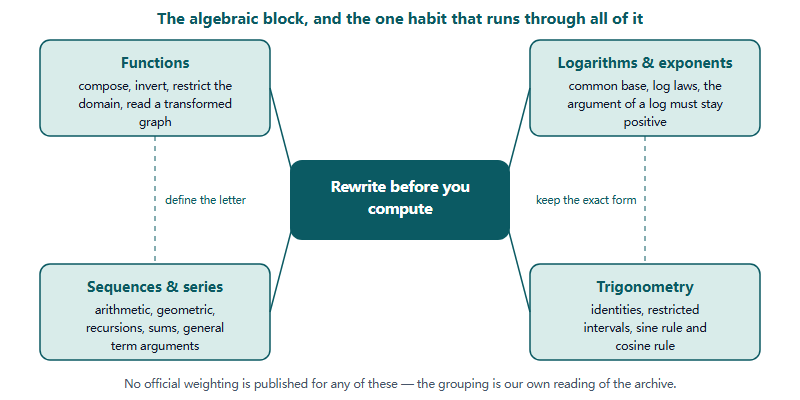
Functions: the domain is the part people forget to write
Function questions on Euclid tend to ask you to compose, to invert, to solve an equation involving a composition, or to work with a graph that has been transformed. The algebra is rarely the hard part for a student at a decent international school. The marks go somewhere else.
In final-answer mode, a function item wants a number and forgives everything else. In full-solution mode the same content asks you to write the reasoning down, and that is where two habits pay:
- Declare the letters. Open with a definitions line. If you are going to write about a composition, say which function is applied first, in words. It costs one sentence and removes an entire category of ambiguity from your page.
- Say what you did to the equation. Squaring both sides is legitimate and it also introduces roots that were never solutions. If you square, write that you will check for extraneous roots, and then actually check them and say which ones you rejected and why. Reporting both roots of a squared equation without testing them is one of the most common self-inflicted losses in this block.
The general principle: a restriction you used but never stated is invisible to a marker. If your argument only works for positive values, the page has to contain the sentence that says so.
Sequences and series: the sentence markers cannot accept
Sequence questions cover the familiar ground — arithmetic and geometric structures, recursions, sums, finding how many terms satisfy some condition — and they frequently touch number theory, since questions about which terms are integers or which are divisible by something sit naturally on a sequence.
The distinctive difficulty is that a full-solution sequence question usually asks you to establish that a pattern holds in general. And in our own marking the most common failure in this block is a version of one sentence: “the pattern continues.” It does not matter how obviously true it is. A marker reading for completeness cannot accept a claim about all terms that has been verified for the first five.
Two legitimate ways out, and you should be fluent in at least one:
- Close it algebraically. Derive an expression for the general term and argue from the expression, so that the claim about all terms becomes a claim about one formula.
- Use induction properly. If you reach for induction, write it out in full: the base case, the inductive hypothesis stated as a hypothesis, the step, and the conclusion. A half-written induction is often worth less than a careful algebraic argument, because it looks like a complete structure with a piece missing.
The other thing to watch is the boundary. Questions asking how many terms of a sequence satisfy a condition are decided by the first and last terms that qualify, and in our own marking, answers are lost by off-by-one errors more often than by anything conceptual. Write down the first qualifying index and the last, explicitly, before you count.
Logarithms and exponents: the algebra of rewriting
This is the most mechanical-looking topic in the block and the one where careless students lose whole questions rather than single steps. Typical demands: bring everything to a common base, apply the log laws in the right direction, solve an equation mixing exponential and linear terms, or handle a small system where two log equations have to be combined.
Three rules carry most of the marks.
- State the domain before you manipulate, not after. The argument of a logarithm has to be positive. Writing that constraint at the top is what lets you legitimately discard a root later; discovering it at the end and quietly dropping a root looks, on the page, exactly like an arithmetic mistake.
- Never divide by something that might be zero. If you divide both sides by an expression containing the unknown, the page must say why that expression cannot be zero — or must handle the zero case separately. This single line is, in our marking of student scripts, the most frequently missing sentence in the whole algebraic block.
- Keep the exact form. CEMC lists Euclid as “some calculators permitted” and publishes a separate policy for which ones; confirm the current list on the official site. But a decimal is not an argument. Where an exact expression is the answer, a decimal approximation is not a substitute for it, and a decimal appearing mid-argument usually destroys your ability to simplify later.
| Topic | Final-answer mode asks | Full-solution mode asks | Most common lost mark |
|---|---|---|---|
| Functions | A value, an inverse, a coordinate | The restriction you used, written as a restriction | Squaring, then reporting both roots untested |
| Sequences | A term, a sum, a count of terms | An argument valid for all terms, not the first five | “The pattern continues”, and off-by-one at the boundary |
| Logs and exponents | An exact value or an exact expression | Domain stated first, zero-division ruled out | Dividing by an expression that could be zero |
| Trigonometry | A value, an angle, a side length | The full solution family, then the interval imposed | Giving one angle when the interval holds three |
Trigonometry that stops short of calculus
Trigonometry on Euclid runs from identity manipulation through solving equations on a restricted interval to the sine and cosine rules, which is where this block hands over to geometry. Since you are not planning on calculus, the emphasis falls on rearrangement and on knowing which identity converts an unworkable expression into a workable one.
The structural trap is the interval. An equation in a trigonometric function generally has infinitely many solutions, arranged in families. A question restricts you to an interval, and the correct method is: solve for the whole family first, then impose the interval, then list every survivor. Students who solve for one principal value and stop are not making a mistake of understanding — they are making a mistake of procedure, and it is worth building the two-step habit deliberately, because it costs nothing when the interval happens to contain only one solution.
On the page, the sentence that earns the completeness mark is the one naming the interval you are working in and the one confirming which members of the family fall inside it. Where a diagram is involved — a triangle with the cosine rule, say — label it, and state which angle you are calling what before the algebra starts. The connection between an unlabelled diagram and a lost mark is direct, and it is the same mechanism described in our guide to how step marks work: what is not on the page cannot be credited.
How to train the block in one term
A workable pattern, and the one we run with students who have a term before the sitting:
- Weeks one to three — separate the modes. Take one topic at a time and do a set of short final-answer items for speed, then take two questions from the same topic and write them out as if they were full-solution items, even if in the original paper they were not. Writing out an item that did not require writing is the cheapest way to build the habit.
- Weeks four to six — hunt the missing sentence. Work through mixed algebraic questions and, for each, identify the one sentence that carries the argument: the domain statement, the case list, the interval. Underline it. If you cannot find it, your argument does not have one yet.
- Weeks seven onward — full papers, in order. Sit complete papers under time and mark them properly. The block stops being a topic at this point and becomes a time-budget question, because the algebraic middle is where most students discover that a clean argument takes longer to write than to find.
One planning note that sits outside the mathematics: none of this matters if the administrative side is not settled, because there is no individual registration route into Euclid and entry runs only through a school or test centre. If that is not yet arranged, deal with it first — the 2027 key dates set out the sequence and the deadlines, which fall well before your revision peaks.
A few questions we are asked repeatedly about this part of the paper:
Does CEMC publish a topic list or weightings for Euclid?
It names eight topic areas in its own Euclid preparation material, but publishes no percentage weighting. Any percentage breakdown you see is an estimate, so build your plan from past papers instead.
Does Euclid require calculus?
Plan pre-calculus methods: complete the square, bound, or argue about a vertex rather than differentiate. Confirm the current description on cemc.uwaterloo.ca.
Why do I lose marks when my final answer is correct?
Full-solution items are assessed on completeness, clarity and presentation style, so an unwritten step costs marks even with the right answer.
Do I need induction for sequence questions?
If you use it, write the base case and the inductive step in full. If you avoid it, close the general argument algebraically instead.
Editorial note: this guide is written by Hanlin Education for China-based international-school students. Contest format, dates, fees and calculator policy are set by the organiser and change between cycles — confirm current details on cemc.uwaterloo.ca before you act on them. Corrections are issued within 7 working days of being reported.