In the world of mathematics competitions, the Euclid Mathematics Contest, organized by the University of Waterloo, is renowned for its high prestige and its emphasis on in-depth logical reasoning. It has become a “golden touchstone” for applications to top global science and engineering programs. For the first 7 questions, many students can achieve solid scores with a strong foundation in high school mathematics and standardized solution steps. However, once you enter the final problem section—Questions 8 to 10—the style changes dramatically. These challenging final problems are the true differentiator that separates “average participants” from the “top 5% globally / Honour Roll” elite.
So, where exactly do the difficulties lie in the Euclid final problems? What are the problem-solving approaches and techniques for achieving a high score? Today, we will break down each of these aspects for you in detail.
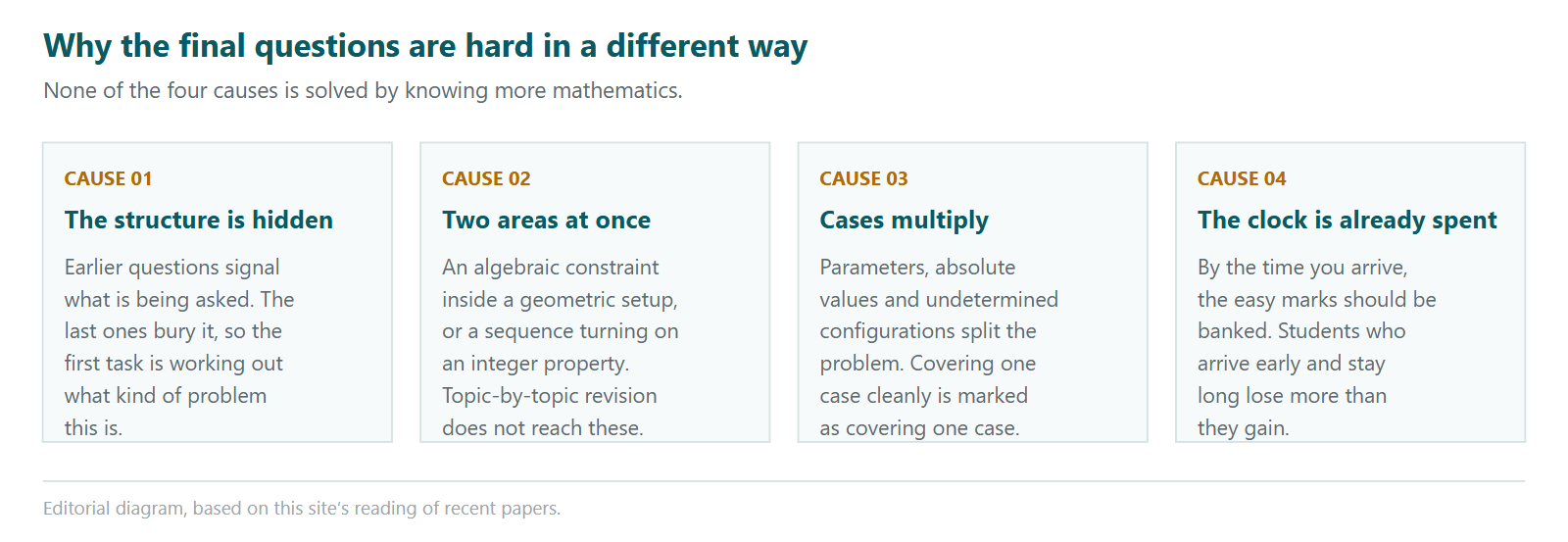
I. The Four Core Difficulties of the Euclid Final Problems (Q8–Q10)
Many students feel at a loss when facing the final problems. The root cause lies in the fundamental difference in design logic between these problems and the earlier ones:
“Information Fog” and Symbolic Abstraction: The final problems rarely present clear numbers or simple function expressions directly. Instead, they introduce complex dynamic parameters, multi-layered nested sequences, or abstract geometric transformations. The problems often set up barriers through lengthy English contextual descriptions, and the first challenge for candidates is to accurately translate everyday language into mathematical language.
“Strong Coupling” of Multi-Module Knowledge: The final problems rarely test a single knowledge point in isolation. They often intertwine algebra with geometry, number theory with functions, or probability and combinatorics with sequences. For example, the underlying derivation of a geometry final problem might ultimately require the use of the discriminant of a quadratic function or inequality scaling.
High Demands for Logical Self-Consistency and Classification Discussion: As parameters change, the positional relationships of figures or the solution sets of equations may encounter discontinuities. The final problems are particularly fond of examining “critical points” and “multi-case classifications.” Missing even one extreme case (such as boundary conditions or degenerate figures) can cost you the entire problem.
The Dual Limits of Psychology and Time: By this point, candidates have usually expended a significant amount of energy and time. Faced with complex final problems, they often experience psychological fear, leading to blocked thinking and chaotic derivations.
II. Four High-Scoring Problem-Solving Techniques to Crack the Final Problems
When faced with what seems like an insurmountable final challenge, top scorers do not possess superpowers; rather, they have mastered a set of mature “dimensionality-reduction methodologies”:
1. Start with the Special Value Method
When you are faced with an abstract final problem involving a general variable n or complex functions and have no clue where to begin, never stare blankly at the abstract symbols.
Operation: Assign a few extreme, simple special values to the variables. By manually calculating specific numerical values and observing the evolutionary patterns, you can “guess” the general conclusion.
Competition Value: The Euclid Contest awards marks step by step. Even if you cannot complete a rigorous final proof, using the special value method to clarify the direction of the conclusion and demonstrating your reasoning for simple cases on your answer sheet can earn you valuable partial marks.
2. Structural Dimensionality Reduction and Sub-Problem Decomposition
The final problems are usually divided into several sub-questions (e.g., (a), (b), (c)). Note: In the vast majority of cases, the preceding sub-question serves as a “stepping stone” or “hint” for the subsequent one.
Operation: If you get stuck on part (b), go back and see what conclusion you proved in part (a). The problem setter often uses part (a) to guide you toward establishing a specific algebraic identity or geometric model, and part (b) usually only requires you to generalize or substitute that model. Breaking a large problem into independent “sub-tasks” can effectively reduce psychological pressure.
3. Graphical Sensitivity and Geometric Intuition
If the final problem appears in the geometry module (which is often the case for Q9 or Q10), never rush to set up a massive Cartesian coordinate system and brute-force your way through (Analytic Geometry Often Leads to Algebraic Nightmare).
Operation: Before you start writing, use a ruler and compass (or draw accurately on scrap paper) to create a standard sketch. Observe whether the figure contains hidden congruent triangles, similar triangles, concyclic points, or symmetries. Many extremely complex algebraic geometry proofs can be instantly “dimensionally reduced” if you can keenly spot an auxiliary circle.
4. Extreme Thinking and Boundary Awareness
The most common place to lose marks in the final problems is “missing solutions.”
Operation: When you derive an algebraic inequality or find the maximum/minimum of a function, be sure to ask yourself: “When the variable tends to infinity, tends to zero, or when the figure degenerates into a straight line, does this conclusion still hold?”
Frequently Asked Questions
Why are the last questions so much harder?
They are built differently. Earlier questions tell you roughly what is being asked; the final ones bury the structure in the setup, so the first task is working out what kind of problem it is. That step has no formula. It is why students who are fluent at technique can still stall at the start of Question 9.
How do strong scorers approach them?
By reducing before solving. Try small cases to see the pattern, restate the problem in your own notation, and look for the constraint that does the real work. Most of these problems become ordinary once the right reduction is found, and finding it is a skill built by seeing many of them rather than by learning a method.
Is it worth spending exam time on them?
Only after the rest is secure, and only within a set budget. The opening of a hard question often carries marks for setting it up correctly, so a disciplined ten minutes can be productive. An undisciplined thirty minutes, spent while easier marks sit unclaimed elsewhere, is the most common way strong students end up with a middling score.