In the landscape of international competitions and applications to top overseas universities, the Euclid Mathematics Contest, organized by the University of Waterloo, stands as an unavoidable milestone. Many students who are passionate about mathematics often harbor doubts when facing this competition: “Is my math skill just ‘average’—am I suitable to take the Euclid? How valuable is this contest really, and is it worth my time and effort?”
Today, we will provide you with an in-depth analysis of this much-discussed topic from three dimensions: the compatibility of your mathematical foundation, the nature of the competition, and its value for university admissions.
I. Can Students with “Average” Math Take the Euclid?
First, a core myth needs to be debunked: the Euclid Mathematics Contest is not an exclusive game for “math prodigies.” If your school math grades are in the “upper-middle” range (for example, you are among the top students in your class, have a good grasp of basic functions and algebra, but are not at the level of the national Olympiad team), you are fully qualified and capable of taking on the Euclid. The reason lies in the fundamental difference between its problem design and the “exam-oriented Olympiad” style found in some countries:
1. It does not test obscure or trick questions: The vast majority of Euclid problems are based on the core high school curriculum (algebra, geometry, trigonometry, sequences, etc.). Unlike some high-difficulty contests, it does not require you to master obscure, out-of-syllabus theorems.
2. It is a marathon of “thinking and expression”: The Euclid’s scoring system is highly inclusive. The entire paper consists of 10 questions, with the first 5–6 questions being of basic to moderate difficulty. As long as you have a solid understanding of the fundamental concepts, scoring half the points is not out of reach.
3. It places greater emphasis on “process marks”: Many students with average math skills in some education systems are used to “plugging into formulas for instant answers.” The Euclid, however, awards marks step-by-step. As long as you present a rigorous logical argument, even if the final answer has minor flaws, you can still earn a significant portion of the process marks. For students with average math skills, simply by changing their problem-solving habits and focusing on expressing their process, they can often achieve results in the Euclid that exceed their expectations.
II. How Valuable Is the Euclid Contest Really?
Among the many North American mathematics competitions, the value of the Euclid lies in its unique “academic authority” and “broad recognition”:
1. A “Hard Currency” for STEM Programs in Canada and North America: The University of Waterloo enjoys a stellar reputation in computer science (CS) and mathematics in North America and globally. The Euclid Mathematics Contest is precisely an official entrance selection and scholarship assessment standard hosted by this university. If you are applying to the University of Waterloo for mathematics, computer science, or engineering, your Euclid score is almost an “invisible threshold.” In today’s fiercely competitive admissions landscape, an outstanding Euclid scorecard directly demonstrates your mathematical potential to admissions officers.
2. An “Academic Endorsement” for U.S. Top 30 Applications: For applicants targeting top American universities, while the AMC 12 may be more widely known, a top 25% or even top 5% honor certificate from the Euclid also carries significant weight. It proves to U.S. admissions officers that you not only excel in school academics but also possess the rigorous logical reasoning skills to tackle university-level mathematical challenges.
3. A Transformative Shift from “Exam-Taking” to “Academic” Thinking: The greatest value of the Euclid lies not in the certificate itself, but in the way it reshapes your mathematical thinking. It forces you to abandon the inertia of mindless problem-drilling and learn how to prove a mathematical truth using clear, precise, and logical English reasoning. This ability is precisely the core competency you will need when studying STEM subjects and writing academic reports in university.
III. How Can Students with Average Math Skills Achieve a Breakthrough in the Euclid?
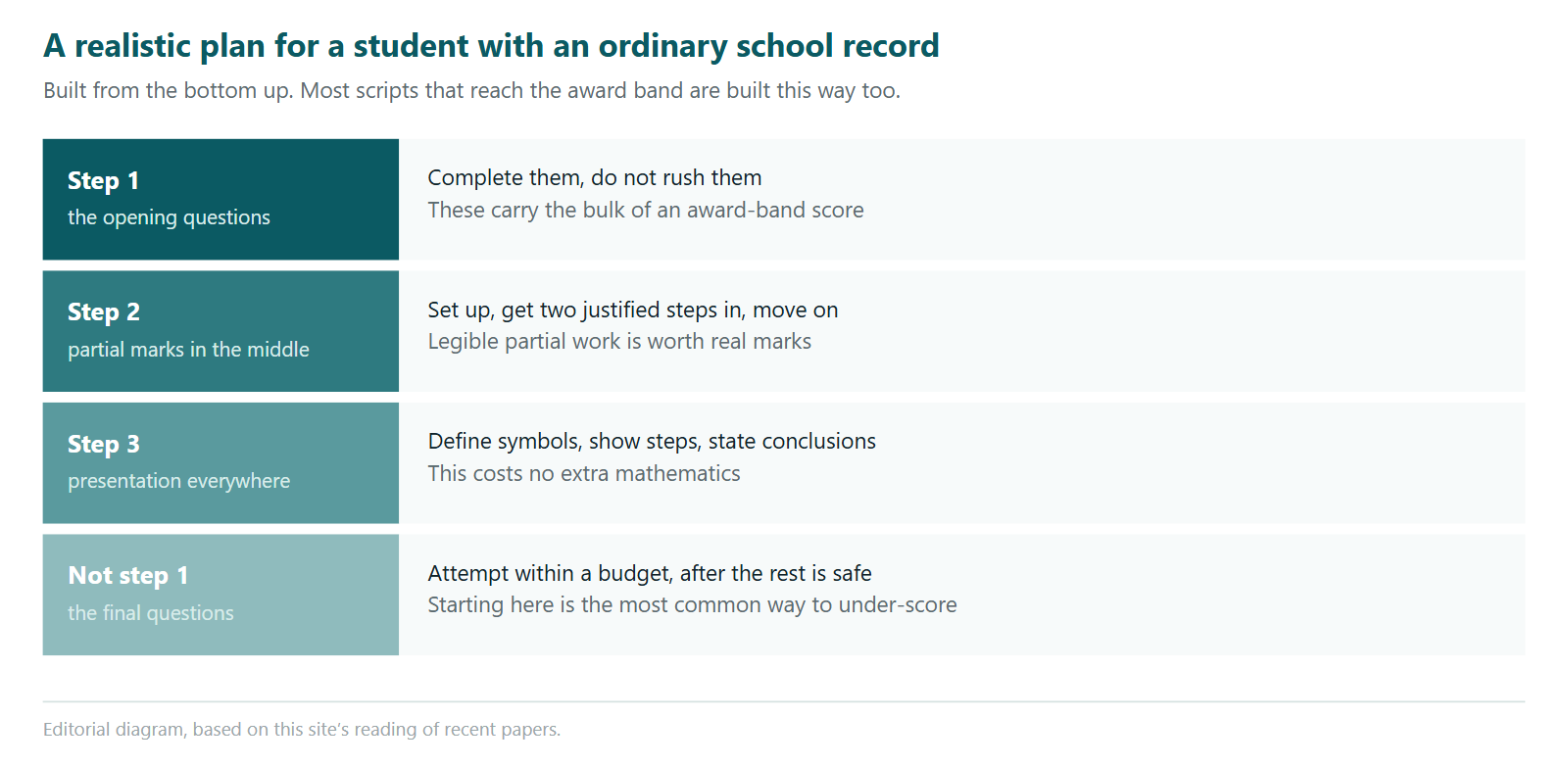
If your current math level is average, but you still aim to achieve a good result in the Euclid (for example, to secure a spot in the top 25% globally), we recommend the following tiered preparation strategy:
Phase 1: Secure the Fundamentals (Q1–Q5): Do not exhaust your energy too early on the last one or two “hellish” challenge problems. Focus your efforts on conquering the first 5 questions, ensuring you do not drop a single mark on these foundational problems. The content of these questions is mostly an extension of school knowledge, and students with average math skills can definitely master them through targeted practice.
Phase 2: Abandon Skipping Steps and Hone Your “Art of Exposition”: Change your writing habits. In your daily practice, force yourself to write out detailed variable definitions and logical connectors (such as “Since,” “Therefore”). Treat each problem-solving session as if you are telling a story to someone else, ensuring the completeness of your logical chain.
Phase 3: Intensively Study Past Papers and Official Solutions: The key to effective practice is quality, not quantity. Select past papers from the last 5 years. After completing them, be sure to carefully read the complete solutions (Full Solution) provided officially by the University of Waterloo. Observe how high-scoring model answers use concise mathematical language to approach and derive solutions, then imitate and internalize that way of thinking.
Frequently Asked Questions
Is this contest only for students who are already exceptional at mathematics?
No, and that assumption keeps suitable students out. A student in the upper-middle range at school has the topic base the paper assumes. What separates results is not raw ability but whether the student has practised writing complete arguments under time pressure, which is a trainable skill rather than an innate one.
What makes the result worth having?
It is set by a university faculty and marked to a published standard, so it says something specific and externally checked about a student’s mathematics. For applicants to mathematics-heavy programmes in Canada and North America, that specificity is the value — it is a different kind of evidence from a school grade average.
What should an average-record student do first?
Not harder problems. Start by writing out full solutions to problems you can already solve, then compare them against worked solutions to see which steps a grader expects stated. Once the writing is sound, add topic depth. Doing it in the other order produces students who know more and score the same.