Organized by the Centre for Education in Mathematics and Computing (CEMC) at the University of Waterloo in Canada, the Euclid Mathematics Contest attracts over 25,000 high school students from around the world each year. As an advanced competition for senior students, it not only tests creative problem-solving skills but also places “mathematical written expression” at its core.
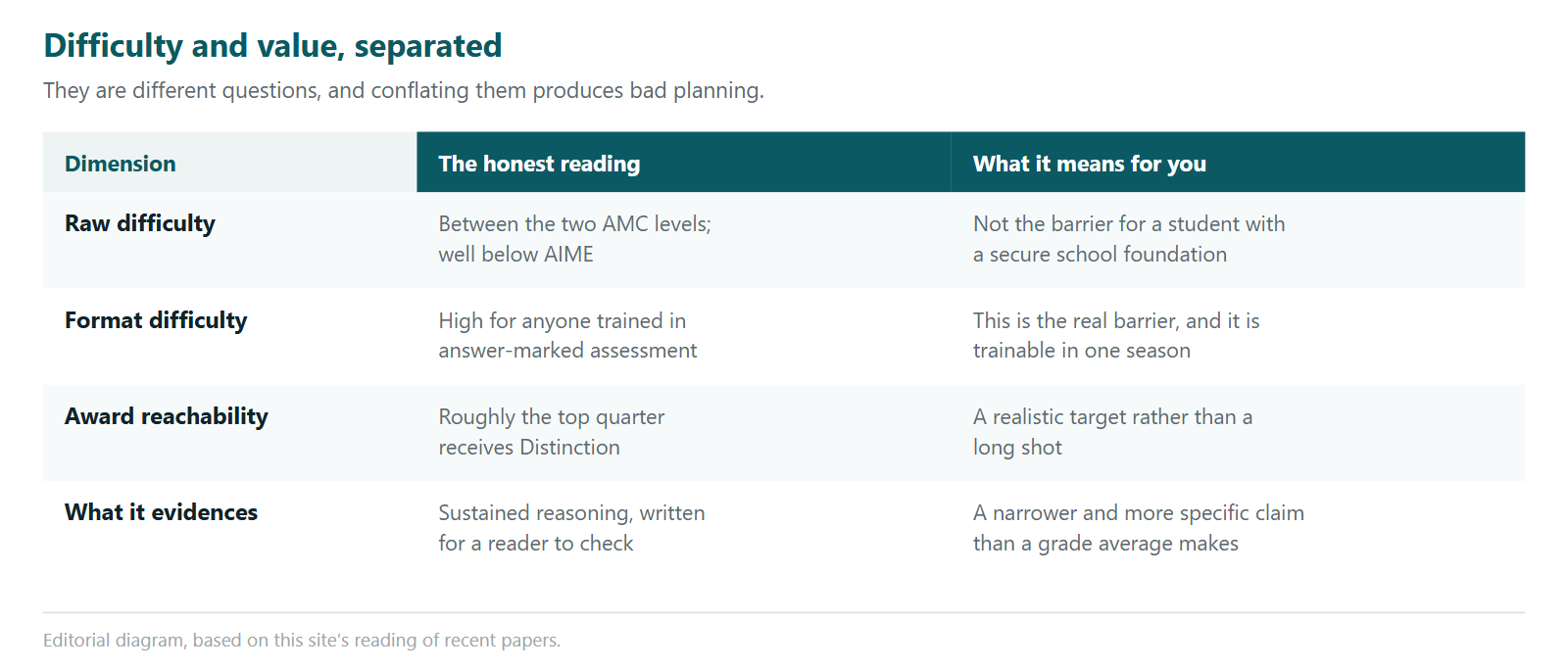
I. Euclid Contest Difficulty Breakdown
The difficulty of the Euclid Contest does not simply lie in the profundity of the topics, but rather in the comprehensive challenges across the following three dimensions:
Extremely High Level of Topic Integration:
The competition rarely tests isolated knowledge points. Many problems appear to have simple conditions, but the entry points are hidden. Students must determine for themselves whether to use algebraic transformations, function analysis, geometric modeling, case-based discussions, or even to start from special cases to identify patterns.
Strict Requirements for English Expression and Process Writing:
Unlike regular school exams that emphasize final results, the “Full-solution” questions in the Euclid Contest place great importance on the derivation process. Students must clearly write in English the basis for each step, the logical chain from conditions to conclusions, the completeness of classifications, and the verification of the final answer. Many students do not completely lack the ability to solve the problems, but lose a significant number of process marks due to skipped steps or unclear expression.
Significant Time Management Pressure:
Completing 10 long-answer questions in 2.5 hours may seem like ample time, but getting bogged down in the more difficult problems in the middle and later sections can easily lead to a collapse in overall scores. Preparation must train students to quickly assess problem difficulty, flexibly arrange the order of answering, and prioritize securing high-confidence scores.
II. Euclid Contest Value Assessment
The high value of the Euclid Contest is not only reflected in the awards themselves, but also in the way it helps students build mathematical abilities that closely align with university-level academic requirements:
Reshaping Mathematical Thinking and Expression Skills:
It moves beyond rote memorization of formulas and competition of calculation speed, requiring students to develop the ability to read English problem statements, sort through conditions, build models, and engage in rigorous logical expression within a limited time. This “English-language deep mathematical expression training” is a core competency for future university STEM studies and academic research.
A Strong Endorsement for Applications to Top Canadian Universities:
Although the CEMC officially states that the Euclid Contest is not a mandatory requirement for admission to the University of Waterloo, it is an important reference indicator for applying to its Faculty of Mathematics and various scholarships, directly demonstrating students’ outstanding abilities in mathematical problem-solving.
A Stepping Stone for UK G5 Universities and Oxbridge STEM Programs:
For students targeting top UK universities, the Euclid Contest is an excellent training ground. The function analysis, geometric reasoning, counting and probability, and number theory thinking involved in the contest have strong transferable value and practical help for subsequent preparation for UK advanced mathematics admissions tests such as TMUA, STEP, MAT, and ESAT, as well as the mathematical reasoning questions in Oxbridge interviews.
Frequently Asked Questions
Is the Euclid hard because the topics are advanced?
Not mainly. The syllabus stays within final-year secondary mathematics — algebra, geometry, trigonometry, logarithms, sequences and number theory. The difficulty comes from combination and from communication: problems that pull two areas together, and marks that follow what you wrote rather than what you concluded. A student who knows every topic on the list can still score modestly if their written argument does not hold together.
Where does it sit against other contests?
In practice it sits between the two AMC levels in raw difficulty, but the comparison is imperfect because the two ask for different things. A multiple-choice paper rewards speed and pattern recognition; a full-solution paper rewards decomposition and clear exposition. Students strong at one are often surprised by the other, which is precisely why sitting both is informative rather than redundant.
What does the contest build that a school course does not?
The habit of writing mathematics for a reader. School assessment usually asks for a correct answer; this paper asks for an argument someone else has to follow and mark. That habit transfers directly into university problem sets and proof-based courses, which is the honest case for the contest beyond the certificate itself.