The Euclid Mathematics Contest, organized by the Centre for Education in Mathematics and Computing (CEMC) at the University of Waterloo in Canada, is one of the most influential high school mathematics competitions globally. Unlike the AMC series, which focuses on multiple-choice questions, the Euclid Contest is entirely composed of long-answer questions that assess students’ mathematical reasoning and expressive abilities. It is often referred to as the “writing test of the mathematics world.” For students aiming for CS, mathematics, or engineering programs at Canadian universities, or those hoping to stand out in a differentiated for top-tier schools, this is a strategically valuable competition.
I. Three Types of Students Who Should Plan for the Euclid Contest
Students with solid in-school math but limited competition experience: The Euclid Contest does not rely heavily on extensive problem-drilling or speed-based techniques. It places greater emphasis on logical derivation and written expression, making it accessible for students with a strong foundation but no systematic exposure to competitions.
Students whose AMC performance fell short of expectations and are looking for a different direction: Students who may have struggled in the AMC due to time pressure or multiple-choice strategies, but who possess a solid mathematical foundation, can find their strength in the Euclid’s long-answer format.
Students aiming for top Canadian universities: The University of Waterloo places significant weight on Euclid results when admitting students to its CS, mathematics, and engineering programs. For some majors, the score is even considered a hard reference point for admission.
II. Key Information for the 2027 Euclid Contest
Exam Date: April 7, 2027 (non-North American regions, including China)
Registration Deadline: March 11, 2027
Registration Method: Registration must be completed through schools or official partner test centers. Individual direct registration is not accepted.
Preparation Advice: For families planning to participate, starting preparation six months in advance is the most comfortable timeline.
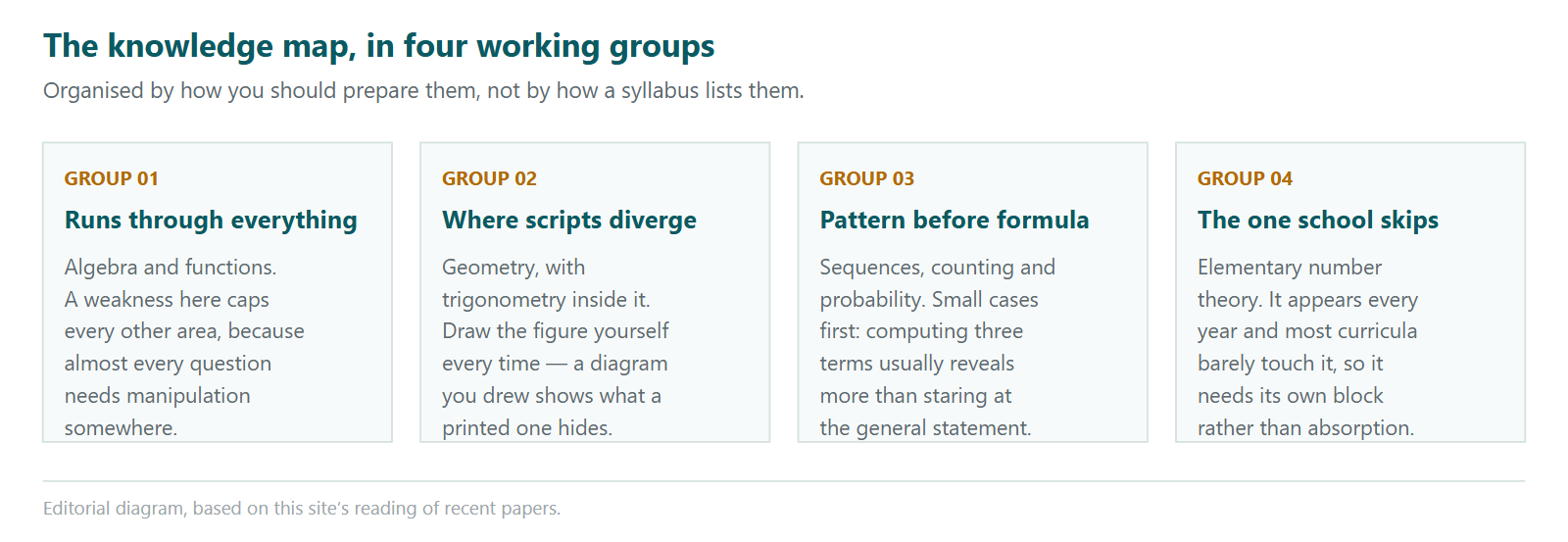
III. Euclid Contest Knowledge Map: Six Core Modules
The Euclid Contest does not simply test A-Level, IB, or Canadian high school mathematics problems verbatim. Instead, it places core high school mathematics content into more open-ended, comprehensive questions. The official CEMC preparation materials cover the following topics:
Algebra and Functions: Equations, inequalities, function graphs and properties, polynomials, exponents, logarithms, and identity transformations. Students cannot simply plug into formulas; they must understand algebraic structures and know when to substitute special values, when to transform expressions, and when to establish functional relationships.
Trigonometry and Geometry: Trigonometric functions, analytic geometry, circles, similarity, area, coordinate methods, and geometric proofs. The difficulty does not lie in the number of topics, but in the ability to translate visual observations of figures into clear mathematical derivations.
Sequences and Series: Recursion, summation, arithmetic and geometric sequences, pattern recognition, and general proofs. Sequence problems in the Euclid often combine with algebra, functions, or counting. Students must first discover patterns and then justify why those patterns hold.
Counting and Probability: Permutations and combinations, case classification, probability models, inclusion-exclusion principles, and recursive counting. These problems may not rely heavily on complex formulas, but they severely test the completeness of classification, the thoroughness of condition checking, and the rigor of expression.
Number Theory: Divisibility, remainders, prime numbers, parity, factors and multiples, perfect squares, and digit problems. Many students struggle with this area initially because it differs significantly from school mathematics and heavily tests observational skills and accumulation of methods.
IV. Preparation Strategy: Intensive Work on Past Papers + Imitating Official Solutions
The most efficient preparation path is: intensive work on past papers from the last 5 years + imitating the logic of official solutions. This can be broken down into two steps:
First, solve problems without time limits: focus on understanding the problem structure and solution approach, without pursuing speed. Then, review against the scoring criteria: practice identifying “which key phrases must be written” to ensure you do not lose process marks.
Three Common Pitfalls to Avoid:
- Pitfall 1: Thinking that, like the AMC, success depends on problem-solving speed. This is wrong. The Euclid tests the depth of derivation, not speed.
- Pitfall 2: Obsessing over the last two problems (Q9-Q10) while neglecting the first eight. Securing the first eight questions gives you a baseline of 60+ points, which is far more cost-effective than obsessing over the final challenging problems.
- Pitfall 3: Writing only the final answer without showing the process. Process marks account for more than half of the total score; losing them is a significant loss.
V. Deep Mutual Reinforcement with In-School Curriculum: Preparation Is Not a Loss
Many parents worry that “additional competition preparation will drag down in-school performance.” However, the opposite is true. The topics covered by the Euclid Contest—functions, polynomials, trigonometry, sequences, analytic geometry, and number theory—overlap heavily with AP Calculus, IB HL Math, and A-Level Further Mathematics. The preparation process itself serves as an early and thorough mastery of these courses, and the skills gained can boost in-school GPA and standardized test scores.
On a deeper level, the Euclid Contest is essentially an “English-language deep mathematical expression training.” Students are not practicing problem-solving speed; they are practicing how to clearly articulate their thoughts and rigorously present their proofs. This skill will continue to benefit students throughout university-level STEM studies, as well as in writing papers and conducting research in the future. So even if you do not ultimately reach the top 5%, the training itself is already immensely valuable.
Frequently Asked Questions
Which students should plan for this contest?
Three profiles fit it well. Students with solid school mathematics but no competition background, because the paper rewards foundation and reasoning over trained contest technique. Students aiming at North American programmes who want an external data point. And students who want one clearly defined target rather than an open-ended contest programme.
What are the key dates and how do I enter?
The 2027 paper is written on April 7 for regions outside North and South America, China included, and April 6 in the Americas. The organiser’s ordering deadline is March 11, 2027. Entry is only through a school that holds an account or through an authorised test centre — there is no individual sign-up. Confirm the current dates before planning around them.
What does the preparation actually consist of?
Past papers worked properly, which means writing each solution out in full and then comparing it against a worked solution — not just the final value. The comparison is where the learning is: it shows which steps a grader expects to see stated. Our collected 1998-2026 set is free to claim by scanning the code on this page.