When it comes to international mathematics competitions, many parents’ first reaction is AMC, AIME, and other “high-difficulty, high-investment” events, feeling that their child is “not a competition and probably has no chance.” But in fact, the Euclid Mathematics Contest (Euclid) is precisely the “blessing for non-competition-oriented students” — it does not pursue advanced skills, does not rely on talent, but rather emphasizes “the steadier, the better.” If you are hesitating about whether to let your child participate in an international math competition, or worry that investing a lot of time might not yield an award, Euclid may be the most suitable choice.
I. These Three Types of Students Are Especially Suitable for Euclid
1. Students with a solid foundation in schoolwork who are not traditional competition participants
The Euclid Contest does not blindly pursue advanced competition techniques, but places more emphasis on students’ mathematical foundation and logical reasoning abilities. For students in the first or second year of high school who have excellent math grades, clear logical thinking, but lack systematic competition training, this is an excellent entry point.
2. Students with good English skills who intend to study in North America / Canada
Euclid scores enjoy a very high level of recognition among North American universities and are a “hard currency” for STEM program applications. Especially for students targeting the Faculty of Mathematics and Faculty of Engineering at the University of Waterloo, this competition result is a core reference indicator for admission evaluation and the awarding of entrance scholarships.
3. Students seeking high cost-effectiveness and hoping to quickly enhance their competition profile
Compared to high-intensity competitions like AMC12 and AIME, the Euclid Contest is more moderate and stable in difficulty, with an overall difficulty level between AMC10 and AMC12. It has a short preparation cycle and a very high input-output ratio: the top 25% globally can obtain a Certificate of Distinction. For domestic students with strong mathematical test-taking abilities, after only short-term targeted training to adapt to North American mathematical logic and English expression, they can achieve impressive awards at a relatively low time cost, adding important weight to their academic applications.
II. Difficulty Positioning: Between AMC10 and AMC12, Top 25% Can Win an Award
Many parents are concerned: how difficult is Euclid really? Objectively speaking, Euclid’s difficulty lies between the American AMC10 and AMC12. Its total score is 100 points, with a test duration of 2.5 hours, consisting of 10 long-answer questions, each containing 2-3 sub-questions, progressing from simple to difficult.
More importantly, Euclid’s award threshold is relatively friendly — being able to reach the top 25% will earn you a Certificate of Distinction. For domestic students, whose mathematical test-taking abilities are inherently strong, after short-term training to familiarize themselves with North American mathematical problem-setting logic and answer standards, winning an award is not difficult.
Looking at the historical score lines, Euclid’s scoring system is very stable. Based on data from 2019 to 2026, the fluctuations in the average score and the top 25% award line have always been controlled within 1-3 points, ensuring the award’s value and fairness remain consistent:
- Certificate of Distinction (Top 25% Globally): 66 points
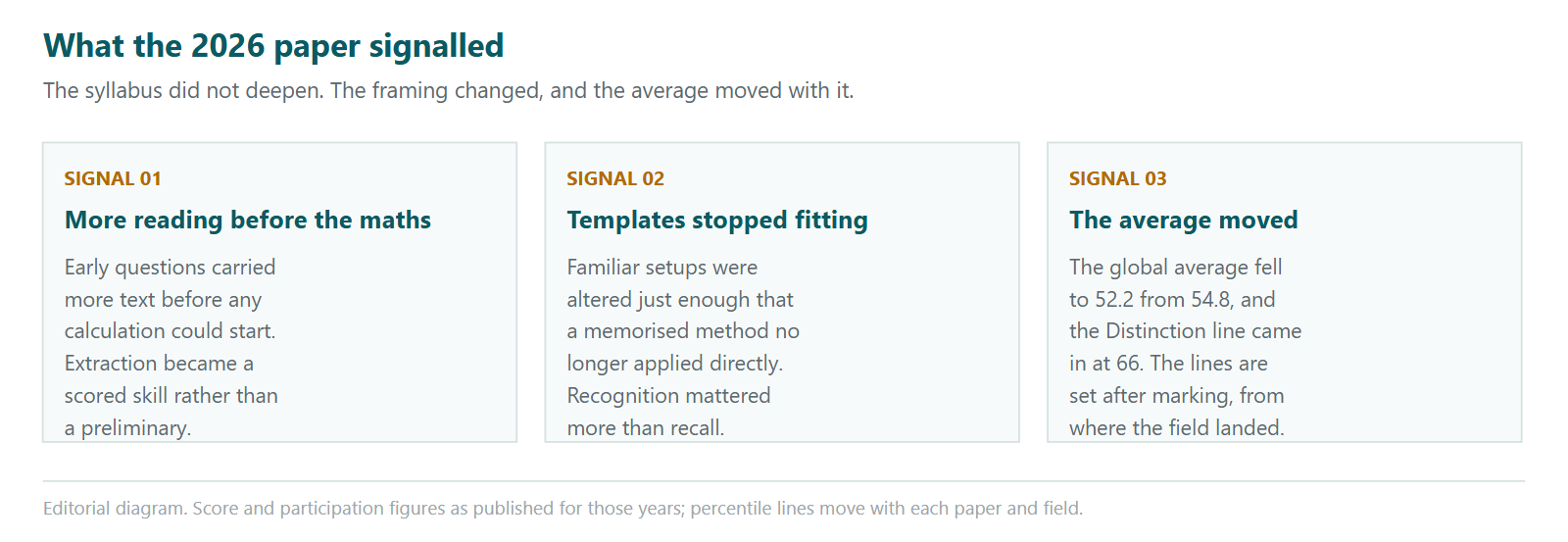
- Global Average Score: 52.2 points
- School Medal Champion (School Champion Award): 52 points
The slight decrease in the 2026 score line is not because the questions became easier, but a natural result of adjustments in question-setting style.
III. 2026 Euclid Contest Trends
The 2026 Euclid Contest has revealed clear question-setting trends, and students preparing for future contests need to adapt in advance:
Signal 1: Emphasis on Understanding, Not Routines
Questions are reducing the direct application of single knowledge points, requiring students to truly grasp mathematical definitions and derivation processes, rather than relying on template-based problem-solving. This means the strategy of “brute-force practicing question types” is becoming ineffective; understanding the essence of concepts is the key to scoring.
Signal 2: Cross-Section Integration
Euclid is breaking down the barriers between algebra, geometry, probability, and other modules, with the proportion of multi-knowledge-point crossover questions significantly increasing. For example, the combination of analytic geometry and probability is becoming more common, more closely resembling the thinking patterns of university-level mathematics. Students need to possess the ability to “call upon knowledge across modules.”
Signal 3: Geometry Questions “De-Modeling”
The fixed geometric models commonly seen in traditional competitions are decreasing, replaced by requirements for students to perform rigorous derivations by establishing coordinate systems and using proportional relationships. This places higher demands on spatial imagination and the completeness of logical chains.
IV. Advice for Parents and Students
If you match any of the following profiles, it is recommended to prioritize Euclid:
- Above-average math grades in school, but no competition background
- Targeting Canadian or North American undergraduate programs, needing academic profile enhancement
- Limited time, hoping to use 3-6 months of preparation in exchange for a highly recognized certificate
In terms of preparation strategy, it is recommended not to follow the old path of “sea of questions,” but instead:
- Thoroughly study official past papers and become familiar with North American mathematical answer standards (especially full English writing and derivation processes)
- Strengthen conceptual understanding, emphasizing the derivation logic of each theorem rather than memorizing conclusions
- Train cross-module thinking, deliberately practicing comprehensive questions combining algebra, geometry, and probability
Frequently Asked Questions
Which students is this contest actually suited to?
Three profiles recur. Students with a solid school record but no competition background, because the paper rewards foundation and reasoning more than trained contest technique. Students aiming at North American undergraduate programmes who want an external data point in their file. And students with limited time who want a single well-defined target rather than a multi-year contest programme.
How hard is it, in plain terms?
It sits between the two AMC levels in raw difficulty, but with a different shape: ten questions across 2.5 hours for 100 marks, where most of the marks follow the written argument. Roughly the top quarter of writers worldwide receive Distinction, so an award is a realistic target for a well-prepared student rather than a long shot.
What should preparation avoid?
Volume for its own sake. Working through hundreds of problems quickly builds pattern recognition that this paper does not reward. The better use of the same hours is fewer problems written out completely, marked against worked solutions, with attention to how each step was justified. Depth of a small number of problems beats breadth across many.