In the landscape of North American mathematics competitions, the Euclid Contest stands as a key benchmark for measuring high school students’ mathematical academic ability, thanks to its rigorous emphasis on written solutions and the endorsement of the University of Waterloo. Tens of thousands of top students participate each year, and one of the most central questions is: what does the “global top 25%” actually mean? How competitive is it for college applications? Today, we will provide an in-depth analysis of the value and application impact of the Euclid “global top 25%” from both quantitative and admissions officer perspectives.
I. The Value of the Euclid “Top 25%”: A Quantitative Measure of Ability
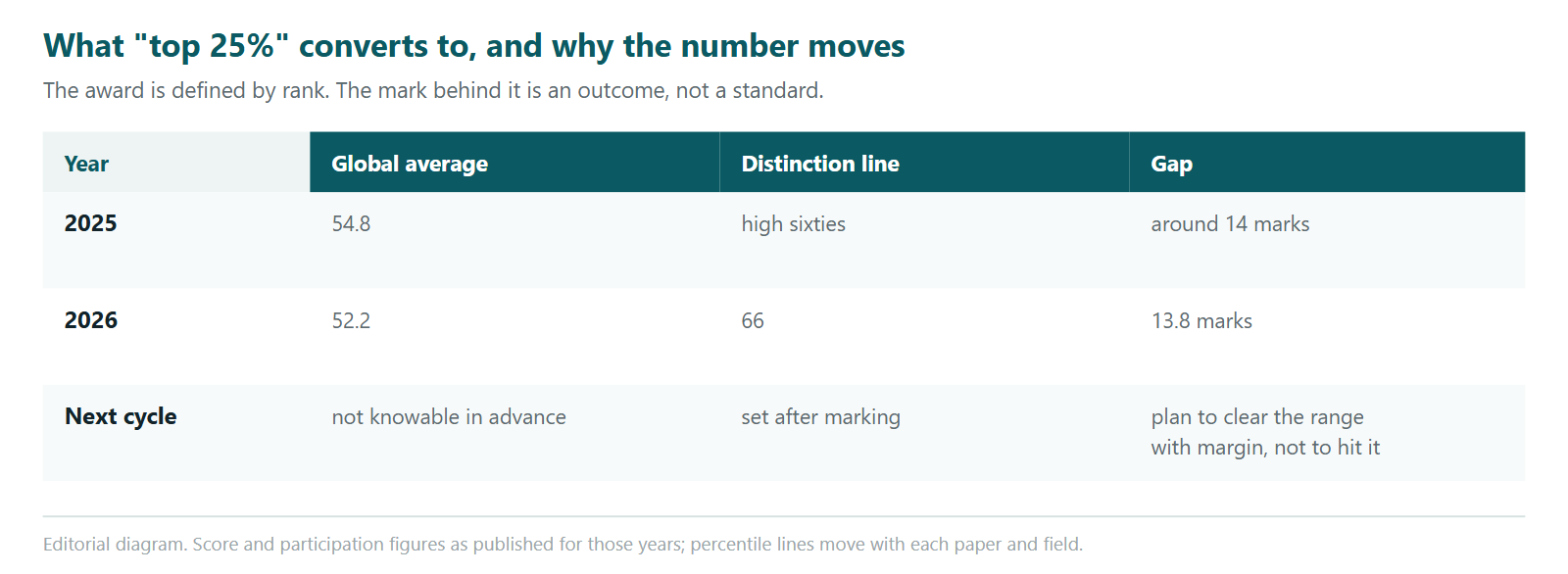
First, we need to clarify what the “top 25%” represents. The University of Waterloo typically awards a Certificate of Distinction to participants ranking in the top 25% globally.
The “Threshold” for the Elite Tier:
Participants in the Euclid Contest are generally already top math students from leading high schools, or candidates targeting STEM programs at top North American universities. Ranking in the top 25% among such a strong field proves that you have surpassed the vast majority of ordinary math competitors and possess a solid mathematical foundation.
Rigorous Proof and Logical Thinking:
The Euclid scoring system does not only look at the final answer, but focuses heavily on the logical steps. Reaching the top 25% typically means that, across all 10 problems on the paper, you were able to provide logically complete and well-structured solutions for at least half of the long-answer questions. This is not only a testament to your intelligence, but also a recognition of your “academic rigor and clarity of expression.”
II. College Application Competitiveness: Is It a “Must-Have” or a “Nice-to-Have”?
For students applying to STEM programs at North American universities—especially top Canadian schools and U.S. Top 30 universities—the top 25% award has a clearly defined value:
1. A “Direct Route” to Top Canadian Universities
If you are applying to Computer Science (CS), Mathematics, or Engineering programs at the University of Waterloo, the University of Toronto, or McGill University, the top 25% certificate is a highly persuasive bonus point. In the admissions review process at these universities, Euclid scores are not only recorded in your file, but in some scholarship evaluations, they can even carry a “decisive” or “priority admission” weight.
2. An “Academic Endorsement” for U.S. Top 30 Universities
For U.S. undergraduate applications, while the top 25% certificate is not an elite-level competition award (such as qualifying for the AIME), it demonstrates that you are “not just a high-scoring student, but one with the capacity to explore academic depth.” It provides excellent material for your personal statement, allowing you to showcase in your essay or extracurricular descriptions how you developed logical reasoning skills through the competition and how you have transferred those skills to other engineering projects or academic research.
III. In-Depth Analysis: How to Maximize the Impact of This Award?
Many students who earn the top 25% certificate simply attach it to their application like a piece of paper, which underestimates its potential. To maximize its impact, you need to:
Align It with Your Major:
Do not treat it as an isolated award. If you are applying for CS, emphasize in your essays how the competition strengthened your thinking on “algorithmic logic.” If you are applying for Engineering, highlight how you handled “mathematical modeling and boundary case discussions” with rigor.
Use It as Evidence of Your Abilities:
Treat the top 25% as proof that you possess “university-level preparedness.” In interviews, if asked about your academic background, confidently discuss the classification and discussion techniques you developed during the competition. This is far more convincing than simply stating your ranking.
Use It as a Springboard for Higher Challenges:
If you have already achieved top 25%, it means you have the potential to aim for the global top 5% (Honour Roll). In the following year, consider more rigorous training to aim for an even higher honor, which will add a powerful boost to your profile.
IV. Pitfall Avoidance Guide: Advice for Contestants
Keep Your Mindset in Check:
The top 25% is a great starting point, but do not become complacent. In the race for admission to top universities, it is only an “entry ticket,” not a “finish line.”
Avoid “Homogeneous” Competition:
If all applicants list the top 25%, how do you stand out? The answer lies in your growth story. In your resume, rather than just the award itself, it is more compelling to document how you overcame mathematical logic hurdles from middle school to high school, and how you progressed from only being able to compute answers to being able to write perfect proofs.
Stay Focused on Your School Grades:
No matter how outstanding your competition results are, your in-school GPA is always the “cornerstone” of your application. Never sacrifice your daily academic performance for the sake of the competition, as that would be putting the cart before the horse.
Frequently Asked Questions
What does the top 25% award actually certify?
It certifies that a writer finished in roughly the top quarter of the global field in that year’s contest. Because it is a percentile rather than a fixed score, the mark behind it moves from year to year — in 2026 it sat around 66 out of 100. What it says about a student is that they wrote sustained, readable mathematical arguments under time pressure, which is a narrower and more specific claim than a grade average makes.
Is it a must-have for a strong application?
No single contest result is a must-have, and nobody can tell you what one line contributed to a decision. What the award does is give a specific, externally checked data point in a file that is otherwise made of grades and self-description. It reads most clearly for applicants heading into mathematics, computer science, engineering or actuarial programmes, where the skill being certified matches the course.
How should the award be used once you have it?
Attach it to something. On its own it is a line in a list. Connected to what you did with it — a topic you chased afterwards, a problem you kept working on, a change in how you write mathematics — it becomes evidence of an interest rather than evidence of one good morning. Applicants who treat it as a full stop get less out of it than those who treat it as a starting point.