For many prospective high school students aiming for top North American universities, “what should I do during the summer after middle school?” is a strategic question that can determine the trajectory of their future applications. Many parents and students have a bold idea: is it feasible to start preparing for the Euclid Mathematics Contest before entering high school? The answer is yes, and not only is it feasible, it is also a plan with immense “tactical dividends.” However, the prerequisite is that you must have a scientific knowledge map and an entry pathway. Today, we will provide an in-depth analysis of the feasibility, necessity, and specific implementation plan for preparing for the Euclid Contest right after middle school.
I. Why Is “Right After Middle School” the Best “Breakthrough Point”?
The period from middle school graduation to the start of high school is the only “golden buffer zone” in the entire high school journey, free from any academic pressure and marked by highly active thinking.
A Window for Transforming Thinking: Middle school mathematics focuses on basic calculations and intuitive geometry, while the Euclid Contest demands rigorous argumentation and logical deconstruction. Using this time to reshape your mathematical logic before the intense academic competition of high school begins will allow you to demonstrate a “dimensionality-reduction” level of depth in your high school math classes.
Avoiding the Double Squeeze of “Competition and Schoolwork”: In high school, GPA is the cornerstone of your application. If you have to cope with heavy schoolwork and competition preparation at the same time in your first year, it is easy to fall into anxiety. Getting an early start means that in your first year of high school, you only need to “refine” your skills rather than “start from scratch.”
II. Euclid Prerequisite Knowledge Checklist: What Do You Need to Catch Up On?
The Euclid Contest is not an “out-of-syllabus” competition; it tests an in-depth exploration of high school mathematics knowledge. If you want to get started smoothly after middle school, you must focus on supplementing the following three knowledge areas:
1. Algebra Foundation: From Calculation to Structure
- Prerequisite Knowledge: Master the relationship between roots and coefficients of quadratic equations (Vieta’s theorem), translation and transformation of function graphs, and basic logarithmic operations.
- Key Point: The Euclid Contest particularly likes to test function extremum problems and the construction of algebraic expressions. You need not only to be able to calculate but also to understand the geometric meaning behind algebraic expressions.
2. Geometric Thinking: From “Intuition” to “Proof”
- Prerequisite Knowledge: Middle school geometry is the foundation, but the Euclid Contest requires a comprehensive understanding of circle properties (tangents, tangent-chord angles, power of a point theorem), as well as rigorous proofs of similar and congruent triangles.
- Key Point: Practice pure geometric proofs, reduce reliance on coordinate analytic geometry, and cultivate abstract spatial imagination.
3. “Introduction” to Number Theory and Combinatorics
- Prerequisite Knowledge: Basic divisibility properties, definition of prime numbers, and simple counting principles (permutations and combinations).
- Key Point: This is a weak area in the middle school curriculum. You can supplement your knowledge with books like “Introduction to Competition Mathematics” to build foundational combinatorial counting concepts (such as case-based discussion and the inclusion-exclusion principle).
III. From Zero to One: A Three-Month Advanced Path Plan
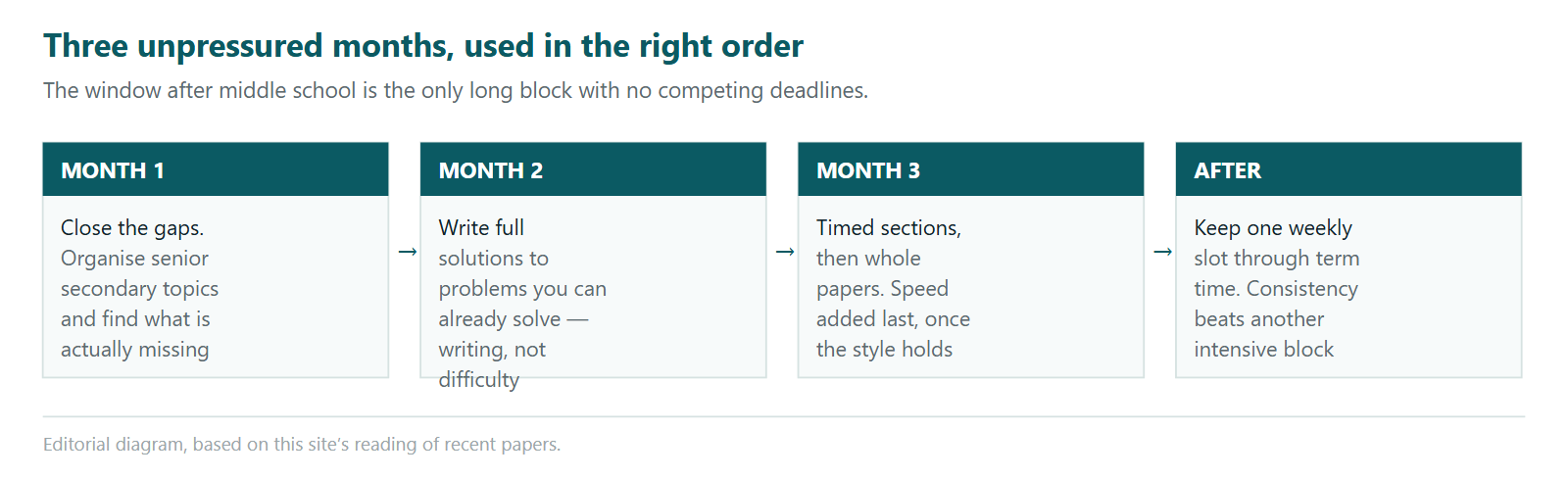
If you plan to use the summer for three months of intensive introductory training, we recommend the following pace:
Month 1: Fill in Knowledge Gaps
Systematically organize the high school mathematics basics not covered in middle school (especially functions and geometry).
- Key Task: Learn to use mathematical vocabulary in English (e.g., Derivative, Tangent, Sequence, Probability) and develop the habit of reading mathematical definitions in the original English.
Month 2: Introduction to Logical Argumentation
Do not focus on the quantity of problems solved; instead, intensively study the first three questions of past papers from the last five years.
- Key Task: Imitate the official Full Solutions provided by the University of Waterloo, practice writing standard proof steps, and break the middle school habit of “only writing the final answer.”
Month 3: Practice and Review
Conduct 2-3 full-length simulated tests.
- Key Task: Record every logical leap, categorize your mistakes into “case-based discussion, geometric proof, algebraic transformation,” and build a preliminary “competition knowledge map.”
IV. Pitfall Avoidance Tips for Beginners
Do Not Be Misled by “Calculators”: The Euclid Contest allows the use of calculators, but it tests logic. Do not try to rely on a calculator to solve mathematical challenges; the soul of the competition lies in the rigorous chain of argumentation.
Overcome the Fear of English Argumentation: Many students feel at a loss for words when writing their first English proof, which is perfectly normal. By imitating the fixed sentence patterns in the official answers (for example, “Since A is equal to B, then…”), you can quickly build up this “linguistic muscle memory.”
Cultivate a “Spirit of Exploration”: The difference between competition problems and exam problems is that competition problems do not have fixed solutions. When you get stuck, try changing your perspective (for example, turning a geometry problem into an algebra problem, or vice versa). This flexibility of thinking is the core value that the competition rewards.
Frequently Asked Questions
Is the summer after middle school a good time to start?
It is one of the few unpressured windows in the whole secondary run, which makes it useful for building foundations rather than revising them. The contest does not test out-of-syllabus material, so the work is depth on senior secondary topics rather than a separate olympiad curriculum. That is exactly the kind of work a free summer suits.
What needs to be in place first?
A working command of algebra and functions, comfort with geometric reasoning that is not purely computational, and enough trigonometry to read a problem statement. Sequences and elementary number theory can be built later. Starting before the algebra is fluent tends to produce frustration rather than progress.
What does a first three months look like?
Roughly: close the topic gaps in the first month, move to complete written solutions in the second, and start timed sections in the third. Resist starting with timed papers. Speed built on top of an argument style that will not score has to be unlearned later, and unlearning takes longer than learning.