As a premier mathematics competition hosted by the University of Waterloo in Canada, the Euclid Contest is a key credential for applications to STEM programs at top North American universities. The official 2026 score handbook has been released, showing a total of 23,985 participants worldwide. This year’s data not only signals a clear increase in difficulty but also introduces new demands on students’ foundational mathematical thinking.
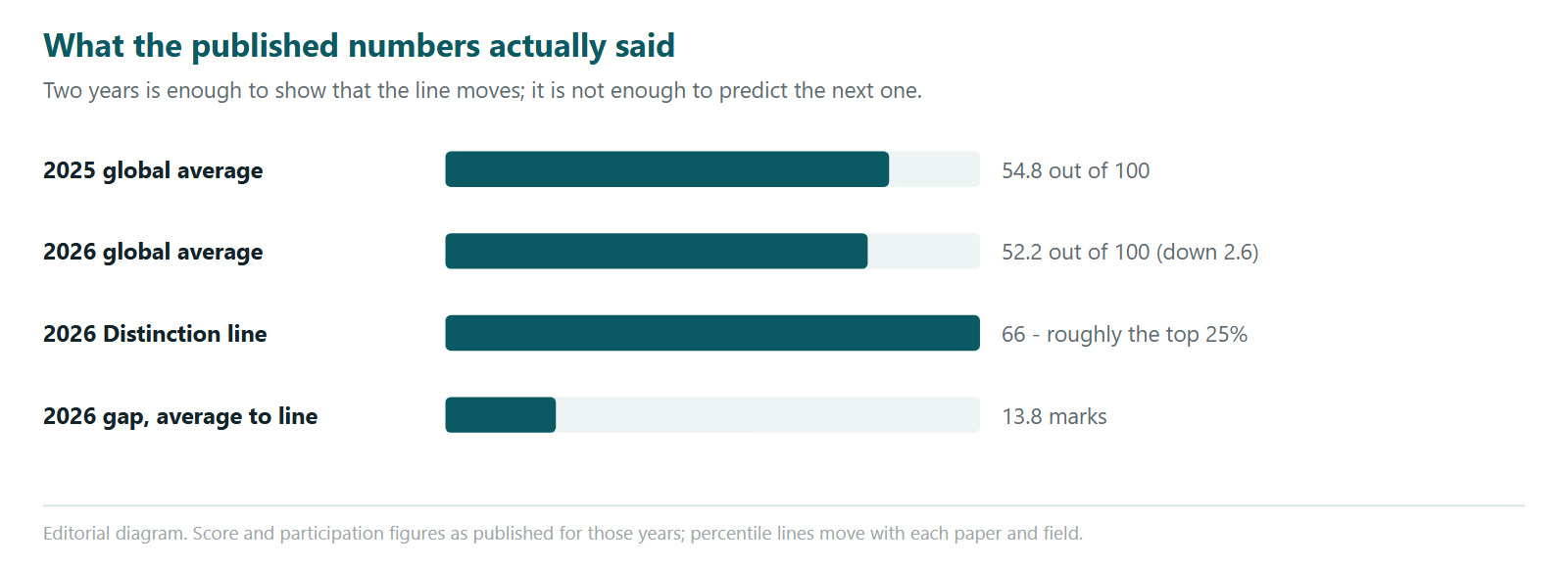
I. 2026 Euclid Contest Core Score Lines and Difficulty Signals
The 2026 Euclid Contest score lines show an overall downward trend:
- Global Average Score: 52.2 points (down 2.6 points from 54.8 in 2025).
- Certificate of Distinction (Top 25% Globally): 66 points (down 2-3 points from the typical 68-69 point threshold).
- School Medal Champion Baseline: 52 points.
Difficulty Signals Behind the Data:
Although the 66-point threshold is on the lower end of the five-year range, this does not mean the contest has become easier. On the contrary, the significant drop in the average score and the general pressure on high-score achievement directly indicate that the 2026 paper was more challenging overall. The Euclid score lines have historically remained highly stable (typically fluctuating within a 1-3 point range), which ensures the value of the awards. This year’s downward shift precisely reflects the increased differentiation among mid-to-high tier candidates.
II. 2026 Season Review: Three Core Trends
Based on official question average scores and candidate reviews, the 2026 Euclid demonstrated a clear “emphasis on thinking, de-emphasis on rote patterns” approach:
1. Higher Barriers to Problem Comprehension
The first six questions serve as the “foundation scoring zone” (totaling approximately 45-50 points) and still had relatively high average scores. However, this year’s foundational questions were not simple formula applications; they placed greater emphasis on deep understanding of mathematical definitions and logical reasoning. Many questions contained hidden logical traps, requiring a true grasp of concepts to avoid pitfalls.
2. Cross-Section Integration as a New Challenge
Question 7 became the “ability watershed” of the paper (with an average score of just 3.4 points). The intermediate-level questions clearly tilted toward “cross-section integration”—for example, combining analytic geometry with probability, or number theory with combinatorics. These questions required students to have a systematic knowledge framework and flexible transfer skills, causing many to start losing points here.
3. Geometry Questions De-Modeling
The proportion of geometry questions that relied on model-based shortcuts decreased, replaced by question types that emphasized “core competence.” Students needed to perform rigorous logical derivations by establishing coordinate systems, using proportional relationships, or constructing auxiliary lines. Meanwhile, the average scores for the final problems (Questions 8-10) were extremely low (totaling less than 4 points). Question 10, in particular, involved new definitions and combinatorial recursion, making simple problem-drilling no longer effective.
III. Score Planning and Preparation Advice
In response to the rising difficulty, future preparation strategies should shift from “covering everything” to “securing what you can,” with precise planning based on target score ranges:
1. Aiming for the Top 25% Award (66+ points)
- Scoring Strategy: Ensure full marks on the first 6 questions (approximately 50 points), aim for full marks on Question 7 (+10 points), and secure 6-8 process points on Question 8 through clear logical steps, while aiming for some process points on Question 9.
- Core Competency Focus: Prioritize breaking through cross-section comprehensive questions, and strengthen logical reasoning and step-by-step writing. The Euclid is a “process marks” contest—even if the final answer is wrong, clear logical steps can still earn substantial points.
2. Aiming for the School Medal Champion Award (52+ points)
- Scoring Strategy: Achieve over 90% accuracy on foundational and intermediate questions, ensuring no loss of basic points on the first 6 questions. Attempt to earn process points on Question 7, abandon Question 10, and use the remaining time to review the first 7 questions.
3. Long-Term Preparation and Deepening Knowledge
- It is recommended to start systematic contest preparation from Grade 9, building a complete knowledge framework early. Focus on training in number theory, combinatorics, and complex geometric proofs.
- Past papers are the best preparation material. Repeatedly reviewing mistakes and summarizing problem-solving strategies is more effective than blind practice.
- Students should view 52 points as the baseline for competency and 66 points as the threshold for proven ability. Strengthening logical writing skills on mid-to-late section questions is key to meeting the rising challenge.
Frequently Asked Questions
What was the Distinction line in 2026?
Sixty-six out of one hundred, against a global average of 52.2 — an average that fell about 2.6 points from the previous year. Distinction goes to roughly the top quarter of writers worldwide, so the line moves with the cohort and with the paper rather than sitting at a fixed number. Treat any published line as a description of one particular year, not as a target that will still be there when you sit.
Does a lower average mean the paper was harder?
Usually, but the useful question is where the marks were lost. In 2026 the fall was concentrated in comprehension: the early questions asked for more reading before any calculation could start. That is a different problem from the final questions getting deeper, and it changes what preparation should look like. It rewards slow, careful reading of the stem far more than another pass at hard algebra.
What score should I actually aim for?
Work backwards from what you want the result to say. Around the mid-sixties puts you in the Distinction band in a typical year. The eighties put you among the strongest writers in your cohort. The nineties are rare in any year. Pick the band first, then decide which questions you intend to finish properly — that decision matters more than how many you attempt.