In the landscape of international mathematics competitions, the Euclid Mathematics Contest, hosted by the University of Waterloo, has long been hailed as the “TOEFL of the mathematics world.” It serves as a gateway to top Canadian universities (such as the Computer Science and Mathematics departments at the University of Waterloo) and holds significant weight as an academic credential for applications to U.S. Top 30 and UK G5 universities.
I. Is Grade 9 the Right Time to Start Preparing for the Euclid?
The answer is a clear yes — and it is an extremely strategic “dimensionality-reduction” approach.
Many parents mistakenly believe that upper-grade competitions are out of reach for lower-grade students. However, the Euclid Contest has unique characteristics that make it particularly suitable for Grade 9 students:
High Knowledge Overlap: The vast majority of the Euclid’s core topics (such as algebra, quadratic equations, plane geometry, and analytic geometry) align closely with the core mathematics content of Grade 9 (the third year of Chinese middle school) through Grade 10 (the first year of Chinese high school). Grade 9 students, having just gone through the middle school entrance exams or the IGCSE transition in international schools, are at their peak in terms of memory and proficiency in these algebraic and geometric fundamentals.
No Calculus: Unlike many other upper-level competitions, the Euclid Contest strictly does not test calculus. This means it has no hard requirement for advanced mathematical knowledge, and Grade 9 students face no insurmountable “knowledge gap.”
High Fault Tolerance and Stress-Free Long-Term Preparation: The Euclid Contest allows students to register multiple times. Even if a Grade 9 student does not achieve the top 25% certificate (Distinction) on their first attempt, it serves as an invaluable full-scale practice run with high stakes. When they take the contest again in Grade 10 or 11, they will already possess the psychological advantage and experience of a “dimensionality-reduction” approach, dramatically increasing their chances of achieving a top 5% or even top 1% global honor.
II. A Complete Breakdown of Question Types and Scoring: How Is the Euclid Structured?
Knowing your enemy is half the battle. Before deciding to prepare, Grade 9 students must have a clear understanding of the Euclid’s paper structure:
Exam Duration: 150 minutes (2.5 hours, relatively ample time).
Total Score and Number of Questions: 10 long-answer questions, each worth 10 points, for a total of 100 points.
The Unique Dual Question Types:
- Light-graded (Direct Answer): Questions marked with a light bulb icon. For these, you only need to write the final correct answer in the answer box; the process does not count toward your score. A correct answer earns full marks immediately.
- Full-graded (Detailed Solution): Questions marked with a handwritten icon. These are standard long-answer questions requiring a complete, detailed solution process, including logical derivations and mathematical proofs. Incomplete steps or logical gaps will result in point deductions; even if the final answer is correct, you cannot achieve full marks without a proper process.
Key Scoring Strategy: The difficulty of the Euclid questions increases in a stepwise manner. Questions 1 through 7 are foundational to intermediate in difficulty, and Grade 9 students, through targeted training, can aim to achieve “near-perfect scores” on these. The difficulty begins to spike from Question 8 onward, with Questions 9 and 10 serving as the final challenges designed to identify top-tier mathematical talent.
For Grade 9 students, securely securing the first 7 questions (earning approximately 70 points) is enough to confidently cross the global top 25% award threshold, which has historically ranged between 65 and 70 points!
III. Core Topics Explained: What Areas Do Grade 9 Students Need to Strengthen?
While the mathematical foundation of Grade 9 covers a significant portion of the Euclid syllabus, achieving a high score requires systematic and targeted reinforcement in four key areas over the course of a year’s preparation.
1. Equations and Functions (Algebra & Functions): The Foundation of Questions 1–5
- Existing Grade 9 Knowledge: Quadratic equations, factorization, basic systems of linear equations in two variables.
- Key Areas for Extended Preparation: Students must deeply master Vieta’s theorem (relationships between roots and coefficients), the Factor Theorem for higher-degree equations, the basic laws of logarithms and exponential functions, and the Remainder Theorem for polynomial division. These are consistently tested in the first five questions.
2. Geometry and Trigonometry (Geometry & Trigonometry): The Core of Questions 3–7
- Existing Grade 9 Knowledge: Middle school plane geometry (congruence, similar triangles, Pythagorean theorem), basic properties of circles.
- Key Areas for Extended Preparation: The Euclid Contest has a strong focus on analytic geometry (slope of a line, distance formula, relationship between tangent values and slope). Furthermore, Grade 9 students must proactively study high school trigonometry, including the Law of Sines, Law of Cosines, and reduction formulas. Trigonometry is the most powerful “dimensionality-reduction” tool for solving complex geometry problems involving area or side lengths.
3. Sequences and Counting (Sequences & Counting): The Differentiator in Questions 4–8
- Existing Grade 9 Knowledge: Pattern recognition, basic enumeration methods.
- Key Areas for Extended Preparation: Students need to systematically master the general term formulas and summation formulas for arithmetic and geometric sequences. Additionally, they must systematically study combinatorics and basic probability. Euclid’s counting problems often involve complex case-based discussions, requiring Grade 9 students to develop logical rigor to ensure completeness without omissions or double-counting.
4. Number Theory and Mathematical Proofs (Number Theory & Proofs): The Final Challenge in Questions 8–10
- Existing Grade 9 Knowledge: Basic concepts of odd/even numbers, prime numbers, and composite numbers.
- Key Areas for Extended Preparation: This involves divisibility, congruence theory, and properties of perfect squares. More importantly, because the second half of the paper requires writing proofs in full English, Grade 9 students need targeted training in using standardized English mathematical language (such as “Let,” “Since,” “Therefore,” “Case 1…”) to construct logically complete and rigorous derivations.
Frequently Asked Questions
Is Grade 9 too early to start?
No, and starting early has a specific advantage: the contest rewards depth of reasoning rather than advanced syllabus content, so a younger student is not automatically outmatched. The organiser’s own position is that motivated students in lower grades are welcome to write. What a Grade 9 student gains is time — several cycles of practice before the year when the result actually matters to an application.
What does the paper look like?
Ten questions in 2.5 hours for a total of 100 marks, mixing final-answer questions with full-solution problems that are graded on the written argument. That structure is the reason an early start pays: the writing habit takes longer to build than the topic knowledge, and it is the part that separates score bands.
What should a Grade 9 student work on first?
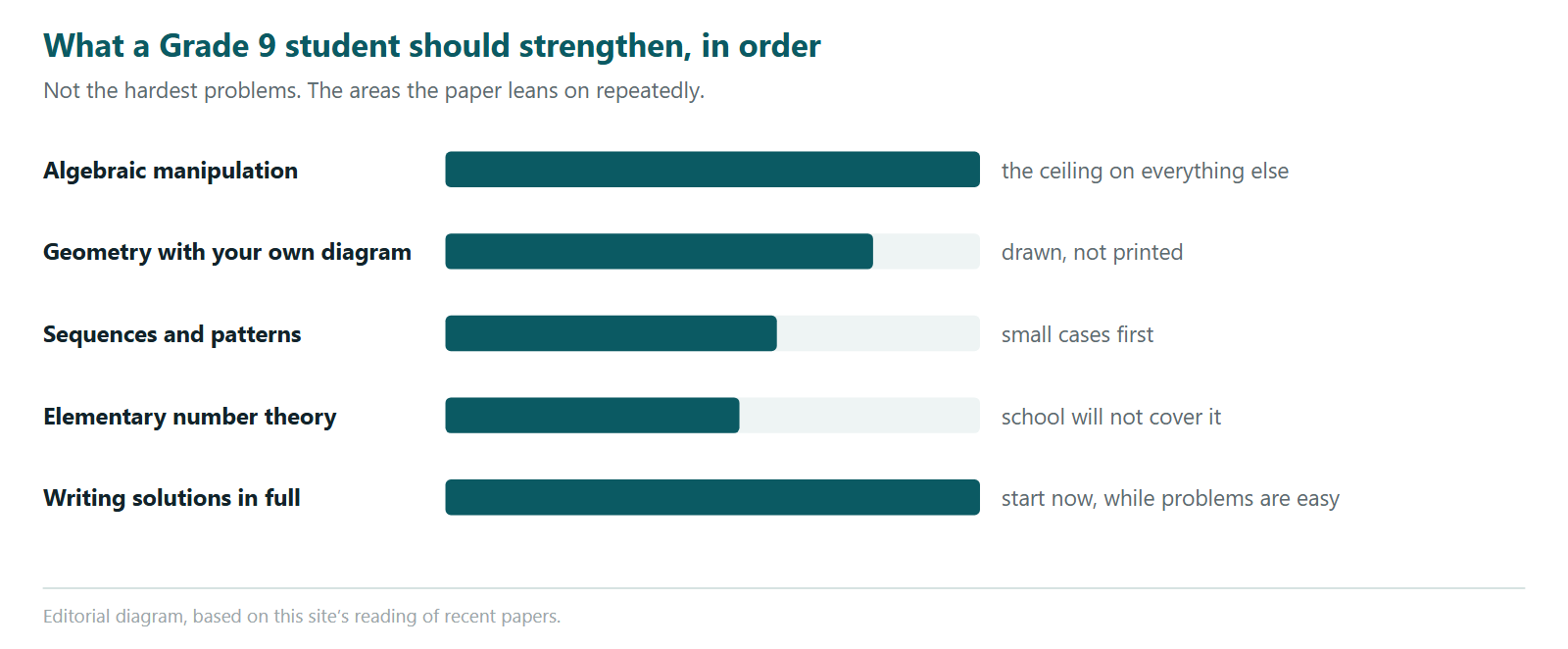
Not the hardest problems. Work on the areas the paper leans on repeatedly — algebraic manipulation, geometry with a diagram you drew yourself, sequences, and the basics of number theory — and write every solution out in full from the beginning. Building the habit while the problems are still easy is far cheaper than retrofitting it in the final year.