In the pursuit of academic excellence for applications to the University of Waterloo, top North American universities, and UK G5 STEM and Business programs, the Euclid Mathematics Contest has long been a critical battleground for elite students to demonstrate their mathematical and logical abilities, thanks to its official endorsement and high academic value.
I. Core Pain Points: Where Are the High-Frequency Difficult Problems in the Euclid Contest?
The Euclid Contest strictly does not test calculus. This means that the challenging long-answer questions in the second half of the paper exclusively test extreme, in-depth variations and hybrid combinations of fundamental high school mathematics modules. Analysis of past papers shows that high-frequency difficult problems and major areas of point loss consistently fall into the following four core categories:
1. Deep Hybridization of Trigonometric Functions and Higher-Order Algebraic Equations
The second half of the paper heavily favors combining trigonometric functions, logarithms, and the relationships between roots and coefficients of higher-degree equations (Vieta’s theorem / Factor theorem) in a hybrid format.
Typical Difficult Problem: Solving a higher-degree polynomial equation involving sin x and cos x, or using sum-to-product, product-to-sum, and double-angle formulas to derive an extremely complex algebraic extremum. These problems involve daunting calculations and have an extremely low tolerance for errors in algebraic manipulation.
2. Irregular Decomposition and Recomposition in Analytic and Plane Geometry
Geometry problems in the second half of the paper often come without any pre-established coordinate system. The problem presents an extremely complex geometric figure (often involving multiple tangent circles, inscribed polygons, or irregular shaded regions).
Typical Difficult Problem: Students are required to independently establish a precise Cartesian coordinate system (choosing axes, defining coordinates of key points), transform plane geometry into analytic geometry, and solve by simultaneously solving equations of circles and lines, and calculating chord lengths and areas.
3. Congruence Logic and Perfect Square Proofs in Number Theory
Number theory is a blind spot in the Chinese public high school curriculum and is a regular feature in the last three questions of the Euclid.
Typical Difficult Problem: Testing divisibility, congruence equations, or proving that a certain algebraic expression is necessarily a perfect square under specific conditions. These problems have no formulas to mechanically apply; they purely test the student’s mathematical intuition and the rigor of their case-based reasoning.
4. Permutations, Combinations, Sequences, and Dynamic Game Models
Typically appears as the ultimate challenge in Question 10.
Typical Difficult Problem: The problem defines a new set of game rules (e.g., two players taking turns moving a piece, or coloring grids according to specific probabilities) and requires deriving a winning strategy or solving for a probability function at the nth step. These problems demand strong mathematical modeling skills, usually requiring students to identify periodic patterns in the initial terms and then provide a rigorous proof using mathematical induction.
II. Exam Scoring Strategies: How to Maximize Partial Marks on Long-Answer Questions in the Second Half
The second half of the Euclid paper consists entirely of Full-graded (detailed solution) questions. Since the papers are marked by human evaluators, even if you do not arrive at a perfect numerical answer, examiners will generously award partial marks based on your derivation process.
To avoid the tragedy of “knowing the solution but failing to get full marks” or “leaving the answer sheet blank out of fear,” you must strictly adhere to the following four scoring techniques during the exam:
Euclid Full-Solution Scoring: A Four-Step Tactical Approach
1. Step One: Always Define Variables When Introduced, and State Prerequisites When Using Theorems
Technique: Standardize your mathematical communication; never allow leaps in your reasoning.
Requirement: Examiners place a high value on the rigor of academic derivation. Any conclusion you reach on your scratch paper must have its logical flow clearly written on your answer sheet.
Execution: Clearly define any new variable you introduce. When using any geometric theorem, state its prerequisites. Present your complete chain of thought using standardized, rigorous English mathematical connectors. This is the foundation for securing full marks.
2. Step Two: Long-Answer Questions Are Usually Divided into Parts (a), (b), (c) — the Preceding Part Is Always a “Stepping Stone” for the Next
Technique: Apply the “reverse the difficult, work on the easy” and “peel the onion” methods, focusing on dimensionality reduction.
Requirement: Questions 8, 9, and 10 typically consist of 2-3 sub-questions with progressively increasing difficulty.
Execution: The problem setters are quite thoughtful; part (a) is often a special case designed to help you uncover the underlying pattern of the problem. If you are stuck on part (b) or (c), immediately look back at how you solved part (a). Try to “abstractly generalize” the algebraic manipulation techniques or geometric decomposition ideas used in part (a) and directly apply them to the more general proof required later.
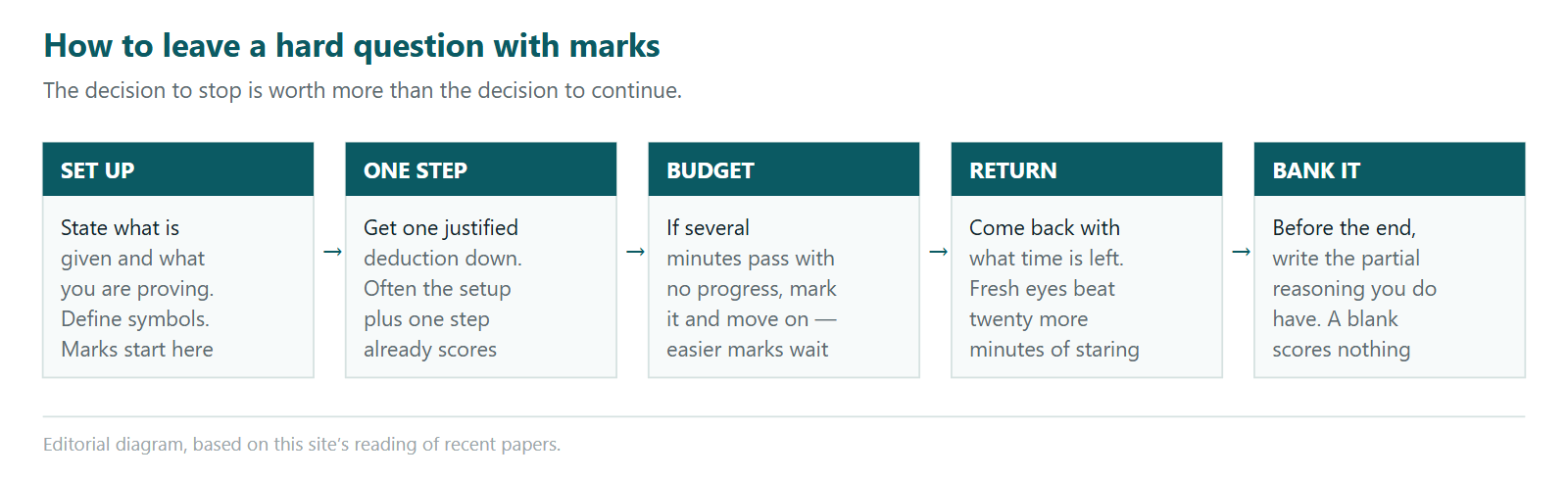
3. Step Three: Never Leave the Answer Sheet Blank — Forcefully Extract Partial Marks by Writing Down Known Conditions
Technique: Even if you cannot calculate the final answer, write down as many “preliminary equations” as possible.
Requirement: Faced with a hellish Question 10, most students will not be able to calculate the final quantitative result. However, leaving the answer sheet blank is the most foolish thing to do in an exam.
Execution: As long as you understand the problem statement, write down all the preliminary quantitative relationships you can think of on your answer sheet. For example, in a geometry problem, write down the equations of lines and circles that you can set up; in a probability problem, manually enumerate and list the first 3-4 basic cases. As long as the examiner sees that you have written down the core mathematical model or initial equations, they will not hesitate to award you 2-3 partial marks.
On the award cutoff line, these few points often determine whether you will receive a certificate.
Frequently Asked Questions
Which topics produce the hardest questions?
The later questions do not reach beyond the syllabus — the paper stays within senior secondary mathematics and does not assume calculus. What they do is combine: an algebraic constraint inside a geometric configuration, or a sequence whose behaviour turns on a number-theoretic property. The difficulty is in seeing which idea unlocks the setup, not in knowing an advanced technique.
How do I collect marks on a question I cannot finish?
By making the partial work legible. State what you are trying to establish, define your symbols, and show the transformations you actually performed. Human graders award marks along a chain of reasoning, so a clearly written half-solution can carry several marks while a page of unlabelled algebra that reaches the right value can carry very few.
Is it worth attempting the last questions at all?
Yes, but with a budget. Attempting the opening of a hard question after you have secured the earlier ones is close to free — the setup and first deduction often carry marks. What is expensive is starting there, or staying past the point where progress stopped. Decide the budget before the paper, not during it.