The Euclid Mathematics Contest, hosted by the University of Waterloo’s CEMC, is for global high school students in grades 10–12. Known for its rigorous logic, process-oriented approach, and absence of obscure questions, it serves as a key reference for top universities like MIT, Waterloo, and the University of Toronto to assess students’ mathematical potential. Its difficulty lies between the Australian AMC and AMC12/AIME, making it very friendly for domestic high school students—no calculus, no multiple-choice, emphasizing logical expression over tricky techniques.
The following constructs an efficient preparation path from four dimensions: topic distribution, difficulty gradient, question trends, and sprint focus.
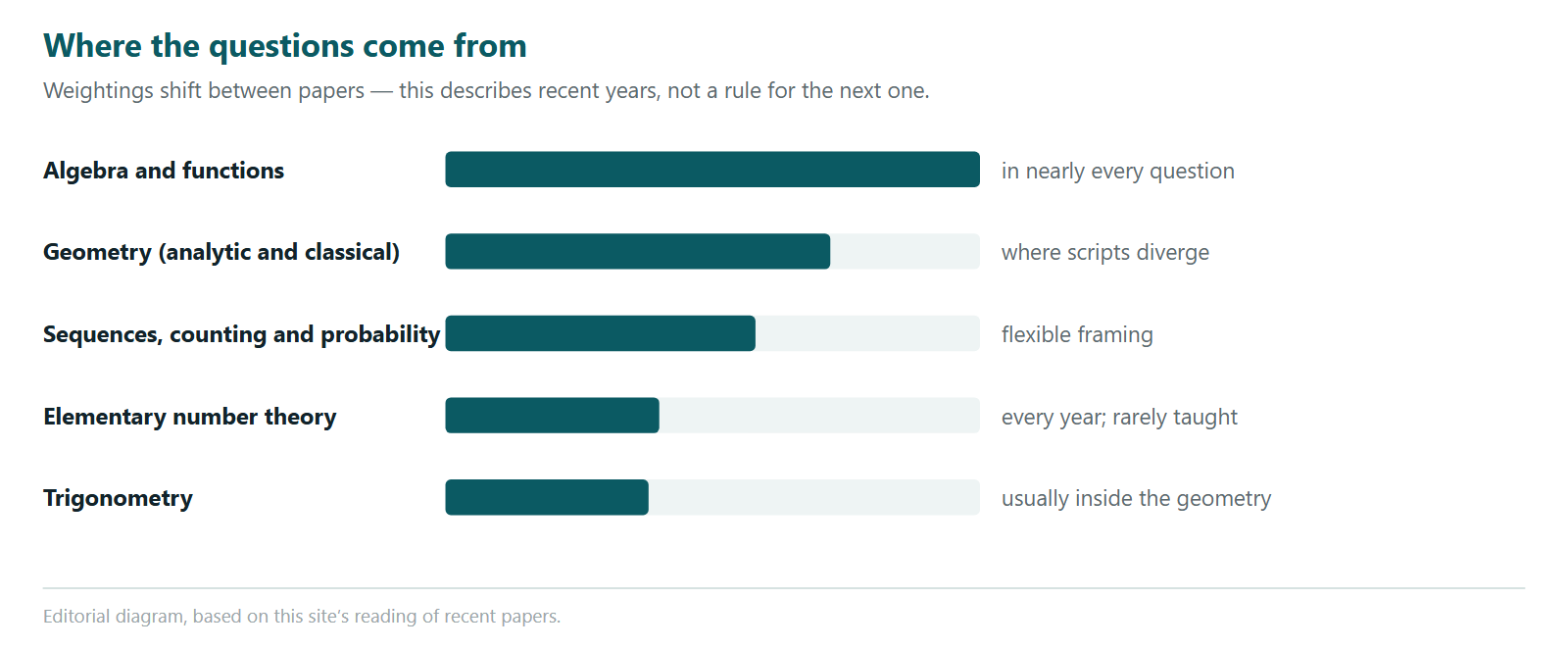
I. Topic Distribution: Four Major Modules, Clear Weighting
| Module | Proportion | Test Focus | Difficulty Level |
|---|---|---|---|
| Algebra | ≈40% | • Function properties & graph transformations • High-degree polynomial factorization (symmetric, cyclic) • Sequences & recurrence (arithmetic/geometric, second-order linear) • Inequalities (absolute value, rational) |
Foundation + Advanced, largest scoring section |
| Geometry | ≈30% | • Plane geometry (triangles, circles, similarity, congruence) • Analytic geometry (locus, vectors, parametric equations) • Power of a point, Ptolemy’s theorem, chord-tangent angle |
Often integrated with algebra, auxiliary line construction is key |
| Number Theory | ≈15% | • Divisibility, prime factorization • Congruence, modular arithmetic • Fermat’s Little Theorem (for simplifying calculations) |
Often appears in medium/hard problems, frequently combined with algebra/combinatorics |
| Combinatorics & Probability | ≈15% | • Counting principles (addition/multiplication) • Inclusion-exclusion principle, recursive counting • Classical probability, conditional probability |
High frequency in final problems, emphasizing rigorous thinking |
Key Features:
No beyond-syllabus content: Entirely based on high school mathematics extensions.
Strong integration trend: Problems 6–10 often cross 2–3 modules (e.g., “solving geometry problems using sequences”).
II. Difficulty Gradient: Three-Tier Structure, Precise Stratification
| Question # | Difficulty | Tested Abilities | Target Strategy |
|---|---|---|---|
| 1–4 | Foundation | • Formula application • Simple reasoning • Calculation accuracy |
Must get all correct! Target accuracy ≥95% → Foundation for aiming for Distinction (~70 points) |
| 5–8 | Medium (Core Score-Differentiation Zone) | • Multi-knowledge point integration • Hidden condition identification • Numerical-graphical combination ability |
Focus on breaking through! → Determines if you can reach top 25% → top 5% |
| 9–10 | Final (High-Score Differentiator) | • Abstract modeling • Constructive proof • Rigorous logical chain |
Process marks > answer marks → Even if unsolved, writing a reasonable approach can earn 3–6 points. |
III. Recent 5-Year Question Trends
Foundation Problems are more “Flexible”: The first 7 problems no longer mechanically apply formulas but test depth of understanding through variations (e.g., deducing a function’s equation from its graph).
Cross-Module Integration is Normalized:
Example 2023 Q9: Using recurrence sequences to find the perimeter limit of an inscribed polygon (Algebra + Geometry + Limit concept).
Example 2022 Q8: Congruence equations + Combinatorial counting (Number Theory + Combinatorics).
Increase in Real-World Context Modeling: E.g., “cell tower coverage area,” “loan repayment model,” testing the ability to abstract mathematical structure from real problems.
Final Problems Emphasize “Solvability” over “Obscurity”: Although difficult, they provide clear logical steps (sub-questions A→B→C), encouraging students to demonstrate their thought process.
IV. Four Key Focus Areas for the Sprint Phase (With Past Paper Strategy)
1. Algebra and Equations
Core Skills: High-degree polynomial factorization (including symmetric forms), functions, inequalities & graph transformations (involving absolute value, rational inequalities), sequences & recurrence (focus on arithmetic, geometric, second-order linear).
Past Paper Focus: Practice questions 1, 3, 6 from 2019–2024, mastering techniques like “completing the square,” “splitting/adding terms,” “symmetric substitution.”
2. Geometry (Constructive Ability is Decisive)
High-Frequency Models: Cyclic quadrilaterals (opposite angles supplementary, Ptolemy’s theorem), midpoint of a chord + perpendicular bisector of chord theorem, finding loci in coordinate systems (parametric method, elimination).
Training Suggestion: Hand-draw 1 geometry problem daily, force yourself to draw auxiliary lines, summarize “when to draw perpendiculars? When to connect to the circle’s center?”
3. Number Theory & Combinatorics (Breakthrough for Final Problems)
Practical Strategies:
For integer solution problems → Try mod 3 / mod 4 analysis to narrow the scope.
Complex counting → Enumerate small cases (n=1,2,3) to find patterns.
Probability problems → Clearly define the sample space + favorable events.
4. Past Paper Practice + Process Refinement
Timed Mock Exams: 2 sets of recent 5-year past papers weekly, strict 150-minute limit, simulating exam rhythm.
Mistake Classification:
| Error Type | Countermeasure |
|---|---|
| Calculation Error | Strengthen scratch work standards, verify each step. |
| Wrong Approach | Redo + compare with official solution, extract the “key to solving.” |
| Knowledge Gap | Return to module-specific training. |
2026 Season Euclid Mathematics Contest registration is open!
Frequently Asked Questions
How is the content distributed?
Across four broad areas — algebra and functions, geometry, sequences and counting, and elementary number theory — with trigonometry running through the geometry. Algebra carries the largest share in most years. Weightings shift between papers, so a published breakdown describes recent history rather than predicting the next paper.
What is the three-tier structure?
The opening questions test secure curriculum knowledge and should be completed rather than rushed. The middle questions require choosing an approach that is not signalled. The final questions combine areas and ask for extended written reasoning. Most of the difference between scripts appears in the middle and late bands rather than at the start.
What should a final sprint focus on?
Presentation and pacing rather than new topics. Sit whole papers under time, mark them against worked solutions, and fix the recurring writing faults you find. Adding a technique in the last weeks rarely changes a score; making the work you already produce markable frequently does.