Among the many international mathematics competitions, the Euclid Mathematics Contest, organized by the University of Waterloo in Canada, stands out for its unique style. Unlike multiple-choice contests that demand extreme speed, the latter half of the Euclid consists entirely of short-answer and proof questions. For many top students who excel in school mathematics, they are often accustomed to the “formula-plugging” and “short and fast” problem-solving rhythm of regular final exams or college entrance exams. However, in the Euclid arena, when faced with proof questions that demand rigorous logical derivation and complete steps, they often encounter the awkward situation of “having the right idea but losing all the step marks.” How exactly can top school math students master the secret to scoring full marks on Euclid proof questions? This article will provide an in-depth analysis of the core techniques for achieving a high score.
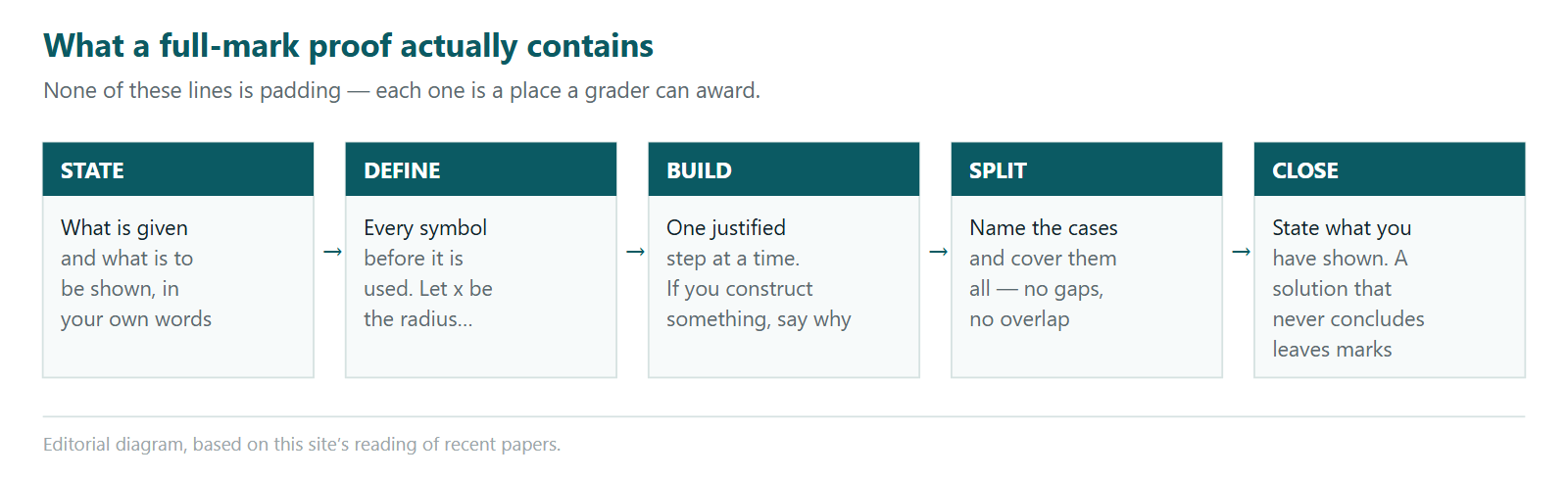
I. Understanding the Euclid’s “Marking Logic”: Rigor Above All Else
In school exams, some teachers may be relatively flexible with the requirements for the process, even giving most of the marks for a correct answer. However, in the Euclid Contest, the examiners use a strict step-by-step marking system.
No superfluous words, only logical chains: The Euclid’s scoring criteria place great emphasis on the standardization of mathematical language. Every conclusion must be supported by clear prerequisites (such as theorem names, axioms, or previously proven conclusions).
Jumping steps is a major taboo: If you skip crucial transitional steps when proving geometric congruence or number-theoretic divisibility, even if your final answer is correct, you will lose valuable logic marks.
Key advice for preparation: During preparation, force yourself to abandon the habit of “thinking in your head and writing the answer directly.” After clarifying your reasoning on scratch paper, ask yourself in your mind when formally writing each step: “Would the examiner ask ‘why?’ when seeing this?”
II. Geometry and Trigonometry Proof Questions: Four “Full-Mark Templates”
The later questions in the Euclid often involve complex geometric figures or trigonometric identity transformations. Top school students tend to think quickly and prefer “clever solutions” or “intuition,” but in proof questions, intuition is often the biggest trap.
1. Make good use of auxiliary lines and return to basic figures: The difficulty of geometric proofs lies in “not knowing where to start.” When facing complex figures, high-scoring candidates avoid blindly drawing lines.
Technique: Prioritize “symmetry, translation, rotation,” or constructing cyclic quadrilaterals. When encountering angle bisectors or perpendicular bisectors, reflexively think of constructing congruent triangles or using the inscribed angle theorem.
2. Strictly adhere to the writing standards for “congruence/similarity”: When proving triangle congruence or similarity, the correspondence of vertices must be strictly aligned. For example, when writing △ABC ≅ △DEF, the corresponding angles and sides must correspond one-to-one. This is the first checkpoint for examiners to check your logic.
III. Algebra and Number Theory Comprehensive Questions: The Art of Case Discussion and Proof by Contradiction
The final problems of the Euclid (such as Questions 9 and 10) often combine sequences, function extrema, or number-theoretic properties, making them highly challenging.
1. Achieve “exhaustive and non-overlapping” case discussions: Many lost marks are not due to not knowing how to solve the problem, but rather “missing solutions.” For example, when dealing with equations involving absolute values, parameter ranges, or floor functions, missing a boundary case can render all your efforts futile.
Technique: Before you start writing, list all possible intervals for the parameters, or draw a number line on scratch paper to divide the intervals, ensuring a closed logical loop.
2. Flexibly use proof by contradiction and mathematical induction: For problems that ask you to “prove a certain property holds for all positive integers” or “prove that an equation has no integer solutions,” the mathematical induction and proof by contradiction you learned in school are excellent tools.
Technique: Master the standard way of stating the induction hypothesis. When writing the induction step, you must clearly write the standard phrasing: “Assume that the statement holds for n = k, then for n = k + 1…”
IV. A “Mindset Upgrade” Guide for Top School Students Aiming for a High Score in the Euclid
If you consistently score high in school math exams, it shows that your computational skills and foundational knowledge are already solid. However, when aiming for the global top 25% (or even the Distinction/Honor level) in the Euclid, you need to complete the following three mindset upgrades:
From “Chasing Results” to “Enjoying the Process”: When practicing past papers, after finishing your answers, compare them against the official Full Solution provided by the contest. Meticulously compare your written steps with the official answers, and learn their concise and standardized mathematical expressions.
The Art of Time Allocation: The Euclid exam lasts 150 minutes and consists of 10 long-answer questions. The first 5 questions are relatively basic, while the difficulty of the last 5 increases sharply. Top students tend to waste time on the earlier simple questions by overcomplicating them, leaving insufficient time for the later proof questions. It is advisable to plan your time reasonably, leaving ample space for thinking and standardized writing for the final problems.
Establish a “Standardization” Error Notebook: Prepare a dedicated notebook to record not the problems you couldn’t solve, but the ones where you lost marks due to “non-standard steps or logical leaps.” Clearly identify whether each loss of marks was due to incorrect theorem usage, missing prerequisites, or incomplete case classification.
Frequently Asked Questions
What does the marking actually reward on proof questions?
Rigour that is visible. Graders follow the written chain, so an argument that is correct in the student’s head but compressed on the page loses marks that were genuinely earned. Stating the claim, the given conditions and each justified step is not padding — it is the thing being marked.
How should a geometry or trigonometry proof be structured?
Draw the figure yourself and label it, state what is given and what is to be shown, then build forward one justified step at a time. Where a construction is introduced, say why. Strong students often prefer an elegant leap; the leap is fine as long as the sentence explaining it is there. Without that sentence it reads as an assertion.
What separates a high scorer on the final questions?
Case discipline. Late questions frequently involve parameters or configurations that split into cases, and the marks depend on covering them without overlap and without gaps. A solution that handles the interesting case beautifully and never mentions the others is marked as incomplete, however sophisticated the interesting case was.