In the landscape of international competitions, Grade 11 has long been regarded as the “decisive year” for applications to top universities in the United States and Canada. Faced with two highly prestigious mathematics competitions—the American AMC 12 (American Mathematics Competition) and the Canadian Euclid Contest (Euclid Mathematics Contest)—many Grade 11 students and their parents often find themselves torn: with such different styles, could preparing for both simultaneously be counterproductive? Is it really feasible to advance on both fronts during this critical year?
This article will provide an in-depth analysis of the feasibility of simultaneous preparation in Grade 11, along with a guide to avoiding common pitfalls, from three dimensions: the exam timeline, the overlap of core topics, and time management strategies.
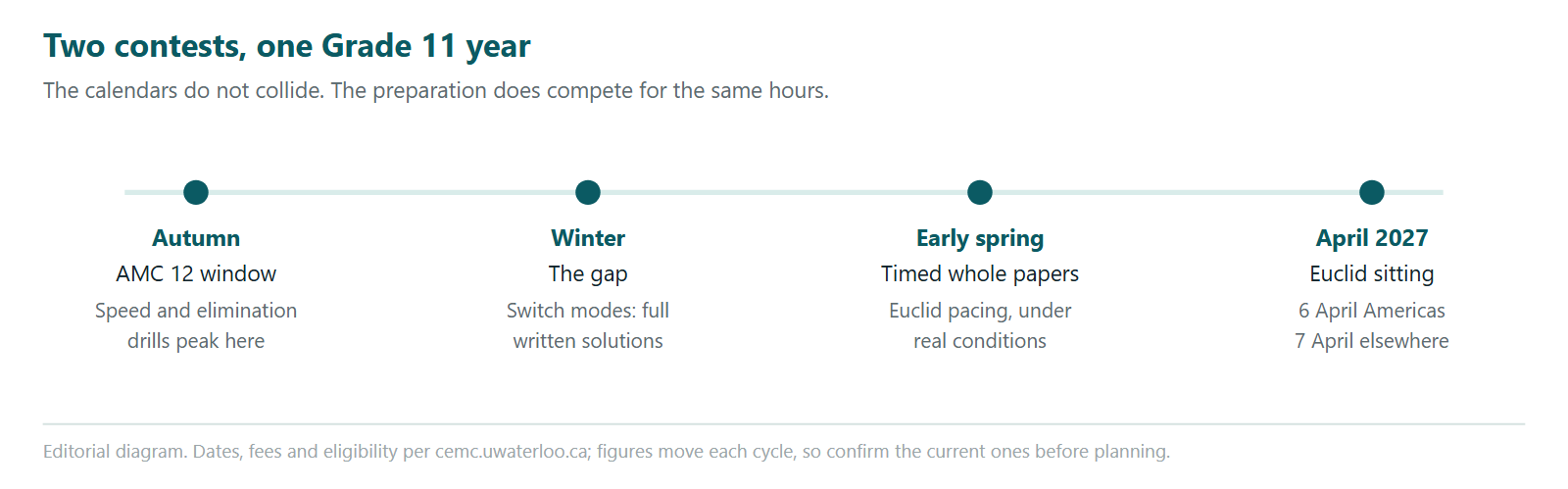
I. Timeline Analysis: A Perfect “Staggered Peak” Cycle
Many students worry about scheduling conflicts between the two competitions. However, looking at the global competition calendar, AMC 12 and the Euclid Contest have a natural “golden staggered peak” advantage in terms of timing:
First Half: AMC 12 Sprint (November each year)
In mid-November of the first semester of Grade 11, students will take either the A or B version of the AMC 12. The main tasks at this stage are tackling multiple-choice questions, adapting to the high-pressure 75-minute pace, and striving to qualify for the AIME (American Invitational Mathematics Examination).
Midfield: AIME Bridge (February each year)
If students qualify successfully, they will experience the AIME in February of the following year, which serves as excellent training for rigorous deductive reasoning skills.
Second Half: Euclid Sprint (April each year)
In early April of the second semester of Grade 11, the Euclid Contest, hosted by the University of Waterloo in Canada, takes the stage. At this point, there is a buffer of nearly five months since the AMC 12 in November—ample time to seamlessly transition from “time-limited multiple-choice thinking” to “full-solution short-answer and proof-question thinking.”
Conclusion:
From a timeline perspective, the two competitions do not conflict at all. Instead, they form a stepped, closed-loop capability enhancement—from speed to rigor, from selection to proof.
II. Core Topic Overlap: The Foundation Is Shared
In terms of mathematical content itself, more than 80% of the high school mathematics topics covered by AMC 12 and the Euclid Contest overlap significantly:
Common Ground:
Both cover functions, sequences, trigonometry, complex numbers, logarithms, and advanced solid geometry and analytic geometry.
Preparation Synergy:
The algebra and number theory foundation built during AMC 12 preparation can be directly transferred to the first half of the Euclid Contest.
Core Differences (and Why Targeted Breakthroughs Are Necessary):
- AMC 12: 25 multiple-choice questions, emphasizing “clever solutions, speed, and strategy” (allowing elimination, special-value methods, and a unique blank-scoring mechanism).
- Euclid Contest: 10 long-answer questions, emphasizing “rigorous logical steps and complete solution writing.” Even if the final answer is correct, non-standard steps will result in point deductions.
III. Feasibility Assessment for Grade 11 Simultaneous Preparation
Simultaneous preparation in Grade 11 is not only entirely feasible but is also a standard strategy adopted by many top-tier university applicants. However, achieving desirable results depends on how you manage your revision rhythm over these months:
Phase 1: Summer Break to November – AMC 12 as the Main Focus
- Goal: Master the full panorama of high school mathematics knowledge (advanced Pre-Calculus) and adapt to the all-English competition context.
- Strategy: Intensively practice AMC 12 past papers from the last ten years, training accuracy on the first 15 questions and breakthrough ability on the last 10.
Phase 2: December to April of the Following Year – Shifting to “Mindset Correction” for the Euclid Contest
- Goal: Adapt to short-answer questions and train the standardization of mathematical expression.
- Strategy: After the AMC 12 experience, start working on Euclid past papers in December. The biggest shift at this point is to “break the habit of skipping steps.” For every problem, not only must you arrive at the answer, but you must also compare your work against the official Full Solutions to learn how to write the reasoning process in flawless mathematical language.
IV. Potential Risks and Pitfall Avoidance Guide for Grade 11 Preparation
Avoid “Chasing Both and Losing Both”:
If the pressure from midterm and final exams at school during the first semester of Grade 11 is extremely high, it is advisable to focus your energy on the AMC 12. If your AMC sprint to the AIME goes smoothly, the Euclid Contest in April will naturally fall into place.
Avoid Confusion in Problem-Solving Habits:
Methods that are acceptable in the AMC, such as “substitution” and “guessing answers,” do not work in the Euclid Contest. You must consciously engage in “written expression special training” after December.
Frequently Asked Questions
Can a Grade 11 student prepare for both AMC 12 and this contest?
Yes, and the calendars help: the two sit at different points in the year, so the intense phases do not collide. The topic bases also overlap substantially at the senior secondary level. What does not overlap is the training, and that is where students underestimate the cost.
Where does the preparation not transfer?
In what each paper rewards. Multiple-choice practice builds fast elimination, answer-checking and the confidence to commit to a choice without proving it. Full-solution practice builds decomposition and written argument, and rewards exactly the step a multiple-choice sitting lets you skip. Time spent on one does not quietly accumulate in the other, so budget separate blocks rather than assuming that general problem-solving covers both. The topic revision genuinely is shared; the exam technique is not.
What is the main risk of doing both?
Splitting attention during a term that is already heavy. If school assessments peak at the same time as one of the contests, it is usually better to commit to that one and treat the other as a lighter sitting. Two half-prepared attempts produce less than one prepared attempt and a calibration run.