In the world of mathematics competitions, the Euclid Mathematics Contest is a unique game of strategy. It tests not only your mathematical intelligence but also your “academic etiquette of logical expression.” Many students find that even when their logical thinking is largely correct, their final scores are often disappointing.
The core of the problem lies in this: the Euclid is a “step-by-step scoring” logic and argumentation contest. The graders value not the final answer, but how you break down a complex mathematical problem into a rigorous proof process. Today, we will deeply deconstruct the “step-mark code” of the Euclid, helping you craft an answer sheet that will impress the graders.
I. Why Are Step Marks the Main Battlefield for Scoring?
Each Euclid problem is worth 10 points, and most questions require a “complete solution process.” This means:
The final answer usually accounts for only 1–2 points of the total score. The remaining 8–9 points depend entirely on your argumentation process.
If you can demonstrate the correct model selection, rigorous deductive logic, and clear sectional discussion, even if there are minor flaws in the final calculation, you can still securely secure more than 80% of the marks. Conversely, if you only provide the conclusion, the score for that problem will be extremely disappointing.
II. Standard Answer Writing Standards: Building Your “Full-Mark Logic Chain”
1. Make Variable Definitions Prominent
Do not just list a series of formulas. Before starting calculations, be sure to define the physical quantities or mathematical symbols involved.
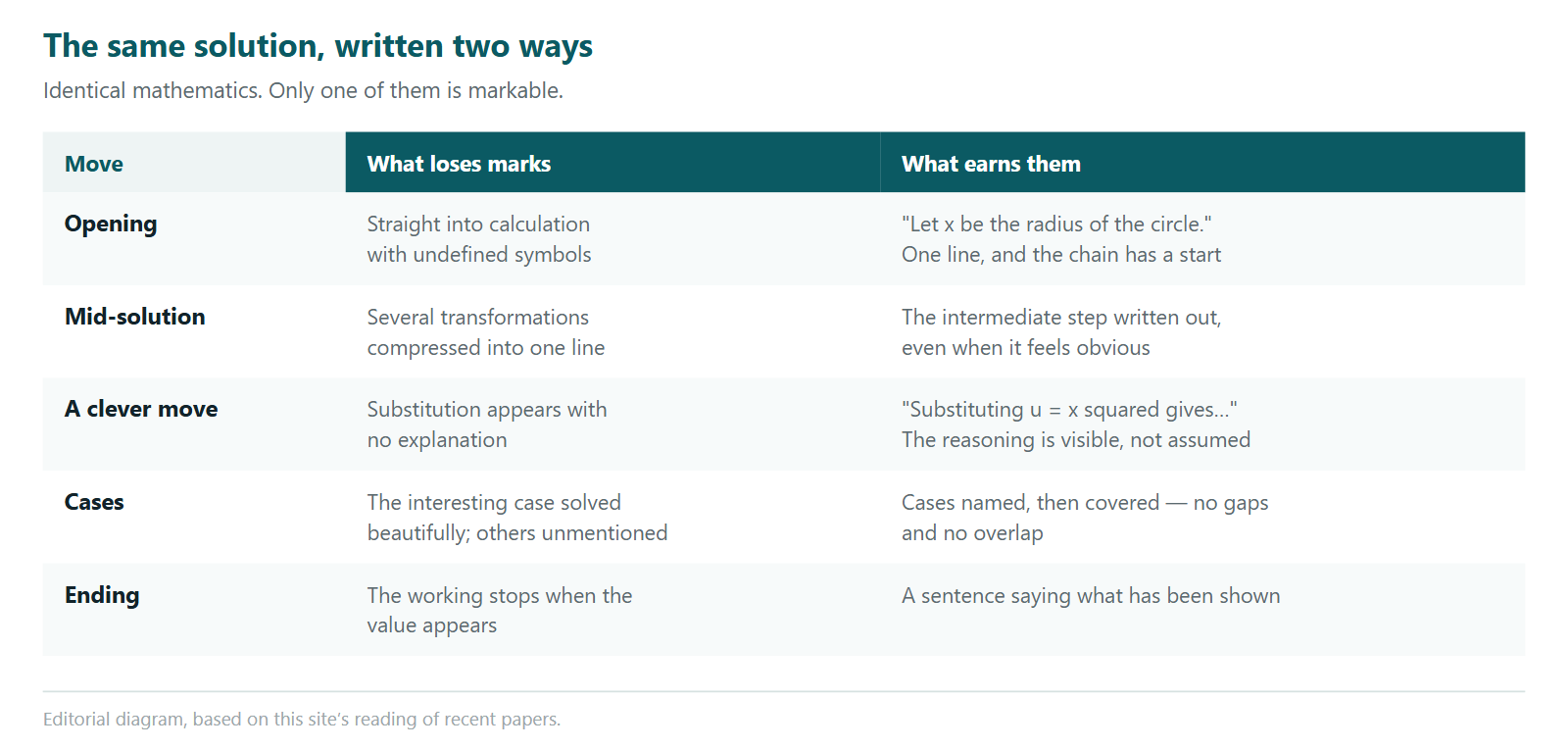
Correct Example: “Let x represent the radius of the circle, and let y be the height of the triangle.”
Function: Clearly defining variables helps the grader quickly understand your physical model or geometric image.
2. Logical Bridges in “Mathematical Language”
Formulas are not isolated islands; they need logical bridges to connect them.
Standard: Before using any theorem, be sure to write a brief explanatory sentence in English. For example: “According to the Pythagorean Theorem…” “Since the function is symmetric about the y-axis…” “By applying the Principle of Mathematical Induction…”
Function: These connecting phrases are not just embellishments; they tell the grader the starting point of your logic. If there is a typo in the formula, the teacher can judge from this sentence whether it is due to carelessness or a fundamental error.
3. Section-by-Section Argumentation
When facing complex problems, be sure to use “stage-by-stage segmentation.”
Standard: It is recommended to use “Step 1”, “Step 2”, or “Case 1”, “Case 2” to divide your solution.
Function: Structured writing makes the grading process exceptionally smooth. A clear hierarchy will leave the teacher with a positive impression of “rigorous thinking,” thereby creating a “goodwill effect” in scoring.
III. Key Scoring Tips: Three Techniques to Improve the Quality of Your Argumentation
1. Show Your “Thinking Path”
If you use some clever transformation at a certain step (such as taking logarithms, variable substitution, or geometric rotation), be sure to annotate it: “By substituting u = x^2…”. This not only demonstrates the depth of your problem-solving but also proves to the teacher that you are an active-thinking mathematical explorer.
2. Rigorous Discussion of Dimensions and Domains
When dealing with functions, fractions, or radicals, be sure to state the domain at the beginning and verify the validity of the solutions at the end. For example, when the solutions are x = 5 and x = -2, if the problem specifies geometric side lengths, you must state: “Since length must be positive, x = 5 is the only valid solution.”
This “boundary awareness” is a key bonus point for scoring high in the Euclid.
3. Diagrams as Supplementary Aids
For geometry problems, drawing a diagram is your “trump card” for scoring. Even if the problem does not require it, if you can draw a clear schematic with key angles or side lengths marked, the grader will be extremely grateful, as it directly reflects your geometric insight into the problem.
IV. Pitfall Avoidance Guide: A “Score Protection” Manual for Candidates
Beware of “Step Skipping”:
Many domestic students are accustomed to skipping basic equation transformations. Do not skip! Write out the key algebraic transformation steps. Although it may seem tedious, it ensures that the grader can 100% follow your thought process.
Reject “Scratch-Paper Style” Expression:
The answer space in the Euclid is limited but sufficient. Keep your handwriting neat and align complex derivation formulas properly. A clean answer sheet not only prevents ambiguity but also reflects your mathematical literacy.
Leave Time for a “Conclusion Summary”:
At the end of your answer, state the result with a clear sentence pattern. For example: “Therefore, the value of x is 10.” A prominent conclusion mark is the last “good impression” you leave on the grader.
Frequently Asked Questions
Why do step marks matter so much on this paper?
Each problem is worth ten marks and most of them ask for a complete solution. The final answer typically carries only one or two of those marks; the remaining eight or nine follow the written argument. That is the whole design of the contest. A correct answer with no visible reasoning can score close to nothing, and a wrong final answer with sound, clearly written work can still collect most of the marks available.
What does a grader want to see first?
Definitions. Before any calculation, state what your symbols mean — let x be the radius, let n be the number of terms. Graders follow a chain, and a chain that starts with undefined symbols is hard to award marks to. After that, show the transformations you actually used, especially the clever ones. Annotating a substitution costs one line and tells the grader the step was reasoned rather than guessed.
What is the most common way students lose marks they had earned?
Skipping the routine algebra. Students trained to work quickly compress several transformations into one line, which reads to a grader as an unsupported jump. Write the intermediate step even when it feels obvious. The second common loss is stopping when the answer appears, without stating what has been shown — a solution that never says what it concluded leaves the last marks on the table.