The Euclid Mathematics Contest is an international mathematics competition for high school students hosted by the University of Waterloo in Canada. Renowned for its high academic standards, strong connection to university academics, and significant reference value for University of Waterloo undergraduate admissions, it is hailed as the “TOEFL of the mathematics world.” This article will provide a detailed analysis of the Euclid Contest’s registration methods, core advantages, difficulty range, and phased preparation strategies to help you prepare efficiently for the April 2026 exam.
I. Euclid Contest Registration Methods
1. Unified School Registration
Applicable Students: Students whose schools are official in-person test centers for Euclid.
Process: Registration is organized and handled uniformly by the school. Individual self-registration is not supported.
Recommendation: Consult your school’s math teacher or the teacher in charge of competitions directly for more information.
For local students in Canada: You can register directly through your school.
2. Registration via Institution Agent
Applicable Students: Students whose schools are not Euclid Contest test centers.
Process: Register through an authorized institution partnered with the contest.
Recommendation: Add and consult teachers from relevant institutions for information and to obtain registration eligibility.
We are an officially authorized test center and can provide registration services on your behalf.
II. Why You Must Choose Euclid?
1. Canada’s “TOEFL of Mathematics,” Highly Recognized by Top Universities
Reference for North American University Admissions: Excellent performance significantly enhances competitiveness when applying to top institutions like the University of Waterloo, University of Toronto, UBC, McGill, and others.
High Global Recognition: Especially suitable for students without AMC scores, serving as supplementary material demonstrating academic ability in STEM fields.
2. Direct Link to Scholarships
Priority for Entrance Scholarships at the University of Waterloo: High-scoring students have the opportunity to receive substantial scholarships, achieving “furthering studies through competition, earning scholarships through competition.”
3. Moderate Difficulty, Extremely High Cost-Effectiveness
Focus on Logical Thinking: Unlike some contests that emphasize out-of-syllabus knowledge, Euclid places greater importance on logical thinking, problem-solving steps, and mathematical expression.
Easy to Score with Systematic Training: As long as students undergo systematic training, most can achieve outstanding results, making it suitable for the vast majority of high school students aiming for success.
III. Euclid Difficulty Range and Benchmarking
1. Overall Difficulty Positioning
Falls between AMC 10 and AMC 12, significantly lower than AIME, slightly higher than the later part of AMC 10, and lower than the most challenging AMC 12 problems.
Difficulty Curve: Gentle at the start, steep at the end, with a sharp increase —
Questions 1–5: “Gimme questions,” solvable with a solid foundation.
Questions 6–8: “The dividing line,” require flexible application of in-class knowledge.
Questions 9–10: “The master zone,” test Olympiad-level thinking and techniques.
2. Knowledge Scope
Covers core high school mathematics areas: Algebra, Geometry, Number Theory, Combinatorics, Functions, Trigonometry, etc.
No Calculus/Linear Algebra: However, the depth of exploration of basic concepts and the integration across modules far exceed in-class requirements.
Typical Question Types: Exponential and logarithmic operations, solving functions, analytic geometry, trigonometric simplification, sequence recurrence relations, circle geometry problems, etc.
IV. Euclid Preparation Tips: Phased Strategy
Phase 1: Foundation Building
1. Quickly Scan and Master Knowledge Points
Core Resource: Past papers and solutions from the University of Waterloo official website.
Task: Quickly review core high school math knowledge points to ensure no knowledge gaps.
2. Intensively Practice the First 8 Questions of Past Papers
Goal: Master the logic of basic question types and improve accuracy in reading questions.
Task: Carefully work through the first 8 questions of past papers from 2015-2020, while memorizing mathematical English vocabulary.
3. Create a Categorized Error Log
Mark Error Causes: Such as fuzzy concepts, calculation mistakes, unclear problem-solving thought process, etc.
Targeted Breakthrough: Conduct specialized practice for weak modules (e.g., geometric auxiliary line construction).
Phase 2: Ability Strengthening
1. Focus on Comprehensive Question Types
Target Question Numbers: Past paper questions 6-9.
Method: Refine core models like substitution methods, case discussions, forming general problem-solving approaches.
2. Tackle Difficult Modules
Key Focus: Tackle challenging areas like Number Theory, Combinatorics.
Task: Combine practice with questions from similar contests to enhance problem-solving ability in complex scenarios.
3. Standardize English Solution Steps
Requirement: Ensure derivations are clear to avoid losing points on process.
Structure: Write the solution process following the “Given → Reasoning → Conclusion” format.
Phase 3: Final Sprint (March 26 – Exam Day)
1. Full Mock Exams to Adapt to the Pace
Task: Use past papers from the last 5-10 years for timed mock exams (150 minutes), simulating the exam environment.
Time Allocation: Control the time for questions 1-7 within 90 minutes, leaving enough time for the most challenging problems.
2. Score-Grabbing Strategy for Challenging Problems
Priority: Tackle the first two sub-questions of question 10.
Task: Organize your thoughts, list relevant formulas, and strive for every possible point.
3. Review and Optimize Test-Taking Strategy
Compare with Scoring Guidelines: Identify issues in steps and time allocation.
Optimization Strategy: Adjust the order of answering and time management based on mock exam performance.
Frequently Asked Questions
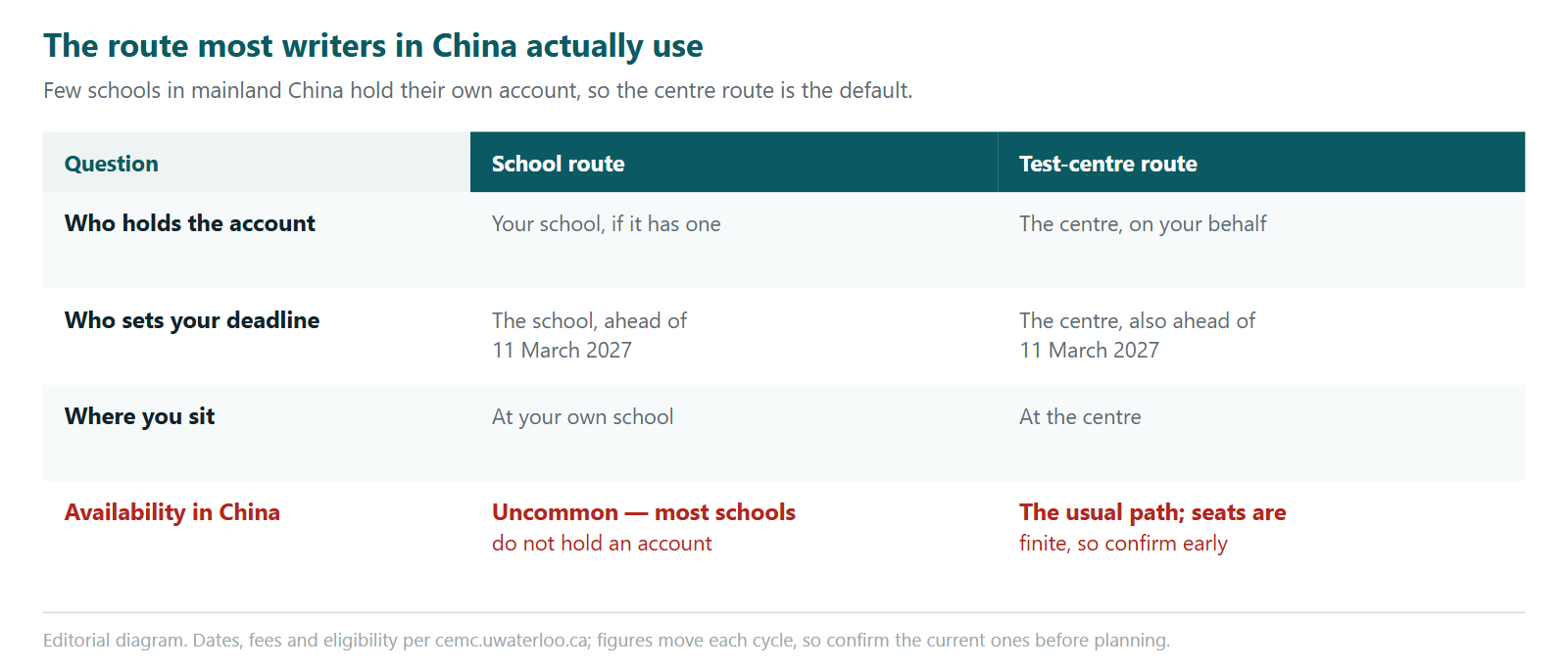
How does a student in China enter?
Almost always through an authorised test centre, since relatively few schools in mainland China hold their own account with the organiser. The centre registers on your behalf, provides the seat and the invigilation, and returns the paper. Confirm the centre’s own cut-off, which sits earlier than the organiser’s March deadline.
What is the case for choosing this contest?
It tests the curriculum a student already has rather than a separate olympiad syllabus, which makes preparation depth rather than new content. And because it is marked on written argument, the result evidences a skill that transfers directly into university problem sets — which is a different and more durable claim than a fast answer.
Where does it sit against AMC and AIME?
Between the two AMC levels in raw difficulty and well below AIME. But raw difficulty is the wrong axis: this is a full-solution paper and those are answer-only, so they test different things. A student comfortable with AMC-level problems can still find their first written paper punishing, and that is about format rather than ability.