CEMC gives away a surprising amount of study material: a weekly problem stream for grades 3 to 12, online courseware in mathematics and computer science for grades 7 to 12, a monthly challenge aimed specifically at grades 11 and 12, and a generator that builds practice sets from past multiple-choice contests. All of it is free and needs no registration. None of it, on its own, trains the thing Euclid actually marks.
What CEMC actually gives away
Almost every conversation about Euclid preparation in China starts and ends with past papers and coaching. That skips a whole tier of official material that costs nothing, is written by the same organisation that sets the contest, and sits in plain sight on cemc.uwaterloo.ca under Resources.
The resources page describes these as developed by expert CEMC educators for students, educators, parents and guardians, and states that they require no registration or fees. That last point is worth pausing on. There is no account to create, no school to go through, no order to place. Unlike the contest itself — which you can only enter through a school or an authorised test centre, as our 2027 registration guide explains — the study material has no gatekeeper at all.
So the reason most students in China never touch it is not access. It is that nobody tells them it exists, and that once found, it is not obvious what each piece is for. That second problem is the one this article is about, because using the wrong free resource for the wrong purpose is how students spend an autumn feeling busy and arrive in April unprepared.
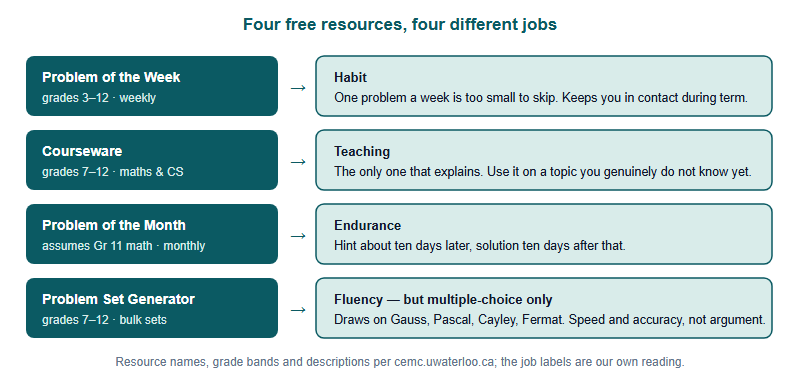
The four resources, and what each one is actually for
Descriptions below are as published on the CEMC resources page. The judgements in the final column are our own coaching reading, not official guidance.
| Resource | Grades listed | What CEMC says it is | What it is genuinely good for |
|---|---|---|---|
| Problem of the Week | 3 to 12 | “Engaging math problems shared every week to enhance problem-solving skills” | Keeping a habit alive during term. One problem a week is small enough that you will not skip it, and consistency matters more than volume in the autumn. |
| Courseware | 7 to 12 | “Online mathematics and computer science materials featuring lessons, interactive activities, enrichment challenges, and opportunities for practice with feedback” | Filling a named topic gap from scratch. This is the only one of the four that teaches rather than tests — use it when you have identified something you simply do not know. |
| Problem of the Month | assumes Grade 11 math | “intended to challenge enthusiastic high school mathematics students” | The closest free match to Euclid's upper end. The release schedule is the tell: a new problem on the first Tuesday of each month, a hint roughly ten days later, and the solution about ten days after that. You are meant to sit with it for weeks. |
| Problem Set Generator | 7 to 12 | “Create your own sets of problems randomly chosen from past Gauss, Pascal, Cayley, and Fermat Contests useful for curriculum support and contest preparation” | Bulk fluency drilling on standard techniques — and note which contests it draws from. All four are multiple-choice papers, so it trains speed and accuracy, not written argument. |
The gap: none of these train the thing Euclid marks
This is the part worth being blunt about, because it determines how much of your preparation these resources can carry.
Euclid is ten questions in 2.5 hours for a score out of 100, and the paper is a mix of final-answer-only and full-solution items. On the full-solution items, marks follow the written argument — a marker reads what you produced and credits the reasoning as it develops. That is the specific thing that makes Euclid different from the multiple-choice family, and it is covered in detail in our guide to how step marks work.
Now look back at the four free resources with that in mind:
- Problem of the Week gives you a problem. Whether you write your reasoning out properly or scribble the answer and move on is entirely up to you, and nobody checks.
- Courseware offers practice with feedback — but interactive feedback tells you whether an answer is right, not whether a proof is complete.
- Problem of the Month is the closest fit, since a hard problem you work on for days naturally produces written work. Still, no marker reads it.
- Problem Set Generator structurally cannot help here. It draws on Gauss, Pascal, Cayley and Fermat, which are multiple-choice papers. A generated set from those contests can never contain a full-solution question.
So the honest accounting is this. Free CEMC material solves your supply problem completely and your teaching problem substantially. It does not touch the two things that actually decide a Euclid score: whether your written argument would satisfy a reader who was not in your head, and whether you can produce ten questions of it inside 150 minutes.
That is not a criticism of the resources. They were never built for that. It just means a plan made entirely of free material has a predictable ceiling, and knowing where the ceiling is beats discovering it in April.
An autumn routine built almost entirely from free material
Working back from the 2027 sitting — Tuesday 6 April in North and South America, Wednesday 7 April everywhere else including China, with the other dates on our 2027 key dates page — there are roughly seven months from the start of a September term. Free material can reasonably carry the first four of them.
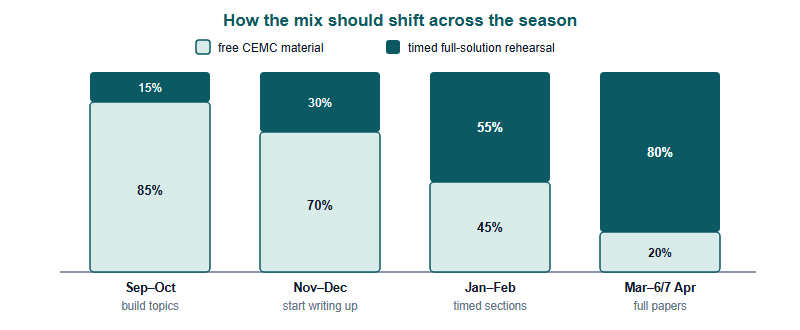
A concrete weekly shape for September and October, costing nothing:
- Once a week — the Problem of the Week, written out in full as if it were being marked. Not solved in your head. This is the single highest-value habit change available for free, because it attaches the writing discipline to something you were going to do anyway.
- One session a week — courseware on one named weakness. Named is the operative word: “I am bad at geometry” is not a target, “I cannot handle circle theorems with an unknown centre” is.
- Once a month — the Problem of the Month, given several sittings across a fortnight rather than one attempt. Long problems teach you what to do when nothing works in the first ten minutes, which is the state most students are in by Euclid's later questions.
- As needed — generated sets when your arithmetic and algebraic manipulation feel slow. Treat these as warm-ups, not as Euclid practice.
Two additions worth knowing about. The courseware covers computer science as well as mathematics, which matters if you are also considering the CEMC's Canadian Computing Competition in February. And because none of these resources requires an account, there is nothing stopping a grade 10 or 11 student from starting the routine a year or two before they intend to sit the paper.
Where free material stops being enough
Two jobs remain after all of the above, and neither is a matter of finding more problems.
The first is full-length timed rehearsal on real Euclid papers. Ten questions, 150 minutes, in one sitting, mixed difficulty, with the final questions arriving when you are already tired. Nothing in the free resource set simulates that, and the Problem Set Generator structurally cannot, since it draws on multiple-choice contests. Our own compiled archive of Euclid papers runs from 1998 to 2026, which is considerably deeper than what is indexed in one place elsewhere; it is available by scanning the code that appears beneath every article on this site. Worked solutions do not exist for every year in that set — the older papers are thinner — and we would rather say so than imply a complete solution library.
The second is having someone read your written argument. This is the genuinely unfixable gap in solo preparation. You cannot self-mark a proof reliably, because the exact thing at issue is whether a stranger can follow it, and you are not a stranger to your own reasoning. A teacher, a strong classmate, a maths club, or a coach all close this gap; the important part is that somebody who did not watch you think reads the page and tells you where they lost the thread.
If you take one thing from this article, make it the smallest one: write out the Problem of the Week properly, every week, from September. It is free, it takes twenty minutes, and it is the only free habit on this list that trains the skill Euclid actually rewards.
Frequently asked questions
Do CEMC's free resources require an account or payment?
The resources page states they require no registration or fees. Entering the contest itself is separate and does need a school or test centre.
Can the Problem Set Generator produce Euclid-style practice?
No. It draws on past Gauss, Pascal, Cayley and Fermat contests, which are multiple-choice, so it cannot generate full-solution questions.
Which free resource best suits a final-year Euclid candidate?
Problem of the Month: one hard problem monthly, with the hint and solution held back, so you must sit with it as you would a Euclid part B.
Can I prepare for Euclid using only free material?
Partly. Free material covers topics and problem supply well, but not timed full-paper rehearsal or feedback on your written argument.
Operated by Hanlin Education for China-based international-school students. Resource names, grade bands and access terms change over time — confirm all current details on cemc.uwaterloo.ca before acting on anything here. Errors reported to us are corrected within 7 working days.