There is no individual registration route into the Euclid Contest. You cannot buy your own seat, and no amount of preparation substitutes for the one administrative fact that decides whether you sit the paper at all: entry runs only through a school or an authorised test centre. For the 2027 sitting on Wednesday 7 April in China, that conversation needs to happen in the autumn, not in March.
Why there is no way to enter on your own
Every year a number of students discover this too late, usually in February, having assumed that a contest with a published date and a published fee must have a sign-up page somewhere. It does not, and the reason is structural rather than bureaucratic.
Euclid is a written paper: ten questions in 2.5 hours for a score out of 100, a mix of final-answer-only and full-solution items. Because a large part of the paper is marked on the written argument rather than on a final number — the mechanism explained in our guide to how step marks work — the marking depends on scripts being produced under supervised conditions and returned properly. That requires an institution: someone has to act as contest supervisor, order the papers, invigilate the sitting, and handle the scripts.
So CEMC issues orders to schools and authorised centres through a supervisor portal, not to individuals. The published fee — $18.00 per participant plus $5.00 processing per order — is charged on that order, which is itself a clue that the unit of entry is a batch placed by an institution, not a single student checking out.
The good news is that eligibility is generous, so the obstacle really is only administrative. The contest is listed for students in their final year of secondary school or CÉGEP students, and the official wording adds that motivated students in lower grades are welcome to write the contest. If you are in grade 10 or 11 and your school tells you that you are too young, that is a school policy rather than a CEMC rule — worth knowing before the conversation.
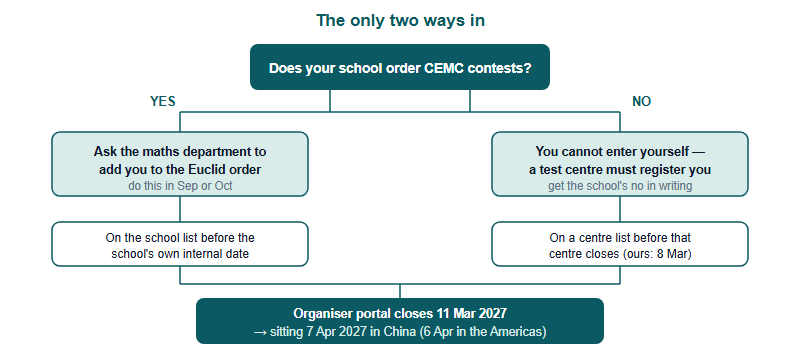
Two routes in, and only two
| Route 1: your own school orders | Route 2: an authorised test centre enters you | |
|---|---|---|
| Who places the order | Your school's contest supervisor, usually in the maths department | The centre, on behalf of students it has registered |
| Where you sit | At school, on the fixed contest date | At the centre's venue, on the fixed contest date |
| What you have to do | Get onto the school's list before its internal cut-off | Get onto the centre's list before the centre's own cut-off |
| Deadline that binds you | Your school's internal date, which is earlier than the organiser's | The centre's own list close, which is also earlier than the organiser's |
| Best case to arrange it | September or October, when next year's contest order is being planned | Any time before the centre closes its list; earlier is better for venue capacity |
Notice what both rows in the last two lines have in common. Whichever route you take, the deadline that actually applies to you is not the organiser's deadline. It is your school's or your centre's, and it sits earlier, because whoever places the order needs their list finalised before they can submit it. This is the single most misunderstood part of Euclid logistics, and it deserves its own section.
Two different closes: 8 March and 11 March 2027
These are two separate dates belonging to two separate parties. Neither corrects the other, and they are not alternative reports of the same event.
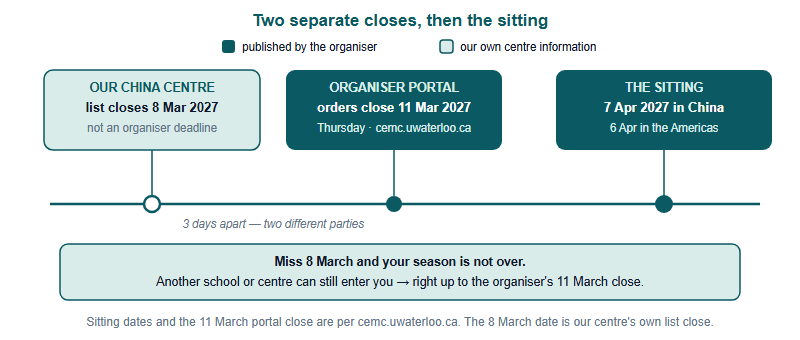
11 March 2027 (Thursday) is the organiser's ordering deadline. It is published on cemc.uwaterloo.ca and it is the date by which any school or centre anywhere must have its order in. After that, nobody can add you — not us, not your school, not another centre.
8 March 2027 is when our own China test centre closes its student list. This is our own test-centre information; the organiser does not publish it, and no other centre is bound by it. We close earlier because we have to confirm numbers, allocate rooms across cities and submit a single clean order before the portal shuts.
Both dates are real, and conflating them causes two opposite mistakes. Some students hear “8 March” and conclude the whole contest closes then, which is wrong — if you miss our list, another school or centre can still enter you up to 11 March. Others hear “11 March” and relax until the 10th, only to find that every centre finalised its list days earlier and nobody can now add a name. Keep the full chain in view; our 2027 key dates page lists it in order.
What to ask your school, and when
The best time to settle this is September or October, while next year's contest calendar is still being planned and adding one more name to an order costs nobody anything. Four questions, in this order:
- “Does the school order any CEMC contests, and who is the contest supervisor?” Many international schools already run one or more — often a February multiple-choice paper — without anyone announcing it. If a supervisor already exists, most of your problem is solved.
- “Will Euclid be on this year's order, and by what internal date do I need to be on the list?” Ask for the school's own date explicitly. It will be earlier than 11 March, and it is the date that binds you.
- “Where and when will it be written?” The sitting date is fixed — 7 April 2027 outside the Americas — so check it against mock exams, coursework deadlines and school trips now rather than in the spring.
- “If the school is not ordering Euclid, can you confirm that, so I can arrange a test centre instead?” This is the one students skip, and it matters most. A clear no in October leaves you five months to arrange an alternative. A vague “we'll see” that resolves into a no in March leaves you nothing.
If the answer to the first question is that nobody at the school has heard of CEMC, do not read that as a refusal. A school placing a first order is doing ordinary administration, not taking on a project, and the process is documented in our 2027 registration guide, which a maths teacher can read in a few minutes.
If your school is not running it: the centre route
This is the situation the no-individual-entry rule was designed around, and it is common in China — a motivated student at a school with no contest tradition and no supervisor. The route is an authorised test centre, which does for you what a school would otherwise do.
For the 2027 cycle, our own centre arrangements — again, our information rather than anything the organiser publishes — are as follows. We plan to run sittings in Shanghai, Beijing, Shenzhen, Guangzhou, Hangzhou, Chengdu, Changsha and Xi'an, with further cities to be confirmed, and to sit the paper from 16:00 to 18:30 local time on the contest date. That window is 2.5 hours, which is simply the length of the paper; there is no extra time built in, so plan to arrive well before 16:00.
Three things worth checking with any centre, ours or another:
- What the centre's own list close is, in writing. Not the organiser's date — theirs.
- What is included. The organiser's published costs are $18.00 per participant, $5.00 processing per order and shipping charged separately — internationally that is 15% of the order total, minimum $10.00, per cemc.uwaterloo.ca; whatever a centre charges for venue, invigilation and administration is a separate matter, so ask for it plainly rather than assuming.
- How results come back to you, and in what form, since you will want them for applications.
One last note on sequencing, because it is the whole point of publishing this in August rather than February. Settling the entry question early is not administrative box-ticking — it is what converts a seven-month preparation window into an actual one. A student who confirms a seat in October spends the winter working on the paper. A student still chasing a supervisor in March spends the winter uncertain whether any of it counts, and that uncertainty is a far worse study companion than a hard question ever was.
Frequently asked questions
Can I register for Euclid as an individual?
No. Entry is only through a school or an authorised test centre; there is no individual registration route into the contest.
Is 8 March or 11 March 2027 the real deadline?
Both are real and different. 11 March is the organiser's portal close; 8 March is our own centre's earlier list close.
What if I miss my centre's list close?
Your season is not over. Another school or centre can still enter you up to the organiser's 11 March close.
Can a grade 10 or 11 student sit Euclid?
The official wording says motivated students in lower grades are welcome to write the contest. A school refusal is policy, not a CEMC rule.
Operated by Hanlin Education for China-based international-school students. Our centre's cities, sitting window and 8 March list close are our own test-centre information, which the organiser does not publish; all contest dates, fees and eligibility rules should be confirmed on cemc.uwaterloo.ca. Errors reported to us are corrected within 7 working days.