The Canadian Team Mathematics Contest is run by the same CEMC as Euclid, in teams of six, across three 45-minute events — and CEMC states that “only the final answer in each event is marked.” That single sentence makes it the mirror image of Euclid, which is marked on the written argument. Outside North and South America a school can run it in-school from Wednesday 14 April 2027, for a published in-school fee of $50.00 covering as many teams as it wants.
The cheapest thing on the CEMC calendar
Every other CEMC contest a China-based school orders is priced per student. Euclid is $18.00 per participant plus $5.00 processing per order. The team contest is not priced that way, and the difference is large enough to change what a school can do with it.
| Published detail | |
|---|---|
| Team size | “Teams of six secondary school students in any combination of Grades 9–12.” |
| Events | Three: an Individual event, a Team event and a Relay event |
| Individual event | “10 problems independently (45 min).” |
| Team event | “25 problems (45 min).” |
| Relay event | 45 minutes |
| Marking | “Only the final answer in each event is marked.” |
| Date, outside North and South America | In-school event: Wednesday, 14 April 2027 or later |
| Date, North and South America | At UWaterloo: Tuesday, 13 April 2027. In-school: Wednesday, 14 April 2027 or later |
| Fee as published | In-school event $50.00 plus $5.00 processing per order; UWaterloo-hosted $240.00 per team in person, $60.00 per team virtual |
| Teams per school | “As many teams of six may participate in the contest as desired in each registered school.” (in-school event — the UWaterloo-hosted event is limited to one team per school) |
| How to enter | The school places the order through the Contest Supervisor Portal; 2027 in-school ordering deadline: Monday, 12 April 2027 |
Read the last three rows together. One in-school order at the published $50.00 covers as many teams of six as the school wants to enter, on a date the school picks from 14 April onward. For a school with thirty interested students, that is five teams under a single order. For a school running Euclid already, the administrative route is one it has used before — the same Contest Supervisor Portal described in our 2027 registration guide. Confirm the current fee schedule and any additional charges on the official site, since published amounts change by cycle.
The sentence that decides what this contest is for
It would be easy to file the team contest under “more CEMC practice” and assume it feeds a Euclid score. It does not, and CEMC tells you why in nine words: only the final answer in each event is marked.
Set that against what CEMC says about Euclid: “Each submitted solution is assessed for completeness, clarity, and presentation style; a correct solution, poorly presented, will not earn a full score for that problem.” Euclid pays for the argument. The team contest pays for the answer. A student can spend a full 135 minutes of team contest across three events without once being required to justify anything in writing.
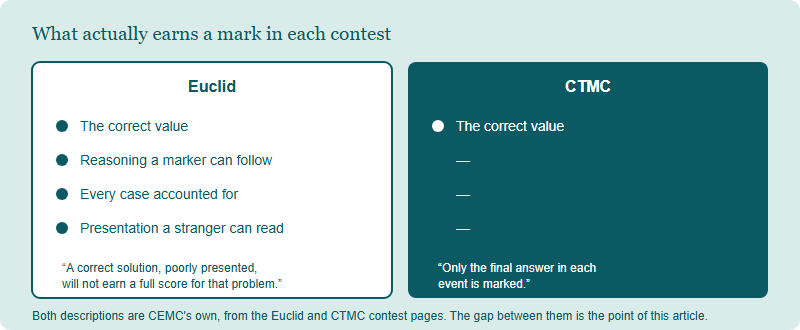
This matters because of how contest practice is usually sold. A student who does well in the team contest has demonstrated speed, recall and accuracy under pressure. They have not demonstrated that they can write a solution a marker will pay for — the skill our guide to how step marks work is entirely about. From coaching students through both, our teaching team's view is that the transfer runs in one narrow direction: team contest work sharpens the fast, answer-getting half of Euclid, and does nothing for the written half. Treat it as cross-training, not as a substitute.
Three events, three genuinely different pressures
The published problem counts make the pacing vivid. The individual event is 10 problems in 45 minutes. The team event is 25 problems in 45 minutes, shared among six people. Euclid is 10 questions in 150 minutes.
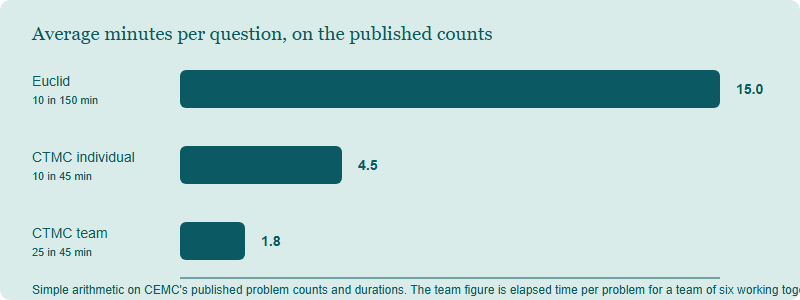
The practical consequence is that the team event cannot be solved by six people each politely working through all 25 problems. It has to be divided, and dividing it is itself the skill: reading 25 problems quickly enough to know which ones you personally should take, handing off the ones you should not, and trusting an answer you did not derive. Very little else in a Chinese international-school mathematics education asks a student to do that.
The individual event, at 4.5 minutes per problem, sits closer to the multiple-choice contests most students already know. The relay event runs 45 minutes like the others; confirm its current published format on cemc.uwaterloo.ca before you design practice around it, as the structure of a relay round is the part most worth checking against the current year's rules.
That difference is worth exploiting rather than smoothing over. Because the individual event is written alone and scored on answers, it is the one place in the contest where a student gets a clean read on their own speed with no team to hide behind — and it is the closest of the three events to the answer-getting half of Euclid. Schools that debrief only the team result throw that away. Ask each student to set their individual event against their own past-paper timings, and the morning starts producing information rather than just an experience.
How to pick six, when CEMC has told you the constraint
Teams may be “any combination of Grades 9–12”, and CEMC adds a caution worth quoting because it is unusually direct: grade 9 and 10 participants can contribute, but teams without grade 11 and 12 students may struggle with the challenging problems.
That reframes team selection. The question is not “who are our six best?” but “does this six contain enough senior mathematical range to survive the hard end of the paper, while leaving room for the juniors who will be here next year?” A school treating the contest as a one-off picks its six strongest seniors. A school treating it as a pipeline puts four seniors and two grade 10s in each team, and has a returning core every April. Since the published in-school fee covers as many teams as the school wants, the pipeline version costs nothing extra.
- Do not build a team of six specialists. The individual event is written alone; every member needs baseline range.
- Do rehearse the handoff, not just the mathematics. Deciding who takes which of 25 problems is where teams lose most, and it is trainable in an afternoon.
- Do keep at least one junior per team if you want the same school entering in 2028 without starting over.
Where it belongs in the April calendar
For a school outside North and South America the sequence is convenient. Euclid sits on Wednesday 7 April 2027. The team contest can be run in-school from Wednesday 14 April 2027 or later, at a date the school chooses — a week or more after Euclid, once the pressure is off and the grade 12s have finished. The full set of April dates and the two distinct March closes are laid out in our 2027 key dates guide.
Used that way, the team contest does something a Euclid-only calendar cannot. It gives grades 9 to 11 a CEMC event of their own in the same month, run by their own school, in which the seniors who just wrote Euclid are teammates rather than a distant benchmark. Our own view, from working with schools rather than from anything CEMC publishes, is that this is where its real value sits: it is a recruiting and continuity instrument for a school's mathematics culture, priced so that the decision does not need a budget meeting.
Seen across a whole season, the CEMC calendar offers three distinct modes rather than one contest repeated. The Canadian Senior and Intermediate contests in November ask for written argument on a nine-question paper. Euclid in April asks for the same thing at greater length and greater weight. The team contest asks for none of it, and tests instead whether six students can organise themselves against a clock. A school running all three is not staging the same event three times — it is measuring three different things, and only two of them are what Euclid marks.
What it will not do is raise anyone's Euclid score by itself. A contest that marks only final answers cannot teach the thing Euclid marks. Enter it because a team of six racing 25 problems is worth having in a school year — and keep the written practice going separately.
Frequently asked questions
Can a school in China run the CTMC?
CEMC lists an in-school event outside North and South America on Wednesday 14 April 2027 or later, ordered through the Contest Supervisor Portal.
How much does the CTMC cost?
The published in-school fee is $50.00, and CEMC states as many teams of six may participate as desired in each registered school.
Does the CTMC use full-solution marking like Euclid?
No. CEMC states only the final answer in each event is marked, which is the opposite of Euclid's completeness, clarity and presentation standard.
Can grade 9 students be on a CTMC team?
Yes — teams are any combination of grades 9 to 12, though CEMC cautions that teams without grade 11 and 12 students may struggle.
Editorial note: Contest dates, fees, team rules and eligibility are re-set by the organiser each cycle — confirm current details on cemc.uwaterloo.ca before acting on anything here. Corrections are issued within 7 working days of notice.