Most of Euclid is built on school mathematics: CEMC describes most of its problems as based on curricula up to and including the final year of secondary school, noting that some might require knowledge beyond the curriculum in a student’s school. For IB, A-Level and AP students the gaps are predictable — number theory, contest counting, circle geometry and complete arguments — and so are the three exam habits the paper penalises. This is the map, checked against the 2025 and 2026 papers.
What Euclid assumes, in CEMC’s own terms
CEMC lists Euclid for students in their final year of secondary school or CÉGEP, and adds that motivated students in lower grades are welcome to write it. On content its description is brief: most problems draw on curricula up to and including the final year, and some may require knowledge beyond the curriculum. The format was printed on the cover of the 2026 paper — ten questions, each worth 10 marks, in two and a half hours, with short-answer parts worth 3 marks each and full-solution parts marked for completeness, clarity and style of presentation. Calculus is not assumed.
The catch is the word “curricula”. Euclid is set in Canada, and a Canadian final-year course is not an IB, A-Level or AP course. Whether a given problem counts as familiar for you depends on what your own course happened to include, and the three international routes include quite different things. So the useful question is not whether Euclid lies within your course, but which parts of it do.
Zone A: what your course already carries
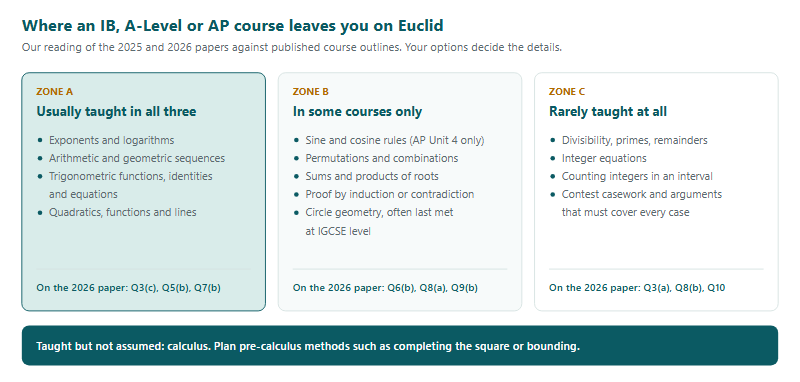
A good share of Euclid sits squarely inside all three routes. Exponents and logarithms, arithmetic and geometric sequences, trigonometric identities and equations, quadratics and functions are standard material in IB Mathematics: analysis and approaches, in A-Level Mathematics, and in AP Precalculus, whose three examined units are polynomial and rational functions, exponential and logarithmic functions, and trigonometric and polar functions. The sine and cosine rules are standard on the IB and A-Level routes, but AP Precalculus lists them only in its Unit 4 vectors topic, which is not assessed on the AP Exam.
The 2026 paper leaned on this ground more than once. Question 3(c) combined a parabola’s intercepts with a triangle’s area, question 5(b) fitted a square between the x-axis and a parabola and reduced to a quadratic that CEMC’s published solution solves with the quadratic formula, and question 7(b) was built from base-2 logarithms. One of CEMC’s published routes through question 6(b) applies the cosine rule twice, which IB and A-Level students will recognise and AP-track students may need to add.
Familiar is not the same as safe. CEMC’s published commentary on the 2025 paper said that most mistakes on its logarithm system came from misapplied logarithm rules, from forgetting that the input of a logarithm must be positive, or from wrongly claiming that its output must be positive. That is course content, lost on exactly the points a school paper rarely presses.
Zones B and C: what most courses leave out
The rest of the map is where international-curriculum students lose the most ground. The table sets out five skill areas that decided parts of the last two papers, and where each usually stands in the three routes.
| Euclid skill | On the 2025 or 2026 paper | IB Mathematics: analysis and approaches | A-Level Mathematics | AP Precalculus |
|---|---|---|---|---|
| Divisibility, primes, remainders, integer equations | 2026 Q3(a); 2025 Q8(b) | Not a course topic | Not in A-Level Mathematics; some Further Mathematics options include it | Not a course topic |
| Counting: casework, complements, integers in an interval | 2026 Q2(b), Q7(b), Q8(b), Q10; 2025 Q5(a), Q6(a) | Counting principles at HL; SL meets combinations through the binomial theorem | Permutations and combinations appear on some boards’ statistics papers, not all | Not a course topic |
| Circle and similar-triangle geometry | 2026 Q8(a); 2025 Q4(b) | No circle-theorem topic | Circle work is mainly coordinate-based; the theorems usually date from IGCSE | Usually taught in a separate geometry course, if at all |
| Roots and coefficients of polynomials | 2026 Q9(b); 2025 Q9 | Sums and products of roots at HL | Factor and remainder theorems; root–coefficient relations usually in Further Mathematics | Zeros and factors; confirm whether your class covered sums and products of roots |
| Complete arguments: “determine all” and “prove” | 2026 Q9(b), Q10(c); 2025 Q9(c), Q10(c) | Simple deductive proof at SL; induction and contradiction at HL | Proof content varies by specification | Justification in free-response work rather than formal proof |
Number theory is the widest gap. None of the three routes teaches it as standard content, yet it appeared on both of the last two papers. In 2026, question 3(a) turned on prime factorisation, asking for the smallest divisor that leaves a perfect cube. In 2025, CEMC noted that a small number of correct solutions to the palindrome question used modular arithmetic — a tool most IB, A-Level and AP students have simply never been shown.
Counting arrives disguised. In 2026, questions 7(b) and 8(b) both began on familiar course ground — a logarithm in one, and the cosine-rule test for an obtuse angle in the other — and both finished by counting the integers in an interval, which none of the courses in the table teaches as a technique.
Geometry is where coordinates can rescue you. CEMC’s published routes through 2026 question 8(a) use the secant–tangent theorem, similar right triangles, or the sine rule. On 2025 question 4(b), its commentary said students who used similar triangles often did not justify the similarity, while students who used coordinates were generally successful. For an IB or A-Level student with strong coordinate geometry, that is a legitimate route to know about — and the justification habit is worth building either way.
Polynomials and complete arguments travel together. CEMC’s published argument for 2026 question 9(b) runs through the product of a cubic’s roots, and its comments on 2025 question 9 said that many students reached the right roots but left out how they found them or why no other answer was possible. HL students usually have the algebra; students on every route need the second half of that sentence.
Three habits your course trained that Euclid penalises
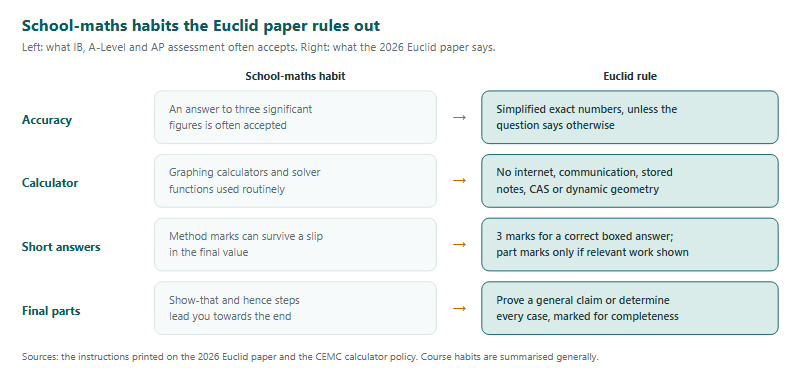
1. Rounding. IB papers tell candidates that, unless a question says otherwise, answers may be given exactly or correct to three significant figures, and school assessment on the other routes often accepts a correctly rounded value too. The Euclid cover asks for simplified exact numbers unless a question says otherwise. The 2025 commentary shows the cost: on one geometry question, students who used trigonometry often rounded and ended with an inexact answer, and on another, CEMC stated that inexact answers did not earn full marks.
2. The graphing calculator. IB and AP courses build habits around graphing technology. The 2026 Euclid cover allowed a calculating device only if it had no internet access, no ability to communicate with other devices, no information stored by students such as formulas, programs or notes, no computer algebra system and no dynamic geometry software, and the CEMC calculator policy names the Casio ClassPad 300 series, the HP Prime and the TI-Nspire CAS as examples of devices that are not allowed. Even a permitted device only does arithmetic for you: the notes on the paper say other mathematical steps must be shown and justified, and use the example of a calculator finding the x-intercepts of a cubic, which you are still expected to derive algebraically.
3. Method-mark instincts. IB and A-Level mark schemes reward method as well as the final value, and structured “show that” and “hence” steps guide you towards the end of a question. Euclid rewards method more narrowly. A short-answer part earns full marks for a correct answer in the box and part marks only if relevant work is shown; a full-solution part is marked for completeness, clarity and style, and the cover says a correct solution poorly presented will not earn full marks. The final parts also stop guiding you: in 2026, question 9(b) asked for a proof and question 10(c) for a closed form in n, and in 2025, question 9(c) asked for a proof and question 10(c) for every value of n that works. Our guide to how step marks work covers that marking in detail.
A one-term add-on plan for each route
| Your route | Usually already strong | Add between October and February |
|---|---|---|
| IB analysis and approaches, SL | Logarithms, sequences, trigonometry, functions | Number theory from scratch; counting casework; circle geometry; full solutions to “determine all” problems |
| IB analysis and approaches, HL | The SL list, plus counting principles, sums and products of roots, induction | Number theory; circle geometry; exact-form discipline; turning induction habits into complete Euclid write-ups |
| A-Level Mathematics, with or without Further Mathematics | Algebra, trigonometry, exponentials, coordinate geometry including circles | Number theory; counting if your statistics route skipped it; IGCSE circle theorems refreshed; exact answers only |
| AP Precalculus and Calculus | Polynomial, exponential, logarithmic and trigonometric functions | Number theory; counting; the sine and cosine rules; geometry if your school had no separate course; written arguments; practice without solver functions |
Order the work so that full-paper practice starts early in the new year, and settle entry before the rush. Euclid has no individual registration, the CEMC ordering deadline for schools and test centres is 11 March 2027, and our own China test centre closes its list earlier, on 8 March. The 2027 key dates page sets out the full sequence.
What a Euclid result adds to an IB, A-Level or AP application
An international-curriculum application has a calibration problem. A predicted 7 in HL mathematics or a predicted A* is a strong claim, but an admissions reader has to judge it against a school, a grading culture and sometimes a curriculum they know only loosely. Readers deal with that by cross-checking: does the transcript agree with the predicted grade, does the activity list show sustained mathematics, do the essays sound like someone who has actually worked hard problems?
A Euclid result helps precisely because it sits outside all of that. It comes from one paper, written under supervision on dates CEMC sets and marked to one published standard, and CEMC’s 2026 results booklet counts 23,985 students registered for that year’s paper. Placed beside a predicted grade, it corroborates the grade. Placed beside a mathematics essay or a second competition result, the pieces corroborate one another, and that consistency is what makes the whole file believable. It is evidence rather than a requirement: CEMC’s own Euclid page states that participation is not required for admission to the University of Waterloo’s Faculty of Mathematics, and no result secures an offer anywhere.
A few questions international-curriculum students ask us about Euclid:
Is IB Maths analysis and approaches HL enough preparation for Euclid?
It covers much of the algebra, trigonometry and counting, but not number theory, circle geometry or contest casework, which you will need to add.
Does Euclid require calculus?
No. Calculus is not assumed, so plan pre-calculus methods such as completing the square or bounding instead of differentiating.
Can I use my IB or AP graphing calculator on Euclid?
Only if it has no internet access, communication, stored notes or programs, computer algebra system or dynamic geometry software. Check CEMC policy.
Will rounded decimal answers lose marks on Euclid?
Often, yes. The paper asks for simplified exact numbers unless told otherwise, and CEMC said inexact answers did not earn full marks in 2025.
Editorial note: this guide is written by Hanlin Education for China-based international-school students. Course descriptions are general summaries of published outlines, and question descriptions are our own summaries of the papers. Contest formats, dates and calculator rules are set by the organiser and can change between cycles — confirm current details on cemc.uwaterloo.ca. Corrections are issued within 7 working days of being reported.