Counting and probability seldom arrive labelled on Euclid. On the 2026 paper only question 10 was built entirely around counting, yet a count or a probability decided parts of four other questions, including a logarithm question and a geometry question whose last step was counting the integers in an interval. This guide maps where counts appeared on the 2025 and 2026 papers, what CEMC’s markers said went wrong, and how to write a count that earns its marks.
Where the counts appeared on the last two papers
CEMC publishes the format of Euclid but no topic weighting, so the only honest way to see how counting behaves is to read the papers themselves. Across the last two, it turned up in three forms: as a question of its own, as a probability, and as the final step of a question that began somewhere else entirely.
| Paper | What the part looked like | The counting move | Question average, out of 10 |
|---|---|---|---|
| 2026 Q2(b) | Three-digit integers whose digits have a given product | Factor the product, list the digit sets, count their orders | 9.1 |
| 2026 Q5(a) | A die with some unknown faces and a given probability of a prime sum | Count the favourable outcomes out of 36 | 5.8 |
| 2026 Q7(b) | A function defined through base-2 logarithms | Unwind the definition to an interval, then count the integers in it | 3.4 |
| 2026 Q8(b) | Integer-sided obtuse triangles with one side k and perimeter 3k | Turn two conditions into bounds, then count the integers strictly between them | 1.8 |
| 2026 Q10 | Arrangements of 1 to n with a single internal peak | Casework for n = 5, then closed forms in n | 0.73 |
| 2025 Q5(a) | Lock combinations under ordering conditions | Apply the conditions without adding assumptions of your own | 4.8 |
| 2025 Q6(a) | Triangles with two equal sides chosen from twelve points on a circle | Count them, then correct for the equilateral triangles | 4.7 |
| 2025 Q8 | Independent pass-or-fail probabilities, then pairs of palindromes | Solve for the probabilities with working shown; count the pairs through divisibility | 2.0 |
Two things stand out. First, the averages fall steeply as the counting moves down the paper: the short digit count sat in a question that averaged 9.1, while the two 2026 questions that ended in an interval count averaged 3.4 and 1.8, though each average covers every part of its question, not the count alone. Second, none of it is labelled. Question 7(b) reads as a logarithm question and question 8(b) as a geometry question, so a student who revises counting as a separate chapter and waits for a counting question will meet most of the counting on the paper unprepared.
The move 2026 used twice: counting the integers in an interval
Strip the logarithms out of question 7(b) and the triangles out of question 8(b), and both finish in the same place: a pair of bounds on an integer, and a count of the integers that fit between them. CEMC’s published solution to 8(b) handles its interval by splitting on the remainder when k is divided by 4. It is the right tool, and it is worth owning well before April.
Two formulas cover every case. For real numbers a < b, the number of integers t with a < t < b is ⌈b⌉ − ⌊a⌋ − 1, and the number with a ≤ t ≤ b is ⌊b⌋ − ⌈a⌉ + 1. When a and b depend on a variable, though, the formula is rarely what belongs on the page. What belongs there is a split by remainder, because it turns every floor and ceiling into a plain integer you can write down.
Here is a worked example of our own, with a different interval from the 2026 one. For a positive integer k, how many integers t satisfy k/3 < t < k/2? Write k = 6q + r, where q is a non-negative integer and r is one of 0, 1, 2, 3, 4 or 5. Then k/3 = 2q + r/3 and k/2 = 3q + r/2, and the count follows case by case:
- r = 0: 2q < t < 3q, so t runs from 2q + 1 to 3q − 1, which is q − 1 integers.
- r = 1 or 2: t runs from 2q + 1 to 3q, which is q integers.
- r = 3 or 4: t runs from 2q + 2 to 3q + 1, which is again q integers.
- r = 5: t runs from 2q + 2 to 3q + 2, which is q + 1 integers.
So if a question asked for every k giving exactly 10 such integers, the answer would be k = 66 (r = 0 with q = 11), k = 61, 62, 63 and 64 (q = 10), and k = 59 (r = 5 with q = 9) — but not 60 or 65, which sit one step to either side. Those two missing values are exactly the kind of boundary a pattern guessed from a few examples tends to miss.
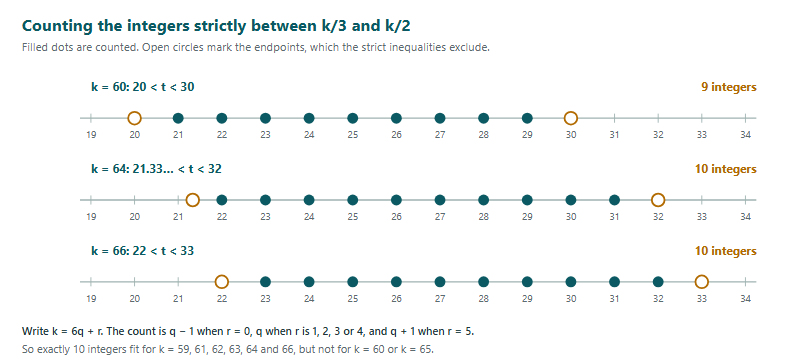
The written habit that earns the marks is simple: state the smallest qualifying integer and the largest, say whether each endpoint is included, and only then subtract and add one. Our guide to how step marks work explains why those lines, rather than the final number alone, are what a marker can credit.
Casework a marker can check
Most Euclid counts are won or lost in the casework. CEMC’s commentary on the 2025 lock question said that students who counted by considering cases often reached slightly wrong answers, for reasons such as quietly assuming two of the values were equal or placing an extra bound on one of them. On the twelve-points question, the most common errors were believing there were 12 equilateral triangles when there are 4, or leaving the equilateral triangles out altogether.
Both failures have the same cure: decide the structure before you count anything.
- Pick one controlling variable. CEMC’s published solution to 2026 question 10(a) organises every arrangement by the value sitting at the peak. One variable, a handful of values, no overlaps.
- Announce the cases in a sentence. A line such as “every arrangement falls into exactly one of these cases, according to the value in position 3” is what tells a marker your partition is complete.
- Prefer the complement when the condition is a prohibition. To count the arrangements of A, A, B, B and C in which the two A’s are not next to each other, count all 30 arrangements, subtract the 12 in which the A’s form a block, and get 18.
- Justify a correspondence in words. Choosing three of the numbers 1 to 10 with no two consecutive matches choosing any three of the numbers 1 to 8: list the chosen numbers in increasing order and subtract 0, 1 and 2. That gives C(8, 3) = 56, but it is the sentence explaining why the matching works in both directions that earns the argument.
Probability is counting with a denominator
Euclid probability is usually counting in disguise, and the 2026 die question shows it: CEMC’s published solution tabulates all 36 outcomes, counts the prime sums in terms of the unknown number of faces, and sets that count against the given probability. When the outcomes are not equally likely, the work turns into algebra, and the 2025 commentary is worth reading closely. On the question about three students passing or failing a test independently, some students made a computation error that produced a probability below 0 or above 1 — a result that should have stopped them immediately — and many who reached the right answer did not show how they solved the system of equations, which CEMC said was required for full marks.
Try this one, again our own. A bag holds n red marbles and 3 blue ones, and two are drawn without replacement. If the probability that both are the same colour is 1/2, determine all possible values of n. Counting ordered draws, the condition is [n(n − 1) + 6] ÷ [(n + 3)(n + 2)] = 1/2, which simplifies to n2 − 7n + 6 = 0, so n = 1 or n = 6. Both survive a check: with one red marble, 6 of the 12 ordered draws are a matching pair, and with six red marbles, 36 of the 72 are. A solution that drops n = 1 because one red marble seems too few has lost a case, and a “determine all” question marks that directly.
Two habits follow from both examples. Check that every probability you compute lies between 0 and 1 before you use it, and write out the equations and every step of solving them, because a correct value without that working is not a complete solution.
Writing a count that earns the completeness marks
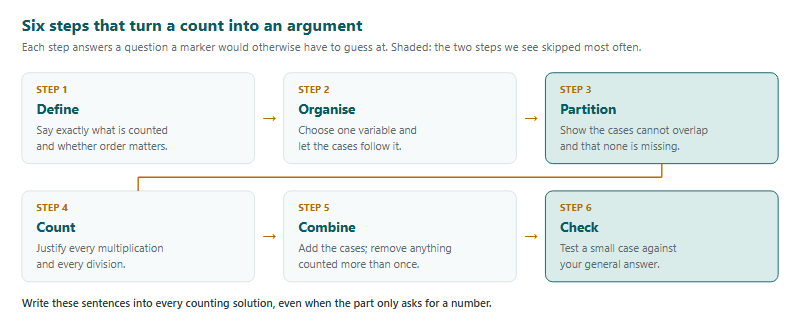
The six steps answer the questions a marker would otherwise have to guess at, and the 2025 commentary maps onto them closely. On the palindrome question, students who relied on trial and error or looked for a pattern usually missed some pairs — a failure to organise and partition. Others assumed the difference of the two palindromes must itself be a palindrome, an unjustified step, while a small number of correct solutions used modular arithmetic to organise the count. On the coin-flipping question, some students argued that the number of coins must be a multiple of 3 because three coins flip on every move, which quietly assumes each coin flips exactly once: a plausible pattern standing in for a reason.
In our own marking, lost marks cluster the same way — cases never shown to cover everything, a multiplication with no reason attached, and closed forms never tested on a small case. The last is the cheapest to fix. If your formula in n claims something, evaluate it at the smallest allowed value of n and compare it with a direct count before you commit it to the page.
How to train the counting block
Because counting hides inside other topics, train it across them. Collect every past-paper part whose final step is a count or a probability, whatever chapter the question seems to belong to, and write each one out in full even when the original part only wanted a number in a box. Our compiled 1998–2026 archive helps here because it spans far more years than the most recent handful; worked solutions are attached to some years, not all, which is one more reason to check small cases yourself. Do this block before full-paper practice begins in the new year, and settle entry well before our China test centre closes its list on 8 March 2027 and the CEMC ordering deadline of 11 March — the 2027 key dates page sets out the sequence.
A few questions we are asked about this part of the paper:
How much counting and probability is on the Euclid paper?
CEMC publishes no topic weighting. In 2026, counting filled question 10 and decided parts of four other questions, often inside other topics.
Do I need permutation and combination formulas for Euclid?
They help, but most Euclid counts are won by organised casework, complementary counting and careful interval counts, written as an argument.
Why did my correct probability answer lose marks?
Full-solution parts need the working. CEMC noted in 2025 that showing how a system of equations was solved was required for full marks.
How do I avoid off-by-one errors when counting integers?
Write down the smallest and largest qualifying integers, decide whether each endpoint is included, then subtract and add one.
Editorial note: this guide is written by Hanlin Education for China-based international-school students. Question descriptions and worked examples are our own; per-question averages and marker comments are as published by the organiser. Confirm current contest details on cemc.uwaterloo.ca. Corrections are issued within 7 working days of being reported.