In the preparation process for the Euclid Mathematics Contest, organized by the University of Waterloo, practicing past papers is undoubtedly the core and most efficient revision method. Many students work through nearly a decade of past papers, some even reworking them multiple times. However, why do some people still find their scores stuck at a bottleneck despite having completed a thick stack of past papers? The problem often lies not in the quantity of practice, but in the quality of practice and the neglect of high-frequency score-losing traps. Unlike purely objective multiple-choice exams, the Euclid has strict marking standards and hidden pitfalls. This article will provide an in-depth analysis of the four most common pitfalls students encounter when practicing Euclid past papers, along with a guide to avoiding high-frequency score-losing question types.
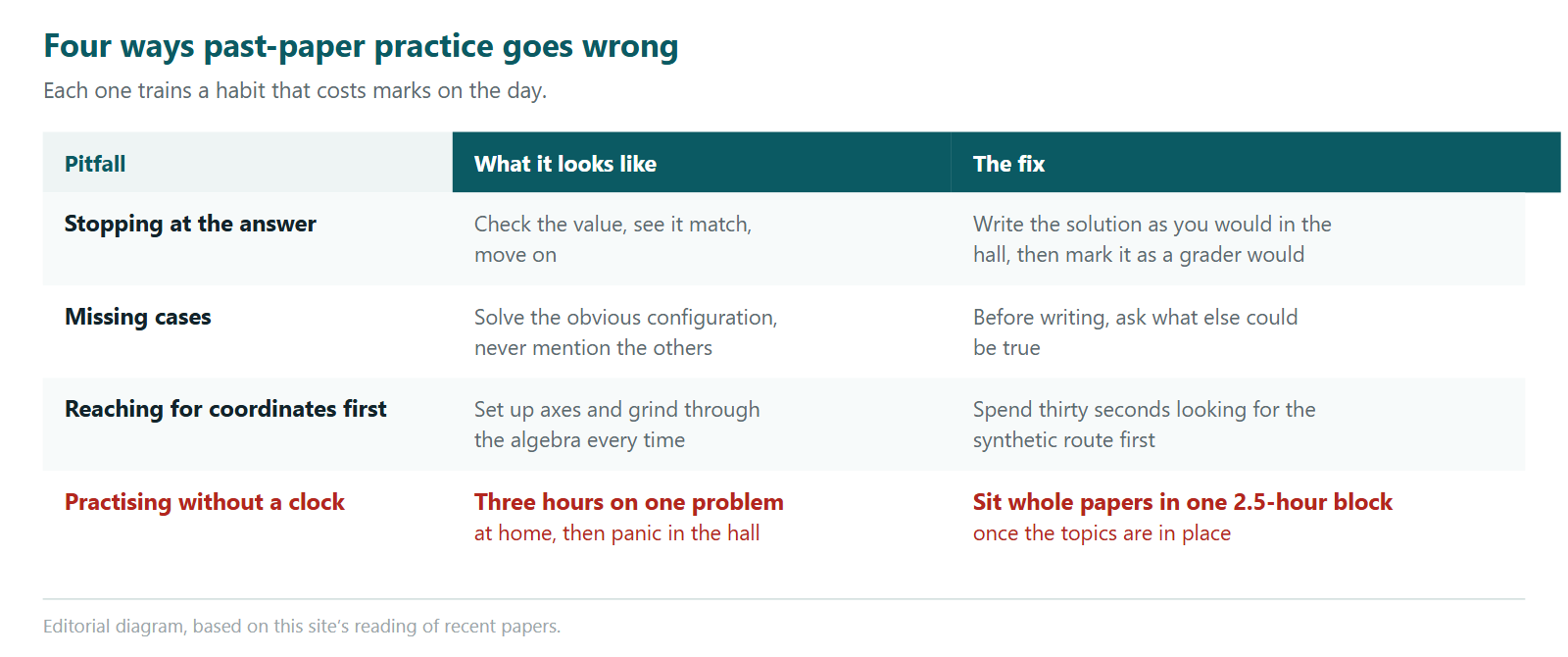
I. Pitfall 1: Being Satisfied with “Getting the Answer” While Neglecting “Rigorous Process”
This is the biggest trap that all candidates (especially those who excel in school mathematics) are most likely to fall into.
Typical manifestation: When practicing past papers, students are used to making guesses and rough calculations on scratch paper. As long as the final numeric or algebraic expression matches the official answer, they immediately check it off as correct, without even bothering to look at the official Full Solutions.
Consequences for scoring: The later sections of the Euclid require “Full Solutions.” Examiners value the completeness of your logical chain. If you directly skip key steps in proof questions (for example, writing “It is obvious that…”) or fail to explain the origin and legitimacy of auxiliary lines in geometry problems, you will be docked a significant portion of the process marks in the actual exam.
How to avoid this pitfall: When practicing past papers, after completing each long-answer question, you must meticulously compare your written steps with the official standard answers. Ask yourself: Does my first sentence state the prerequisites? Does each step of the derivation violate mathematical logic?
II. Pitfall 2: Missing Cases in Classification Discussions, Leading to Logical Dead Ends
The final problems of the Euclid (typically Questions 7 to 10) heavily favor comprehensive questions that involve parameters, absolute values, inequality constraints, or uncertain geometric positions.
Typical manifestation: When solving problems, students only follow their habitual thinking and write down the most common case (for example, assuming x > 0 or assuming an acute triangle), completely ignoring other boundary conditions.
Consequences for scoring: Such “half-baked” solutions usually only earn a meager number of starting marks in the Euclid. For example, when dealing with the positional relationship between a circle and a line, or the range of a function’s extrema, missing an endpoint or a geometric configuration renders all your effort on that problem futile.
How to avoid this pitfall: Develop a “classification awareness”: Whenever you see absolute values, radicals, parameters like k, or descriptions in geometry problems such as “a point can lie on either side of a line segment,” alarm bells must ring in your head immediately. Force yourself to first delineate the discussion intervals. Review and train: In your past-paper error notebook, specifically tally the problems where you lost marks due to “missing a case,” and summarize the common scenarios that trigger the need for classification (such as parity discussions, sign discussions, and internal/external tangency cases in geometry).
III. Pitfall 3: Blindly Applying Formulas While Ignoring “Geometric Intuition” in Geometry and Algebra
The problems in the Euclid are often designed with both depth and elegance. Many students, when practicing, habitually resort to “heavy artillery” right from the start (such as forcibly setting up a large coordinate system and using analytic geometry to brute-force calculations, or employing complex trigonometric identities).
Typical manifestation: Turning an elegant proof problem that could be solved in just a few lines using elementary geometric properties (such as similar triangles, the inscribed angle theorem, or the power of a point theorem) into a tedious, error-prone algebraic equation spanning dozens of lines.
Consequences for scoring: Within the limited time of the exam, an excessive amount of computation greatly increases the likelihood of arithmetic errors. Once a single sign is written incorrectly, the entire solution collapses. Even if you eventually arrive at the correct answer, it will severely cut into the time available for thinking about other final problems.
How to avoid this pitfall: After completing past papers, make sure to review the “Alternate Solutions” provided in the official answers. You will find that the official solutions often favor the most concise and geometrically elegant pure geometry approaches. Take time to internalize this way of thinking, cultivate your intuition for figures, and reduce unnecessary “brute-force” attempts.
IV. Pitfall 4: Failing to Review “Time Allocation,” Leading to a “Slow Start, Tight Finish”
Many students, when practicing past papers in their daily routine, like to “take three hours to slowly work through a single final problem while sipping milk tea at home,” thinking that as long as they eventually solve it, it counts as success.
Consequences for scoring: Once you are in the high-pressure environment of the 150-minute actual exam, with the extensive calculations in the first half and the lengthy proof problems in the second half, your rhythm is completely disrupted. Often, students spend too much time on the mid-range questions, leaving no time to even read the last two big problems.
How to avoid this pitfall: Timed mock exams: In the month before the exam, you must conduct strict timed mock exams (150 minutes), without referring to any materials or taking breaks. Review time granularity: Track how much time you spend on the first 5 questions, the middle 3 questions, and the last 2 questions. Optimize your problem-solving strategy: Aim to solve the first 6 questions quickly and accurately (compressing them into 50–60 minutes) to reserve sufficient time and energy for the more challenging problems ahead.
Frequently Asked Questions
What is the biggest mistake when working through past papers?
Stopping at the answer. Students who are strong at school mathematics often check the final value, see it match, and move on — which trains exactly the wrong reflex for a paper where eight or nine of ten marks follow the written work. Practising a paper means writing the solution out as you would in the hall, then marking it against a worked solution the way a grader would.
How do students lose marks on the later questions?
Missing cases. Questions seven through ten routinely involve parameters, absolute values, inequality constraints or geometric configurations that are not fully determined. A solution that handles one case cleanly and never mentions the others is incomplete, and it is marked as incomplete. Getting into the habit of asking what else could be true before writing is worth more than extra speed.
Should I practise with a timer from the start?
Not from the very start, but sooner than most students do. Working a single hard problem for three hours at home teaches you that you can solve it, not that you can solve it in the hall. Once the topics are in place, sit whole papers in one 2.5-hour block. Time allocation is a skill of its own, and it is usually the first thing to fail on the day.