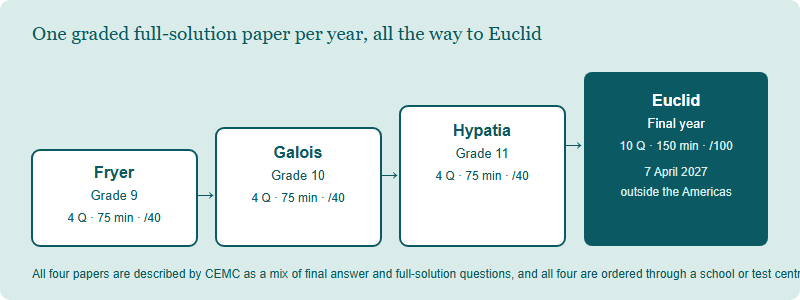
Euclid is listed for students in their final year of secondary school. That leaves grades 9, 10 and 11 with three years of waiting — except CEMC runs a full-solution contest for each of those grades. Fryer, Galois and Hypatia are 4 questions, 75 minutes, out of 40, described as “a mix of final answer-only and full-solution”, sat on Thursday 8 April 2027 outside North and South America. That is the day after Euclid, on the same ordering deadline.
The three-year gap that is not actually empty
Ask what a strong grade 10 student at a Chinese international school should be entering, and the answer usually points somewhere other than Waterloo — a multiple-choice contest, a summer programme, more school mathematics. The reasoning is sound as far as it goes: CEMC lists Euclid for students in their final year of secondary school or CÉGEP, and while it notes that younger high achievers may write it, it also attaches its own conditions to official recognition, which are re-set each cycle and should be confirmed on the official site.
What that reasoning misses is that CEMC did not leave the lower grades to multiple choice. It built a contest for each of them, using the same phrase it uses for Euclid, and it runs them in the same week.
| Fryer | Galois | Hypatia | |
|---|---|---|---|
| Grade | 9 | 10 | 11 |
| Structure | “4 questions; a mix of final answer-only and full-solution” | ||
| Score | Out of 40 | ||
| Time | “Time allowed for completion is 75 minutes” | ||
| Date (outside North and South America) | Thursday, 8 April 2027 | ||
| Date (North and South America) | Wednesday, 7 April 2027 | ||
| Ordering deadline | Thursday, 11 March 2027 — the same organiser deadline as Euclid | ||
| Fee as published | $12.00 per participant, plus $5.00 processing per order; international shipping 15% of order total, minimum $10.00 | ||
| Calculators | “Some calculators permitted” | ||
| How to enter | Through a school or test centre — no individual registration route | ||
One contest per grade, each ending where the next begins, each marked on written work, each priced at $12.00 per participant. For a student who will write Euclid in grade 12, that is three rehearsals with real markers before the paper that counts.
The arithmetic that makes these papers harder to sit than they look
A 75-minute paper out of 40 sounds like a gentler version of a 150-minute paper out of 100. On two measures that matter, it is not.
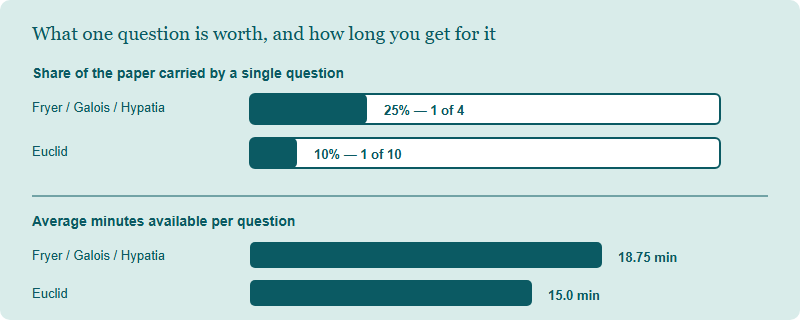
Each question carries far more weight. Four questions in a paper means one question is a quarter of everything available. On Euclid, one of ten questions is a tenth. A student who abandons a single question on Hypatia has walked away from 25% of the paper; the same decision on Euclid costs 10%. Whatever your instinct is about skipping a question you dislike, it needs recalibrating by a factor of two and a half.
There is more time per question, not less. Seventy-five minutes over four questions is 18.75 minutes each. One hundred and fifty minutes over ten is 15. The lower-grade papers are not speed tests with a shorter clock — they give a student more room per question than Euclid does. That tells you what they are actually testing: not how fast you can produce answers, but whether you can stay inside one problem long enough to write the whole of it down.
Both facts push in the same direction, and it is the direction our guide to how step marks work is about. On a four-question paper, the marks you salvage from a question you cannot finish are a large fraction of your score. A student who writes down the set-up, states the case they are considering and gets two steps in has protected something real. A student who works it out in their head, fails to reach the end, and leaves the page blank has thrown away a quarter of the paper.
7 and 8 April: one order window, two consecutive papers
The 2027 calendar puts these contests next to each other. Outside North and South America, Euclid is sat on Wednesday 7 April 2027 and Fryer, Galois and Hypatia on Thursday 8 April 2027. Both carry the same organiser ordering deadline of Thursday 11 March 2027.
Two consequences follow, one administrative and one for planning.
The administrative one: a school deciding in February what to order can settle Euclid and the lower-grade papers in the same conversation, because the organiser's window closes on the same day for both. Note the shipping term while you are there — international orders are charged 15% of the order total with a $10.00 minimum, so how a school groups its order is worth asking about rather than assuming. And be careful which deadline anyone is quoting at you: 11 March is the organiser's portal close, while our own China test centre closes its Euclid list earlier, on 8 March 2027, which is our own arrangement and not something the organiser publishes. Those two dates are both real and they are not the same thing; our 2027 registration guide sets out how each route works, and the 2027 key dates guide keeps the full calendar in one place.
The planning one is for grade 11. A student in grade 11 is inside the published band for Hypatia on 8 April, and CEMC also allows younger high achievers to write Euclid on 7 April subject to its own recognition conditions. Writing both on consecutive days is possible in principle, and we would generally advise against treating it as a default. Two full-solution papers in two days is a lot of sustained writing, and the honest question is what the second paper is for. If Euclid on the Wednesday is a first exposure with no expectation attached, Hypatia on the Thursday is the paper that will actually produce a meaningful mark. If it is the other way round, sit one properly.
Building the on-ramp, without pretending it is a shortcut
Set against a four-year plan, these papers give a student something specific: repeated experience of being marked on written mathematics by someone who is not their teacher, starting in grade 9 and repeating annually. The autumn term offers a second opportunity in the same year, since CEMC also runs a nine-question, two-hour paper in November whose three full-solution questions are assessed on the same published standard.
- Grade 9 — Fryer. The goal is not a score. It is producing four written attempts under time, and reading the marks back honestly.
- Grade 10 — Galois. Same structure, harder content. By now the set-up habits should be automatic: define the variables, state the claim, finish the case.
- Grade 11 — Hypatia. The last rehearsal where the stakes are entirely your own. This is the year to fix presentation, not to discover it needs fixing.
- Grade 12 — Euclid. Ten questions, 150 minutes, out of 100, on 7 April 2027 outside the Americas.
For context on the destination: across our own Euclid cohorts, students scoring 80 or above numbered 49, 63, 75, 97 and 112 in 2022 through 2026. Those are our own de-identified tallies per Hanlin, not a CEMC statistic, and individual results vary. From coaching those cohorts, our teaching team's consistent observation is that the students who struggle most in grade 12 are rarely short of mathematics — they are meeting an external marker for the first time with five months to go. Three earlier papers do not remove that problem, but they move it to a year where it costs nothing.
It is also worth being plain about what a contest record is not. CEMC states that participation in the Euclid Contest is not required for admission to the Faculty of Mathematics at the University of Waterloo. Waterloo's own material describes contests as a way to demonstrate sufficient mathematical background, noting this is “especially useful in cases where we may be unfamiliar with an education system” — a fair description of the situation many international-school students in China are in, and a long way from any claim about outcomes. Enter these papers because writing four solutions a year that a stranger marks will make you better at mathematics. The rest is not ours to promise.
Frequently asked questions
When are the Fryer, Galois and Hypatia contests in 2027?
Thursday 8 April 2027 outside North and South America, and Wednesday 7 April 2027 within them, as published by CEMC.
Which contest matches my grade?
CEMC lists Fryer for grade 9, Galois for grade 10 and Hypatia for grade 11. Each is 4 questions in 75 minutes, scored out of 40.
Can a grade 11 student write both Hypatia and Euclid?
They sit on consecutive days in 2027 outside the Americas. Euclid recognition conditions for younger students are set by CEMC — confirm officially.
Is the ordering deadline the same as Euclid's?
Yes, the organiser's deadline is Thursday 11 March 2027 for both. Our own China centre closes its Euclid list earlier, on 8 March 2027.
Editorial note: Contest dates, fees, eligibility and recognition conditions are re-set by the organiser each cycle — confirm current details on cemc.uwaterloo.ca before acting on anything here. Corrections are issued within 7 working days of notice.