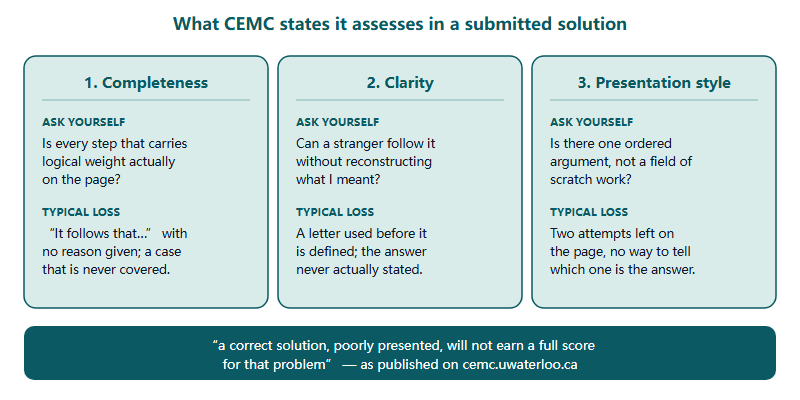
You can mark your own Euclid attempt, and CEMC tells you what to mark it against. Its contest page states that “each submitted solution is assessed for completeness, clarity, and presentation style; a correct solution, poorly presented, will not earn a full score for that problem.” Those three words are a usable rubric. This is the protocol we run with our China cohort when a past paper has no worked solution attached.
The three words CEMC publishes, and what they mean when you are holding the pen
Most students preparing for a full-solution paper assume they cannot mark themselves, because marking means comparing your page against an answer key and they do not have one. That assumption is wrong in a specific and useful way. Euclid is not marked by comparison to a single official route. It is marked on the artefact you produced. The published criteria are completeness, clarity and presentation style — all three of which are properties of your own page, visible to you, with no key required.
Unpacked into questions you can actually answer about your own script:
- Completeness — is every step that carries logical weight actually written down? Not thought, not implied by the next line. Written.
- Clarity — can a reader follow the chain without reconstructing what you meant? Every letter defined before it is used, every claim attached to a reason.
- Presentation style — is there one ordered argument on the page, ending in a stated conclusion, rather than a field of scratch work with the answer somewhere inside it?
The sentence that follows those three words is the one worth memorising: a correct solution, poorly presented, will not earn a full score. That is the whole reason self-marking is possible. If marks tracked only the final number, you would need a key. Because marks track the written argument — which is exactly the mechanism our guide to how step marks work sets out in detail — you can audit most of your own loss without one.
Why you will often be marking blind, and why that is closer to the exam
Euclid is ten questions in 2.5 hours, out of 100, described by CEMC as “a mix of final answer only and full-solution.” That split matters for practice. The final-answer items self-mark in seconds: you either have the number or you do not. The full-solution items are the ones that need judgement — and they are exactly the ones where a published solution would not answer your real question anyway. A solution set shows you one route. It does not tell you whether your route was complete.
There is also a supply problem. The publicly indexed archive covers roughly the last ten years. The compiled archive we hand to our own students runs from 1998, and worked solutions are not attached to every year in it — some years carry them, many of the older ones do not. So if you train on the deep archive, which is where the unfamiliar problems live, a large share of your practice will happen without any written solution in front of you.
Treat that as a feature. On the day itself nobody hands you a marking scheme, and the skill that decides your score is the ability to look at your own written argument and know whether a stranger could follow it. Students who only ever practise against a solution set never build that skill; they build the different skill of recognising a correct answer once someone shows it to them.
The protocol: five steps, one of which is doing nothing
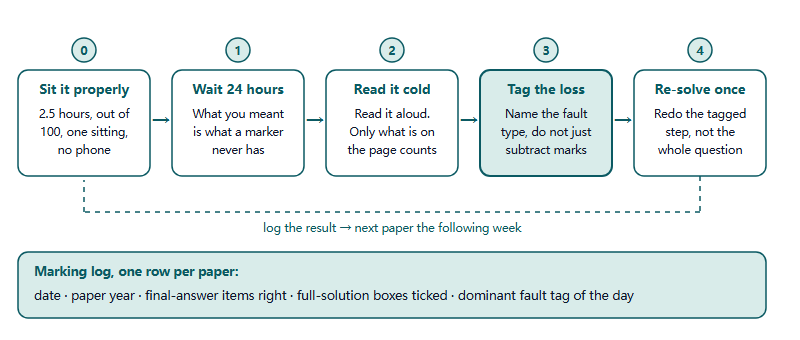
Step 0 — sit it properly. One sitting, 2.5 hours, phone in another room, all ten questions. CEMC lists Euclid as “some calculators permitted” and maintains a separate calculator policy page; the permitted list is set by the organiser and re-issued each cycle, so confirm the current policy on the official site before you rely on a particular machine in practice. Half-sat papers produce half-useful data.
Step 1 — wait twenty-four hours. This is the step students skip and the one that carries most of the value. Within an hour of writing, you still remember what you meant. That memory is precisely what the marker will never have. Waiting a day is the cheapest way to buy yourself an outside reader's eyes.
Step 2 — read it cold, out loud, only what is written. Read your own script aloud as though it were a classmate's. The rule is absolute: if you have to supply a sentence from memory to make the argument work, that sentence was missing from the page. Mark the spot. Do not fix it yet.
Step 3 — tag every loss with a category, not a number. This is the difference between a marking session and a useful marking session. Subtracting four marks tells you nothing next week. Writing “unstated case” next to the gap tells you what to train.
| Tag | What it looks like on your page | The fix you practise |
|---|---|---|
| Missing justification | “It follows that…” or “clearly…” with no reason attached | Force one because-clause per assertion for a whole paper |
| Unstated case | You solved for the positive root, or one interval, and never said the other was ruled out | Write the case list before solving, then tick each one off |
| Undeclared notation | A letter appears mid-argument with no “Let n be…” | Open every full-solution answer with a definitions line |
| Conclusion never stated | The value is computed on line six and the answer is never written as an answer | End every answer with one sentence beginning “Therefore” |
| Presentation | Two competing attempts, crossings-out, work running up the margin | Rough on a separate sheet; transcribe one clean argument |
| Arithmetic slip | Method sound, a sign or a digit wrong downstream | Log it, but do not confuse it with a reasoning fault |
Step 4 — re-solve only the tagged step. Not the whole question. If your case analysis was incomplete, rewrite the case analysis and nothing else. Redoing a question you already solved mostly rehearses the part you can already do.
Scoring it honestly: three boxes instead of one number
For each full-solution question, resist giving yourself a mark out of anything. Tick three boxes instead — complete, clear, presented — as yes, partly or no. Then apply one conservative rule: if any box is not a clear yes, you do not award yourself the top band for that question.
The purpose is not precision. You cannot reproduce an official marking scheme and you should not pretend to. The purpose is a stable, comparable signal across attempts, so that the fifth paper can be honestly compared with the first. A number you generated generously in March and strictly in April tells you nothing about progress.
In our experience two failure modes account for most bad self-marking:
- Generous marking. You know what you meant, so you read the missing sentence into the page. Cure: the twenty-four-hour gap, and reading aloud.
- Punitive marking. You find a worked solution for a nearby year, see that it took a different route, and delete your own valid argument. Cure: remember that the criteria are completeness, clarity and presentation style. A different route that is complete and clearly set out is not a worse answer. It is another answer.
That second point deserves emphasis for students coming from a school system where the model answer is the answer. On a full-solution paper the published solution is one demonstration, not the specification. Your argument is assessed as an argument.
What the log tells you after eight papers, and what self-marking cannot do
Keep the log to one row per paper: date, paper year, how many final-answer items you got, how many full-solution boxes you ticked, and the fault tag that appeared most often that day. After roughly eight to ten papers a pattern shows up, and in our experience of coaching this cohort it is usually a single dominant tag rather than a spread. One student loses marks almost entirely to unstated cases. Another writes complete arguments but leaves two attempts on the page. Those two students need completely different practice, and neither of them needs the instruction “do more past papers”.
Be honest about the ceiling, though. You can audit completeness well, presentation reasonably, and clarity only up to a point — because clarity is defined relative to a reader who is not you. Two cheap corrections:
- Swap scripts with one classmate once a fortnight. They do not need to be better at mathematics than you. They need to be a genuine stranger to your handwriting and your intentions.
- Ask a teacher to read one paper a month for legibility and structure only — not for the mathematics. That is a five-minute favour rather than a marking job, so you will actually get it.
Finally, put the season on a calendar and work backwards. The 2027 sitting is Tuesday 6 April in North and South America and Wednesday 7 April elsewhere, China included, and the organiser's ordering deadline is Thursday 11 March 2027; the 2027 key dates piece sets out how those interact with our own China test-centre list, which closes earlier. Because entry is only ever through a school or a test centre and there is no individual registration route, the administrative side needs settling long before your marking log matters — the 2027 registration guide covers that sequence.
Questions students ask about self-marking
Can I mark my own Euclid paper without an official solution set?
Yes. CEMC assesses completeness, clarity and presentation style, so you score the page you produced rather than compare it to a key.
How long should I wait before marking my own attempt?
At least 24 hours. Within an hour you still remember what you meant, and that memory is exactly what a marker does not have.
Does using a different method from the published solution lose marks?
No. The paper is marked on your written argument, so a valid alternative route scores if it is complete and clearly set out.
Do all past papers come with worked solutions?
No. Our compiled 1998 to 2026 archive does not carry worked solutions for every year, which is exactly why a self-marking protocol matters.
Editorial note: this guide is written by Hanlin Education for China-based international-school students. Contest format, dates, fees and calculator policy are set by the organiser and change between cycles — confirm current details on cemc.uwaterloo.ca before you act on them. Corrections are issued within 7 working days of being reported.