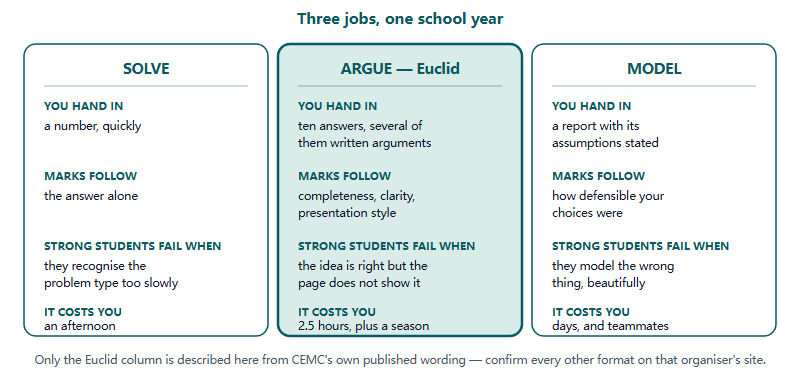
Solving fast, arguing on paper and modelling an open problem are three different jobs, not three rungs of one ladder. Euclid sits squarely in the middle one: ten questions, 2.5 hours, out of 100, a mix of final answer only and full-solution, where marks follow the argument you write down. Choosing a contest year is mostly choosing which of the three you want evidence for.
Three skills, not a difficulty ladder
The most common planning mistake we see in grade 10 and 11 is treating contests as a single ranked queue: do the easy multiple-choice one, then the harder written one, then the hardest olympiad. Families arrange the year that way because difficulty is the only axis anyone talks about. It is the wrong axis.
Consider what each format actually asks a student to be good at.
- Solve. Short-answer and multiple-choice contests reward recognition speed. You see a configuration, you know within seconds which tool applies, you execute cleanly, you move. Elimination and estimation are legitimate weapons. Nobody reads your working, and the fastest correct route is simply the best route.
- Argue. This is Euclid's territory. CEMC states that each submitted solution is assessed for completeness, clarity and presentation style, and that a correct solution, poorly presented, will not earn a full score for that problem. Recognition speed still helps, but it is no longer sufficient: a student who sees the answer instantly and cannot write the chain of reasoning down will lose marks that a slower, more careful writer keeps.
- Model. Team modelling contests hand you an open, under-specified situation. There is no answer to find. You choose assumptions, defend them, build something, test whether it survives its own edge cases, and write a report over days rather than hours. Formats vary by organiser, so confirm the current rules on that organiser's own site — but the shape of the job is stable, and it is not a mathematics exam.
These sit on different axes. A student can be genuinely excellent at speed-solving and still lose a third of a full-solution paper to unwritten steps. A student who writes beautifully argued pages can be mediocre under a two-minute-per-question clock. Neither result is a “level”. Both are information — and knowing which of the three you are weakest at is worth more than another year of the format you already do well.
Why the middle column is the one most students have never trained
Chinese international-school students arrive at grade 10 with a great deal of practice at column one. School examinations, entrance testing and the multiple-choice contest circuit all reward the same thing: get to the right answer, and do it quickly. Almost nothing in that training asks a student to produce a page that a stranger can audit.
Then Euclid asks exactly that, and the gap shows up as a specific, repeatable pattern: the student solves the problem in their head in four minutes, writes three lines, and receives a fraction of the marks. Nothing was wrong with the mathematics. The page simply did not contain the argument. That mechanism — and how to write so the marks are actually available to you — is set out in our guide to how step marks work.
This is why we treat the middle column as the highest-value addition to most students' years rather than as a harder version of what they already do. It is not a step up in difficulty. It is the column they have never been asked to train.
The one date you can fix right now
Contest calendars are frustrating to plan because most of the dates move, are announced late, or depend on a school. Euclid is the exception: the 2027 cycle is already published, so it can act as the fixed point you build the rest of the year around.
| Item | The 2027 cycle, organiser values unless the row says otherwise |
|---|---|
| Sitting — North and South America | Tuesday, 6 April 2027 |
| Sitting — outside North and South America (China included) | Wednesday, 7 April 2027 |
| Organiser ordering deadline | Thursday, 11 March 2027 — the date the organiser's portal closes |
| Our China test-centre list | Closes earlier, on 8 March — a different deadline, not the same one |
| Format | 10 questions, a mix of final answer only and full-solution, 2.5 hours, out of 100 |
| Fee as published | $18.00 per participant, plus $5.00 processing per order |
| Entry route | Only through a school or a test centre — there is no individual registration |
| Audience | Final year of secondary school or CÉGEP; “Motivated students in lower grades are welcome to write the contest” |
Two points deserve emphasis for a grade 10 or 11 student. First, the audience line is not a prohibition: CEMC lists Euclid for students in their final year and states that motivated students in lower grades are welcome to write it, while attaching its own conditions to official recognition, which are re-set each cycle and should be confirmed on the official site. Sitting it early is a normal thing to do, and it is how you arrive in your final year with the format already familiar rather than new.
Second, the deadlines are administrative, not academic, and they arrive a month before the paper. Because entry runs only through a school or test centre, a student who decides in March that they would like to sit Euclid has usually decided too late. Our 2027 registration guide covers what to do when a school does not run it, and the 2027 key dates piece lays out the full sequence.
How several results corroborate each other in an application
The reason to think in columns rather than in a ranked queue becomes clearest when the results reach an application file. An admissions reader does not receive your award in isolation. They receive it alongside a transcript, an activity list and your essays, and their working method is comparison: does this claim agree with the rest of the file?
A written-argument result cross-validates unusually well, because it is hard to explain away. It is evidence of something a reader can also look for elsewhere — in the mathematics grade on the transcript, in whether the activity list contains anything that would have produced that practice, in whether the essays talk about work the student actually did. When those parts agree, the file reads as true. That is the whole mechanism: not the impressiveness of any single line, but the agreement between lines.
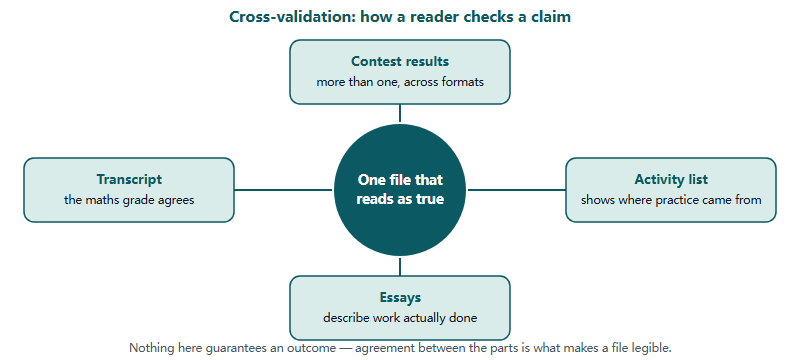
Two guardrails, because this framing is easy to overstate. No result guarantees an outcome, and any specific admission statistic you encounter should be traced to whoever published it before you believe it. And a spectacular one-off next to a flat transcript and an activity list with no mathematics in it is not fraudulent — it simply invites the reader to work out which line is the anomaly. Consistency is worth more than a spike.
A sane load for one school year
From coaching this cohort, the pattern that works is narrower than most families expect: two formats trained properly beat five entered casually. Concretely, for grade 10 and 11:
- Pick one speed contest and one argument contest. The speed contest keeps recognition sharp and costs almost nothing to prepare separately. The argument contest — Euclid, on 7 April 2027 for students sitting outside the Americas — is the one that needs a season rather than a week, because writing is a trained skill and it improves slowly.
- Add a modelling team only if you genuinely have teammates and a clear multi-day window. The modelling format costs days, not hours, and it costs them from three or four people at once. Entered without a real team, it produces a line on a list and no learning at all.
- Apply the drop rule. If a contest does not change what you actually practise on a Tuesday evening, it is not training. It is an entry. Cut it and give the hours to the format that does change your practice.
- Sequence by workload, not by prestige. Build backwards from the fixed date. The organiser portal closes on 11 March 2027 and our own China centre list closes earlier, on 8 March; a serious writing season needs the months before that; so the decision about whether Euclid is in your year belongs in the autumn, not the spring.
The deeper point is that a year built this way answers a question about yourself. If you sit a speed contest and an argument contest in the same season, you will find out which column you are actually strong in — and that is a far more useful thing to know in grade 10 than another certificate in the format you were already good at.
Questions students and parents ask
Is Euclid harder than a multiple-choice contest?
It is a different job. Euclid marks a written argument, so speed on short answers does not automatically transfer to it.
Can I enter Euclid myself if my school does not run it?
No. Entry is only through a school or a test centre, and there is no individual registration route into the contest.
When is the 2027 Euclid contest?
Tuesday 6 April 2027 in North and South America, and Wednesday 7 April 2027 elsewhere, which includes China.
How many contests should one student enter in a year?
Two formats trained properly usually beats five entered casually. Add a team modelling contest only with real teammates.
Editorial note: this guide is written by Hanlin Education for China-based international-school students. Contest format, dates, fees and eligibility conditions are set by the organiser and change between cycles — confirm current details on cemc.uwaterloo.ca before you act on them. Corrections are issued within 7 working days of being reported.