If you are deciding whether to sit Euclid on 7 April 2027, sit this first: a 60-minute check with eight short-answer items and two full-solution problems, built to mirror the two kinds of part on the real paper, with a marking key further down. It does not predict a Euclid score. It places you in one of four profiles, and each profile comes with a plan for the months before entry closes.
Why the check belongs in September, not in March
Euclid has no individual registration route. You sit it through a school that orders the contest or through a test centre, and that arrangement has to be in place about a month before the paper. Two dates get confused at this point, so keep them apart: 11 March 2027 is the CEMC ordering deadline for schools and centres, and 8 March 2027 is when our own China test centre closes its Euclid list — our arrangement, not an organiser date. Our 2027 registration guide walks through the entry routes.
The later you decide, the less of the season is left for the work that actually changes a score. A check in September gives you a verdict while there are still six months of school weeks ahead, and it tells you what kind of preparation to spend them on. Deciding in February tells you only whether you still have time to enter.
| Date | What happens | Whose date |
|---|---|---|
| September 2026 | Sit this check and read your profile | Our suggestion |
| 22 October 2026 | Ordering deadline for the Canadian Senior and Intermediate Mathematics Contests | CEMC |
| 19 November 2026 | Canadian Senior and Intermediate Mathematics Contests written outside North and South America | CEMC |
| 8 March 2027 | Our China test centre closes its Euclid list | Hanlin |
| 11 March 2027 | Euclid ordering deadline for schools and test centres | CEMC |
| 7 April 2027 | Euclid written outside North and South America, China included (6 April in the Americas) | CEMC |
| 8 April 2027 | Fryer, Galois and Hypatia written outside North and South America | CEMC |
What the published results say about where the marks come from
CEMC publishes the average mark for every Euclid question in its results booklets, and the last two years tell a consistent story. Each question is worth 10 marks. In 2025 the first four questions averaged 9.7, 9.1, 8.3 and 7.2; in 2026 they averaged 9.5, 9.1, 8.2 and 7.9. Together they supplied 34.3 marks of a 54.8 average in 2025, and 34.7 marks of a 52.2 average in 2026 — between 63% and 66% of a typical script.
The end of the paper went the other way. Questions 8 to 10 together averaged 4.6 marks in 2025 and 3.7 in 2026. The middle band moved most: question 7 averaged 6.1 in 2025 and 3.4 in 2026.
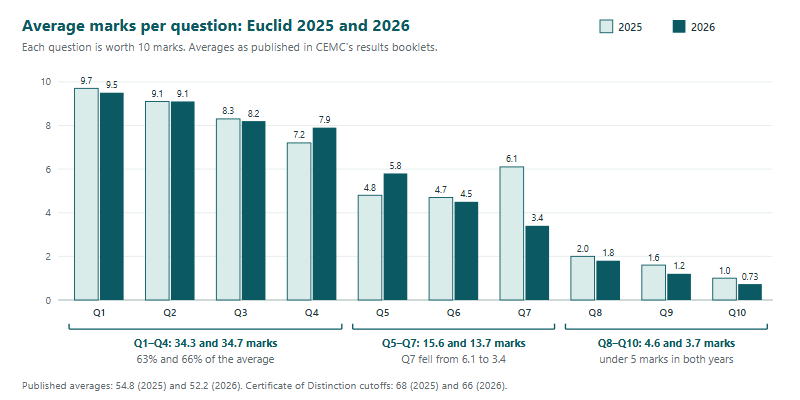
Now set the Certificate of Distinction against that profile. CEMC awards it to participants in the top 25%, and the cutoff was 68 in 2025 and 66 in 2026, some 13 to 14 marks above the average both times. Perfect scores on questions 1 to 4 would add only about five or six marks to the average profile, because that is all the headroom those questions have left. The rest of the distance has to come from further down the paper, mostly from questions 5 to 7.
That is why the check is built the way it is. Part A works at the level of questions 1 to 4, where a reliable candidate should lose almost nothing. Part B tests whether you can write the kind of complete solution that the middle of the paper pays for. It deliberately makes no attempt to measure questions 8 to 10, because in September a result there would tell you very little.
The check: ten questions, 40 marks
Sit it under conditions close to the real paper:
- Time: 60 minutes in one sitting, with no notes and no internet.
- Calculator: only the kind the real paper allows. The front cover of the 2026 Euclid paper excluded any device with internet access, the ability to communicate with other devices, stored information such as formulas, programs or notes, a computer algebra system, or dynamic geometry software. Use it for arithmetic, not for solving.
- Answers: simplified exact numbers such as fractions and surds, because the paper asks for them unless a question says otherwise.
- Part A: write just the answer, but keep your working beside it. On the real paper, a short-answer part earns part marks only if relevant work is shown.
- Part B: full solutions in English, written for a marker who cannot ask you what you meant.
Part A. Short answer, 3 marks each (24 marks)
- Solve 4x+1 = 8x−1.
- Find the exact value of log212 + log26 − log29.
- The 4th term of an arithmetic sequence is 17 and the 11th term is 45. What is the 30th term?
- The line through A(−2, 5) and B(4, −1) crosses the x-axis at P. What are the coordinates of P?
- How many positive divisors does 360 have?
- How many different arrangements of the letters in LEVEL are there?
- A bag holds 4 red and 3 blue marbles. Two are drawn at random without replacement. What is the probability that they are different colours?
- How many values of θ with 0° ≤ θ < 360° satisfy 2sin2θ = sin θ?
Part B. Full solution, 8 marks each (16 marks)
- Determine all real numbers x for which √(x + 7) = x − 5.
- Determine all pairs (m, n) of positive integers with m ≤ n for which 1/m + 1/n = 1/4.
Stop here and sit it before you read the key.
The marking key
Mark Part A strictly: 3 marks for the correct exact answer. If your answer is wrong or not exact, give yourself 1 mark only if your working shows a correct method spoiled by a single slip. That rule is ours, but it rests on the same principle as the real paper, where part marks on a short-answer part depend on relevant work being shown.
| Item | Answer | If you missed it, look at | Topic block |
|---|---|---|---|
| 1 | x = 5 | Writing both sides as powers of 2 before comparing exponents | Exponents |
| 2 | 3 | Combining the logarithms first: 12 × 6 ÷ 9 = 8 | Logarithms |
| 3 | 121 | Seven steps separate the 4th and 11th terms, so the common difference is 4 | Sequences |
| 4 | (3, 0) | The slope is −1, so the line is y = −x + 3 | Coordinate geometry |
| 5 | 24 | 360 = 23 × 32 × 5, which gives 4 × 3 × 2 divisors | Number theory |
| 6 | 30 | Dividing 5! by 2! for the repeated L and again for the repeated E | Counting |
| 7 | 4/7 | Red then blue and blue then red both count; a decimal is not exact | Probability |
| 8 | 4 | Solving sin θ = 0 as well as sin θ = 1/2, across the whole interval | Trigonometry |
Question 9 (8 marks). Award 3 marks for squaring correctly to reach x2 − 11x + 18 = 0; 1 mark for solving it to x = 2 or x = 9; 3 marks for testing both candidates in the original equation, or for stating x ≥ 5 before squaring, and rejecting x = 2 with a reason; and 1 mark for a clear conclusion that x = 9 is the only solution. An answer that stops at “x = 2 or x = 9” scores at most 4, however tidy the algebra.
Question 10 (8 marks). Award 1 mark for clearing the fractions to mn = 4m + 4n; 2 marks for rewriting that as (m − 4)(n − 4) = 16; 2 marks for explaining why both factors are positive (if m ≤ 4 then 1/m ≥ 1/4, which leaves nothing positive for 1/n, so m > 4, and then n ≥ m gives n > 4 as well); 2 marks for listing the factor pairs 1 × 16, 2 × 8 and 4 × 4 and saying there are no others with m ≤ n; and 1 mark for the answer (5, 20), (6, 12) and (8, 8). Three correct pairs found by trial, with no reason why no others exist, score at most 3.
Both Part B questions are small versions of what the middle of the paper asks for. Each has a tempting shortcut — square and report both roots, or find some pairs and stop — and each is marked on the sentence that closes the shortcut off. That mechanism is explained in detail in our guide to how step marks work.
Four profiles, and what each one means for 2027
Total Part A out of 24 and Part B out of 16 separately. The overall score matters less than where the two sit against each other.
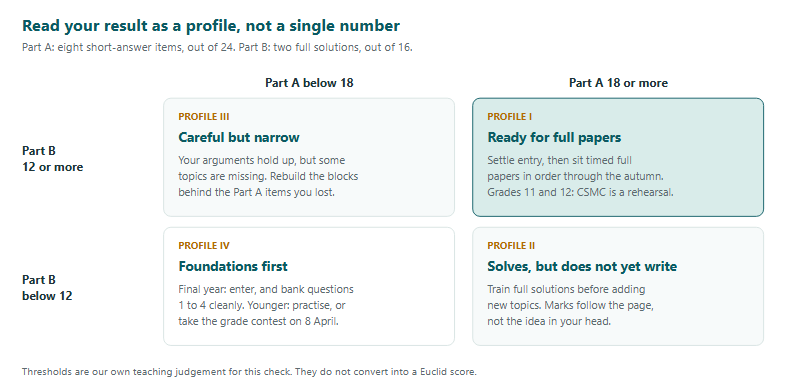
Profile I: Part A 18 or more, Part B 12 or more. You are ready to train on full papers. Settle entry now, then sit timed full papers in order through the autumn and mark each one properly. Our compiled 1998–2026 archive carries worked solutions for some years but not all, so learn to self-mark early. If you are in Grade 11 or 12, the Canadian Senior Mathematics Contest on 19 November 2026 makes a useful rehearsal: nine questions in two hours, six answer-only and three full-solution, set and marked by the same organiser. CEMC opens it to Grades 11 and 12 and welcomes motivated younger students.
Profile II: Part A 18 or more, Part B below 12. You solve problems but do not yet write them. It is a profile we meet often among students with strong school grades, and it is the most fixable of the four. Before you add any new topic, rewrite your two Part B answers until every step a marker needs is on the page, then do the same with one full-solution problem each week. New topics can wait until your writing stops leaking marks.
Profile III: Part A below 18, Part B 12 or more. Your arguments hold up, but your coverage has holes. Use the right-hand column of the Part A key: each item you missed names a topic block. Rebuild those blocks between October and December, then sit a full past paper in January as your second check, rather than retaking this one.
Profile IV: both below the line. Foundations come first, and the right call depends on your year. If you are in your final year of secondary school, 2027 is your Euclid: enter, and plan around banking questions 1 to 4 cleanly, since the published averages show that is where most marks sit. If you are younger, CEMC welcomes motivated students in lower grades to write Euclid, so a practice sitting is one option; the other is your grade-level contest, with Galois (Grade 10) and Hypatia (Grade 11) written on 8 April 2027 outside North and South America, the day after Euclid. Either way, retest with a full past paper in December.
A few questions students ask us about the check:
Is this readiness check an official CEMC test?
No. It is our own 60-minute self-test, built to mirror the short-answer and full-solution parts of the real paper. It gives no Euclid score.
What score on the check means I should enter Euclid 2027?
No single score is a gate. Profiles I to III usually enter now, while Profile IV depends on your grade and whether 2027 is your final year.
Can I use my graphing calculator on Euclid?
Only a device with no internet access, no communication, no stored notes or programs, no computer algebra system and no dynamic geometry software.
When do I need to decide about entering Euclid 2027?
Our China test centre closes its Euclid list on 8 March 2027. The CEMC ordering deadline for schools and test centres is 11 March 2027.
Editorial note: this guide is written by Hanlin Education for China-based international-school students. The readiness check, its marking rules and its profiles are our own teaching judgement, not an organiser instrument. Contest dates, formats and calculator rules are set by the organiser and can change between cycles — confirm current details on cemc.uwaterloo.ca. Corrections are issued within 7 working days of being reported.