Preparing for the Euclid Mathematics Contest is not just about solving problems; it is about managing your most valuable resource: Euclid past papers. Many students exhaust their supply of unseen questions too early, leaving them without fresh material for final mock exams. A strategic sequencing plan ensures you have high-quality, unfamiliar problems available when you need them most.
The Value of Recent vs. Older Papers
Recent papers reflect the current difficulty curve and stylistic trends set by the Centre for Education in Mathematics and Computing (CEMC). For instance, the 2026 contest showed an increased emphasis on algebraic complexity and nuanced geometric proofs. However, older papers remain essential for building foundational fluency. The key is to avoid burning through the last five years of exams during your initial learning phase.
| Paper Era | Best Use Case | Strategy Tip |
|---|---|---|
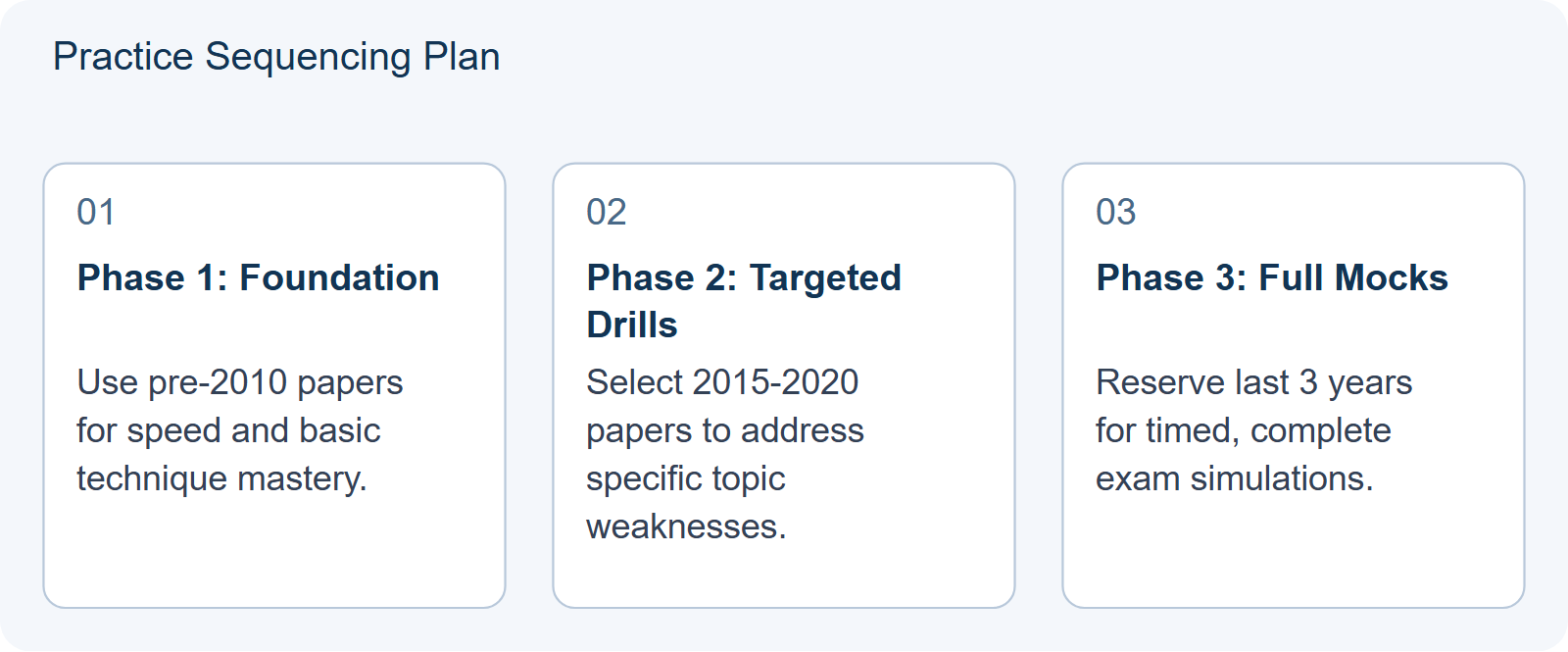
| Last 3 Years | Final Mock Exams | Save for timed, full-paper simulations under strict conditions. |
| 4–10 Years Ago | Topic-Specific Drills | Use to isolate weak areas like number theory or combinatorics. |
| Pre-2010 Archive | Foundational Fluency | Great for speed drills and mastering standard algebraic techniques. |
Sequencing Your Practice
A common mistake is starting with the most recent paper because it feels “relevant.” Instead, begin with mid-range papers (e.g., 2015–2020) to build confidence. These years offer a balance of modern problem styles without the extreme pressure of the latest contests. As you identify gaps in your knowledge—such as trigonometric identities or modular arithmetic—pull specific questions from older archives where those topics were heavily featured.
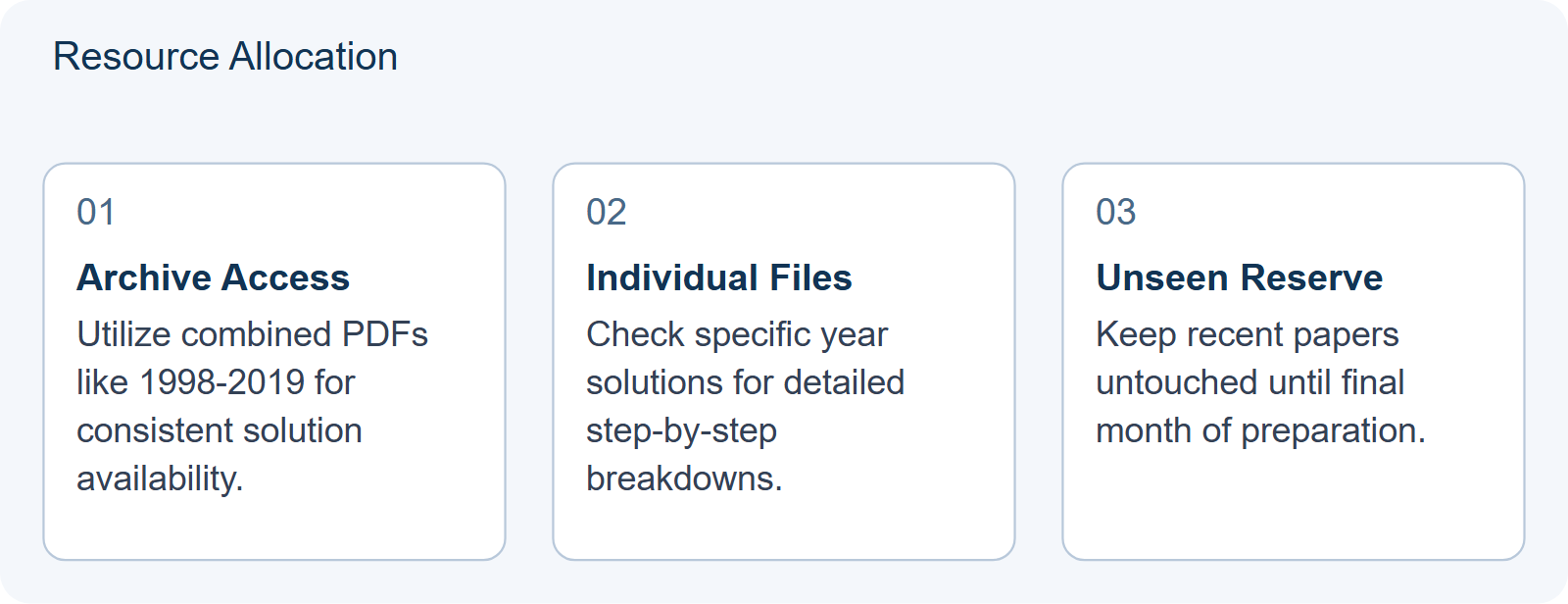
For example, if you struggle with geometry proofs, look at papers from the late 1990s and early 2000s. The Euclid1998-2019.pdf archive is particularly useful here, as it consolidates solutions for this entire period, ensuring you have access to worked examples even if individual year files are scattered. This allows you to study the evolution of proof standards over two decades.
Preserving Unseen Material
As the contest date approaches (April 6 or 7, 2027), you should have saved the three most recent papers for full-length practice tests. Do not solve these questions piecemeal during your weekly study sessions. Treat them as sacred resources for assessing your readiness. If you run out of unseen questions before February, you will lack the ability to accurately gauge your progress.
To extend your runway, consider supplementing with other CEMC contests. While distinct in format, the underlying mathematical rigor is similar. However, prioritize Euclid-specific patterns first. The exam consists of 10 questions, each worth 10 marks, with partial credit for correct steps. Practicing with older papers helps you understand how CEMC awards these step marks, which is crucial for maximizing your score.
Common Pitfalls to Avoid
- Solving all questions immediately: Save recent papers for mocks.
- Ignoring solution keys: Always compare your work with official solutions to learn proper notation.
- Over-relying on calculators: Remember that while allowed, they cannot store formulas or connect to the internet. Practice mental math and efficient calculator use separately.
By strategically allocating your Euclid past papers, you ensure that every practice session contributes to long-term improvement rather than short-term familiarity. Start with the archive, drill your weaknesses, and save the freshest challenges for the final countdown.
HYPOTHETICAL/ILLUSTRATIVE: The “Mid-Range Diagnostic” Decision
To illustrate how to apply sequencing advice, consider a hypothetical student named Alex. Alex has six months until the contest and possesses a digital folder containing Euclid papers from 2014 to 2026. The critical decision point occurs in Month 2: should Alex use the 2023 paper for a timed mock exam now, or reserve it for later?
Alex’s current skill profile shows strong algebraic manipulation but weak geometric reasoning. If Alex chooses Option A (Immediate Mock), they sit down with the 2023 paper under strict time limits. They score well on early questions but stall on geometry proofs. Afterward, they review the solutions, realizing they missed key steps. However, because they have already seen the specific problems, the 2023 paper is no longer “unseen.” It cannot be used again for a true diagnostic assessment of their final readiness. Furthermore, using a recent paper for topic-specific drilling wastes its value as a holistic simulation tool.
If Alex chooses Option B (Diagnostic Drill), they select the 2018 paper instead. This falls into the “mid-range” category mentioned in the article. Alex does not time themselves strictly. Instead, they isolate the three geometry questions from that year. They spend two hours attempting these specific problems, consulting older archives for similar proof structures if stuck. They then compare their work against the official solution key, focusing entirely on notation and logical flow rather than speed. By doing this, Alex preserves the 2023 paper for a full-length, timed simulation in Month 5. The 2018 paper becomes a targeted training tool, while the 2023 paper remains a pristine resource for measuring overall progress.
| Decision Factor | Option A: Use Recent Paper Now | Option B: Use Mid-Range Paper Now |
|---|---|---|
| Primary Goal | Assess current total score potential. | Fix specific conceptual gaps (e.g., geometry). |
| Resource Cost | High. Consumes a prime mock exam resource. | Low. Uses surplus mid-range material. |
| Future Impact | Reduces ability to gauge late-stage improvement accurately. | Preserves recent papers for high-stakes simulations. |
The choice changes based on the student’s timeline and weakness severity. If a student is generally competent across all topics but lacks stamina, Option A might be justified earlier to build endurance. However, for most students with identifiable weak areas like Alex, Option B is superior. It aligns with the principle of matching the paper era to the task: mid-range papers are for learning, recent papers are for testing.
Reusable Self-Check: Before opening any past paper, ask yourself: “Am I trying to learn a new technique or measure my current level?” If you are learning, pick an older or mid-range paper and focus on one topic. If you are measuring, pick your freshest unseen paper and simulate exam conditions. Never mix these purposes, as it devalues both the learning process and the diagnostic accuracy.
Before selecting a practice sequence, ensure you understand the Euclid 2027 Readiness Check to gauge current ability. Address specific topic gaps using resources on The Algebraic Middle of the Euclid Paper. Finally, review How to Mark Your Own Euclid Paper to accurately assess progress without official solutions.
Frequently Asked Questions
Are solutions available for all past Euclid papers?
Yes, comprehensive archives such as the combined file covering 1998-2019 provide solutions for those years, alongside individual solution PDFs for many other years listed in the source materials.
When is the next Euclid contest?
The 2027 Euclid Mathematics Contest is scheduled for April 6 for North/South America and April 7 for other regions, with registration deadlines typically in early March.
How many questions are on the Euclid exam?
The exam consists of 10 questions, each worth 10 marks, completed within a 150-minute timeframe.