Writing the Euclid Contest and being listed as an official participant are two separate things. CEMC marks every submitted paper regardless of status, and unofficial writers remain eligible for Certificates of Distinction and school medals. What official status controls is narrower but consequential: honour-roll placement, contribution to a school’s team score, and the top cash prizes reserved for Canadian participants. Below is a precise map of which recognitions depend on which status, drawn from CEMC’s current Euclid rules.
What “Official” and “Unofficial” Actually Mean in CEMC’s Rules
CEMC does not use “unofficial” as a synonym for “disqualified” or “unmarked.” The term describes a participant who does not satisfy one or more eligibility criteria that CEMC publishes on its Euclid Contest page. Every full-time student may write the contest; the official/unofficial distinction governs only a subset of post-contest recognitions.
For school coordinators, the practical takeaway is that “unofficial” is a status attached to the participant record, not a reason to exclude a student from writing. The student still sits the paper, the supervisor still collects it, and CEMC still marks it.
The Two Checklists: Inside Canada vs Outside Canada
CEMC applies slightly different criteria depending on where the participant writes. The distinction matters most for international schools coordinating entries from outside North America.
| Criterion | Inside Canada | Outside Canada |
|---|---|---|
| Student Information Form properly completed | Required | Required |
| Born on or after 1 January 2008 | Required | Required |
| Lives in Canada | Required | Not applicable |
| Contest received by CEMC on time | Required (otherwise unofficial) | Required (otherwise unofficial) |
Notice that the birthdate cutoff is identical worldwide: 1 January 2008. A student born in December 2007 writing in April 2027 would be unofficial everywhere. The residency requirement, however, applies only to participants writing at a Canadian school. A Canadian citizen attending school in Singapore, for example, would be assessed under the outside-Canada checklist and would not need to “live in Canada” to be official.
For a deeper look at how registration works when a school does not offer the contest, see our companion piece on Euclid 2027 having no individual registration.
What Unofficial Participants Still Receive
This is the section most coordinators and students need to read carefully, because the common assumption—that unofficial means invisible—is wrong.
Marking. CEMC states plainly that unofficial participants will have their contests marked. The paper goes through the same assessment process: each solution is evaluated for completeness, clarity and presentation style, and the score is out of 100.
Certificate of Distinction. Every participant scoring in the top 25 percent of all competitors receives a Certificate of Distinction. The rule does not qualify this with “official.” In 2026, with 23,985 contestants and a mean score of 52.2, the Distinction cutoff was 66. An unofficial participant scoring 66 or above would qualify. (These are 2026 published figures; 2027 cutoffs will differ.)
School Champion Medal. Each School Champion—the top scorer at their school who meets the medal cutoff—receives a Contest Medal at CEMC’s discretion. In 2026 the medal cutoff was 52. The published rule does not restrict medal eligibility to official participants; it says unofficial participants “are still eligible for certificates and medals.” In the event of a tie at the top of a school, two medals are awarded.
For context on what the top-25-percent threshold means in practice and how it has shifted across recent seasons, see our analysis of the Euclid Global Top 25% and award competitiveness.
What Official Status Unlocks
The recognitions that do require official status form a shorter but high-profile list:
- Honour rolls. The names of top-scoring official participants in Canada appear in zone, provincial and Canadian honour rolls (published for regions with at least 30 participants). Outside Canada, top-scoring official participants appear in International honour rolls. An unofficial participant’s name will not be listed, regardless of score.
- Team score contribution. A school’s team score is the sum of its three highest-scoring official participants’ scores. If a school’s top scorer is unofficial, that score does not count toward the team total. Schools may opt out of the team competition entirely.
- Top Canadian prizes. Each of the top five official participants in Canada receives a plaque and a $500 prize at CEMC’s discretion. The next ten official participants receive $200 each. These are explicitly limited to official participants in Canada.
- Team championship hardware. Canadian schools compete for National Championship Plaques, Provincial Championship Plaques and Zone Championship Certificates, all contingent on having official participants contributing to the team score. Outside Canada, rankings and team honour rolls are provided.
The practical implication for a supervisor: if your school’s strongest writer turns out to be unofficial—perhaps because the Student Information Form was incomplete—the team score drops to the next three official participants, and that student’s name will not appear on any public honour roll even with a top-ten score.
The Late-Arrival Caveat
CEMC’s rules include a footnote that is easy to overlook: a participant’s contest may also be considered unofficial if it is received by CEMC too late to be included in the final results. This is distinct from the registration criteria. A student can satisfy every form and birthdate requirement and still end up unofficial because the school’s return shipment arrived after CEMC’s processing window closed.
Each school is responsible for independently arranging and paying for the return shipping of completed contests to CEMC. CEMC recommends using a courier to ensure materials arrive safely and in good condition. No refunds, returns or cancellations are offered. For schools outside Canada, the 15 percent shipping surcharge on the contest order and the separate return-shipping cost mean that logistics planning should begin well before the April contest date.
The ordering deadline for Euclid 2027 is Thursday, 11 March 2027. Contest dates are Tuesday, 6 April 2027 in North and South America and Wednesday, 7 April 2027 elsewhere. Supervisors should build in courier transit time when scheduling the return shipment.
Pre-Contest Verification Checklist for Students and Supervisors
The following checklist consolidates the official-status requirements into actionable steps. It is designed for the weeks between the ordering deadline and contest day.
- Student Information Form. Confirm every participant has properly completed the form. “Properly” means all required fields are filled legibly. Blank or partially completed forms risk unofficial status. Note that for 2027, question booklets will not be shipped; supervisors download and print them from the Contest Material Repository roughly one day before contest day. All other paper materials, including Student Information Forms and Solution Booklets, are still shipped.
- Birthdate check. Verify each participant was born on or after 1 January 2008. A student born in 2007 is ineligible for official status regardless of grade level.
- Residency confirmation (Canada only). For schools inside Canada, confirm each participant lives in Canada. International students attending a Canadian school on a temporary basis should check with the supervisor whether their residency status satisfies CEMC’s requirement.
- Return-shipping plan. Arrange courier pickup for the day after the contest. Label the package clearly. For schools outside Canada, confirm the return address and customs documentation in advance.
- Team competition decision. Decide before contest day whether the school will participate in the team competition. CEMC permits schools to opt out entirely. If participating, confirm that at least three official participants will contribute scores toward the team total.
For supervisors who want to run a practice marking session before the real contest, our guide on self-scoring a Euclid paper without a solution set outlines a structured protocol. And for the broader registration timeline and key dates, see the 2027 Euclid registration guide.
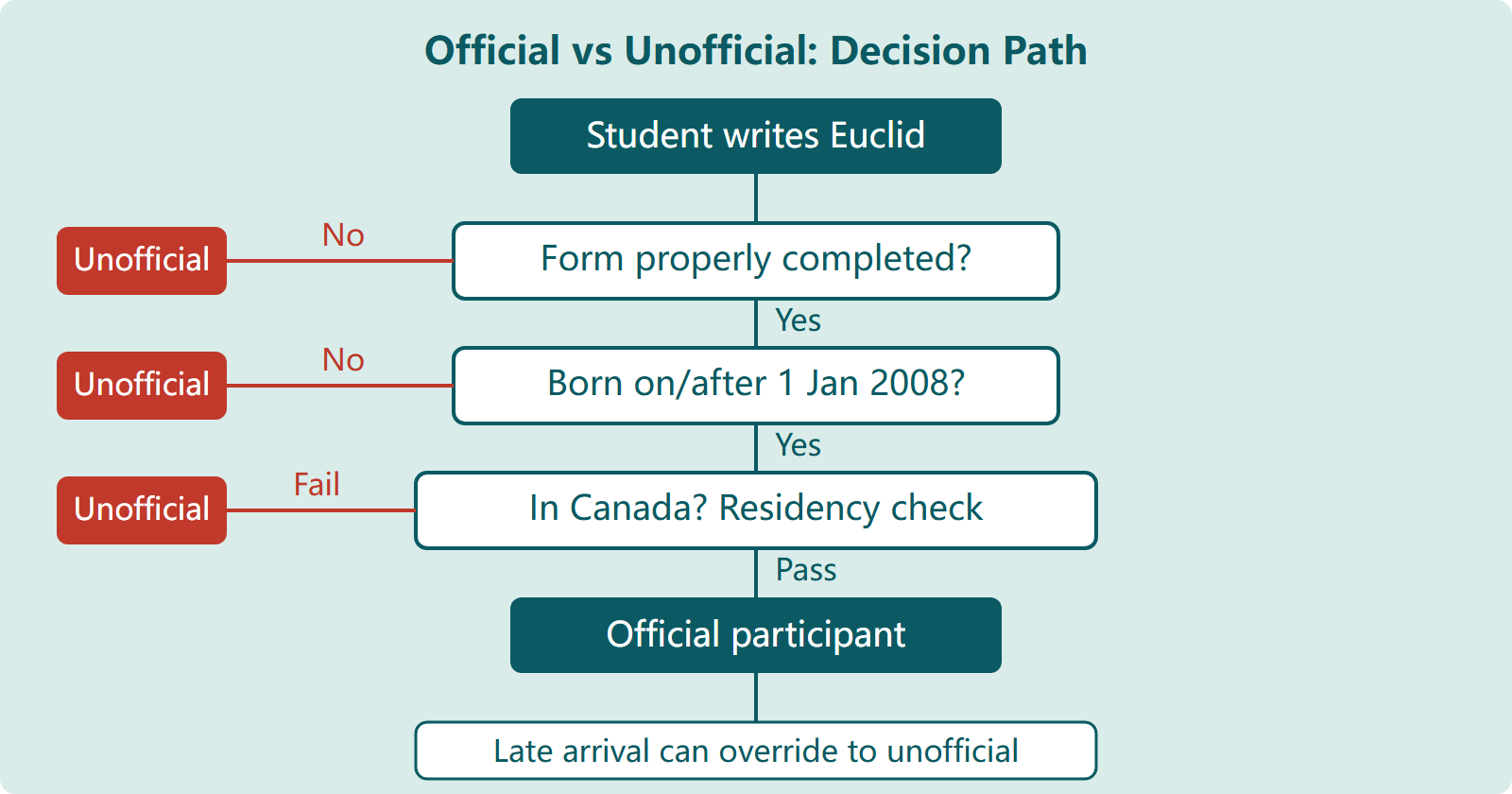
Fig 1. CEMC’s decision path for official participant status. Failing any gate results in unofficial classification. A late-arriving contest can also trigger unofficial status regardless of prior checks.
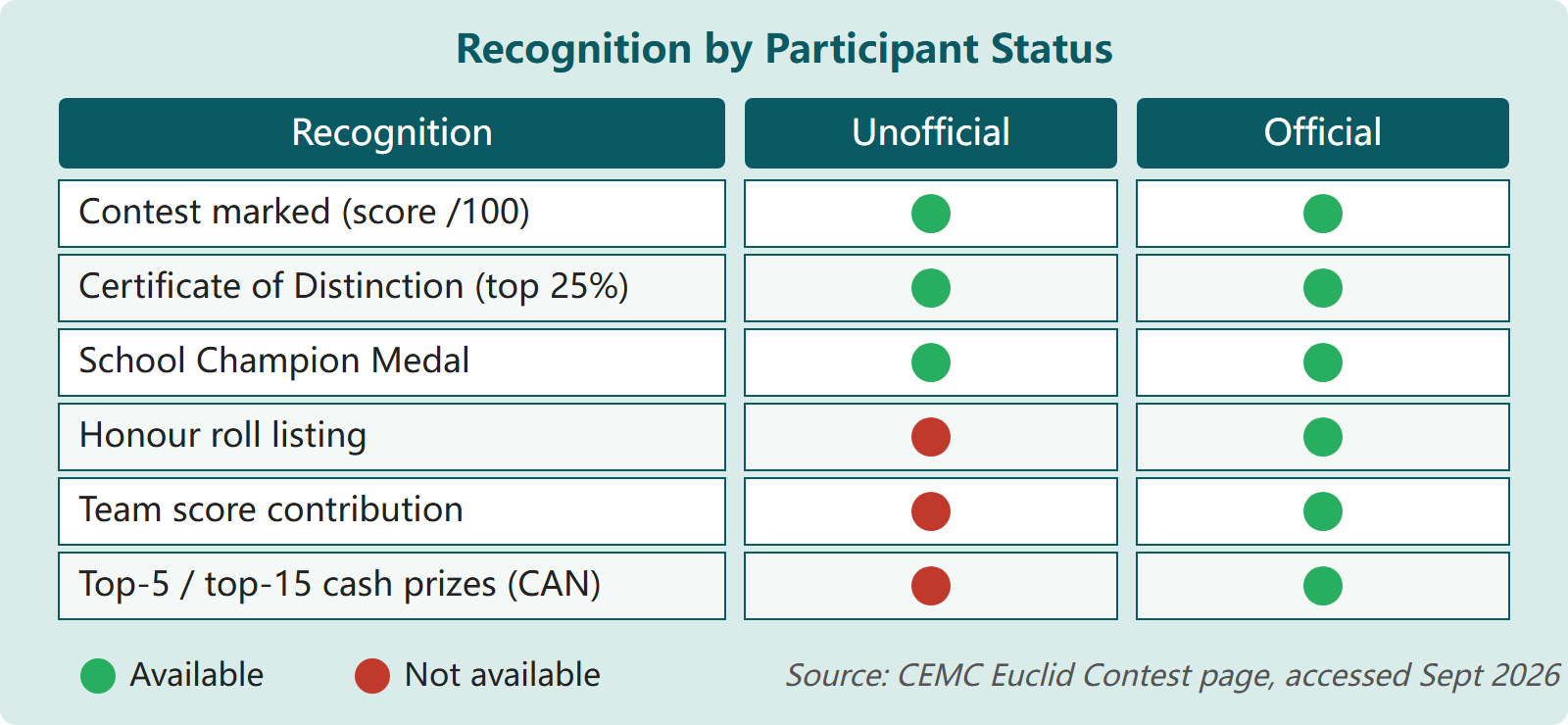
Fig 2. Green circles mark recognitions available to all participants; red circles mark those restricted to official participants. Medal and Distinction eligibility spans both columns.
Frequently Asked Questions
Can an unofficial participant still receive a Certificate of Distinction?
Yes. CEMC awards a Certificate of Distinction to every participant scoring in the top 25 percent of all competitors. The rule does not limit this to official participants. Unofficial participants also have their contests marked through the standard process.
Does an unofficial participant’s score count toward the school’s team score?
No. A school’s team score is the sum of its three highest-scoring official participants’ scores. If a school’s highest individual score belongs to an unofficial participant, that score is excluded from the team total. Schools also have the option of not taking part in the team competition at all.
What happens if a participant’s contest arrives at CEMC too late?
CEMC notes that a participant’s contest may be considered unofficial if it is received too late to be included in the final results. This applies even if the student met every registration criterion. Schools are responsible for arranging return shipping, and CEMC recommends using a courier to protect the materials.
Editorial note: This article is published by an independent Euclid information site. We are not affiliated with, endorsed by or sponsored by CEMC or the University of Waterloo. All contest rules referenced here are drawn from CEMC’s publicly available Euclid Contest page as of September 2026. CEMC may update its policies; supervisors should verify current requirements at cemc.uwaterloo.ca before the 2027 contest. Participation in the Euclid Contest is an academic activity and does not guarantee admission to any university programme.