On Thursday 19 November 2026, five months before Euclid, the same CEMC runs a contest that goes almost unmentioned in China-market Euclid preparation: the Canadian Senior and Intermediate Mathematics Contests. Nine questions, two hours, out of 60 — six answer-only and three full-solution, marked with the same sentence CEMC applies to Euclid. It is the closest thing to a dress rehearsal the organiser publishes, and ordering closes on 22 October 2026.
The contest sitting in plain sight
Ask a Euclid candidate in China what else the CEMC runs and you will usually get one of two answers: nothing, or the AMC-shaped contests they have heard of from elsewhere. The Canadian Senior Mathematics Contest and the Canadian Intermediate Mathematics Contest are published on the same contest calendar as Euclid, ordered through the same portal, and sat in the same academic year — and they are almost invisible in Chinese-market discussion of Euclid preparation.
Here is what cemc.uwaterloo.ca currently publishes for them. The two contests share a page and a format; they differ in who writes which.
| CIMC | CSMC | |
|---|---|---|
| Who writes it | “Students in Grades 9 and 10” | “Students in Grades 11 and 12 and CÉGEP students” |
| Younger students | “Motivated students in lower grades are welcome to write the contest.” | |
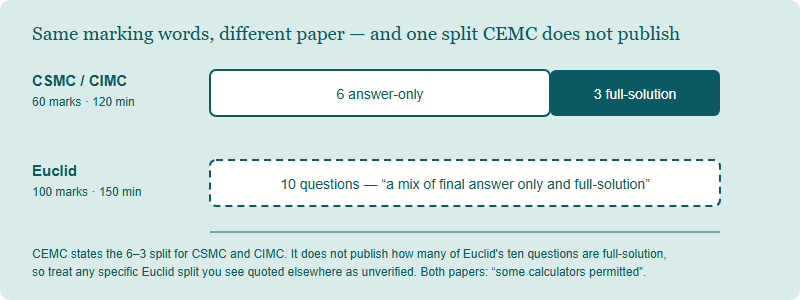
| Structure | “9 questions; 6 are answer only and 3 are full-solution.” | |
| Score | Out of 60 | |
| Time | “Time allowed for completion is 2 hours.” | |
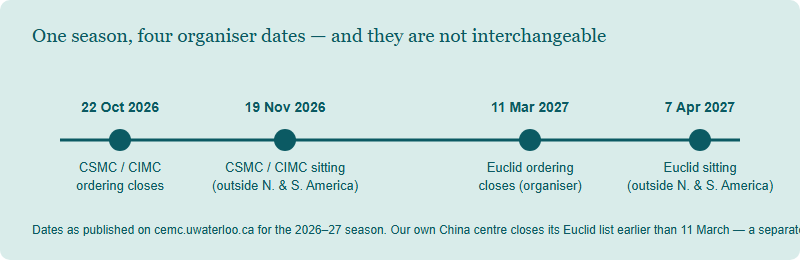
| Date (outside North and South America) | Thursday, 19 November 2026 | |
| Date (North and South America) | Wednesday, 18 November 2026 | |
| Ordering deadline | Thursday, 22 October 2026 | |
| Fee as published | $14.00 per participant, plus $5.00 processing per order | |
| Calculators | “Some calculators permitted.” | |
| How to enter | Through a school or test centre via the Contest Supervisor Portal | |
Two of those rows deserve a second look before anything else. The ordering deadline is 22 October 2026, which is roughly seven weeks from now, and it is the organiser's deadline for this November contest — it has nothing to do with Euclid's ordering deadline of 11 March 2027, and nothing to do with the earlier close our own China centre operates for its Euclid list. Three different dates, three different purposes. If you take one thing from this article, take the habit of always naming which deadline you mean.
Why this is a rehearsal and not just another contest
Plenty of contests could be described as “good practice” for Euclid. Very few can point to the organiser saying so. This one can, twice over.
First, the marking language. CEMC describes Euclid submissions with a specific sentence: “Each submitted solution is assessed for completeness, clarity, and presentation style; a correct solution, poorly presented, will not earn a full score for that problem.” The CSMC and CIMC page applies the same three criteria — completeness, clarity, and presentation style — to its own full-solution questions. That is not a family resemblance invented by a tutoring company; it is the same published standard on two contest pages from the same organiser.
Second, and more directly, CEMC publishes a single set of preparation material covering both contests, and states plainly: “The mathematical background required for these two contests is similar, so students can use these preparation materials for both.” The organiser groups CSMC and Euclid together and says so in one sentence. The material is organised, in CEMC's words, into “eight major topic areas”, with a toolkit per topic.
So the case for writing CSMC is not that it is a similar-looking paper. It is that the organiser treats the two as drawing on one body of background, and marks the written work in both by the same three words. If you want to know whether your argument-writing will survive contact with a CEMC marker, November is when you find out, rather than April.
What three full-solution questions actually train
Three questions is a small number, and that is the point. A student who has spent a year on multiple-choice contests has usually never been marked on a written argument by anyone other than their own teacher, working from their own school's expectations. Three CEMC-marked full-solution questions in November produce something a school report cannot: evidence about how a stranger reads your work.
From coaching students through both papers, our teaching team finds the same three habits cost marks in November and again in April, and they are all presentation rather than mathematics:
- The unstated “let”. A variable appears in line three that was never introduced. The student knows what it means; the marker is not required to guess.
- The vanished case. A quadratic yields two roots, one is silently discarded because it is “obviously” wrong, and the reason is never written. Completeness is one of the three published criteria.
- The answer with no claim. The work is correct, the final line is a number, and nothing states what has been shown. Clarity is a second of the three criteria.
None of these is fixed by more practice problems. They are fixed by writing solutions that someone else marks, and by reading the marks back. That is the mechanism our guide to how step marks work on Euclid describes in detail, and CSMC is the cheapest place in the calendar to test whether you have absorbed it.
There is a second benefit that has nothing to do with marking: a two-hour paper in November is a rehearsal for sustained concentration. Euclid runs 2.5 hours. A student whose longest ever timed mathematics sitting is a 75-minute school test is not being tested on stamina in April by accident.
Who should write which paper — and who should skip it
The grade bands are published and straightforward: CIMC for grades 9 and 10, CSMC for grades 11 and 12 plus CÉGEP students, with CEMC adding that “motivated students in lower grades are welcome to write the contest.” In practice the decision for a China-based international-school student comes down to what the November sitting is for.
| Your situation in autumn 2026 | Reasonable call | Why |
|---|---|---|
| Grade 12, entering Euclid in April 2027 | Write CSMC | A marked full-solution rehearsal five months out, on the organiser's own standard, while there is still time to change how you write |
| Grade 11, planning Euclid in 2027 or 2028 | Write CSMC | You are inside the published band, and a first marked experience a year early is worth more than a first marked experience the week before |
| Grade 9 or 10, strong and curious | Write CIMC | Same nine-question shape at your level; builds the writing habit long before it has to carry a score |
| Grade 12, already writing timed full past papers with solutions marked by a teacher | Optional | You already have the feedback loop; the marginal gain is stamina and an external reference point, not a new skill |
| Any grade, currently unable to finish a full-solution question at all | Fix that first | A contest is a measurement, not a remedy. Two weeks of written practice first will make the measurement worth having |
One caution about the entry route, because it catches people every year. CSMC and CIMC are ordered the same way Euclid is: through a school or a test centre using the Contest Supervisor Portal. There is no individual sign-up page for them any more than there is for Euclid, which is the subject of our 2027 registration guide. If you sit Euclid through a centre, do not assume the same centre automatically orders the November contest as well — it is a separate order, in a separate window, and you should ask.
What a November result does and does not tell you
Across our own Euclid cohorts we count Distinction results of 96 in 2022, 165 in 2023, 177 in 2024, 233 in 2025 and 217 in 2026, with scores of 90 or above numbering 7, 8, 17, 8 and 21 across those same five years. Those are our own de-identified tallies per Hanlin, not a CEMC statistic, and individual results vary. We publish the year-by-year shape because it is the part nobody else can, and because it makes one point clearly: the counts do not move smoothly. A single cohort's November performance is a signal about writing habits, not a forecast of an April score.
Read a CSMC result as diagnostic. A student who scores modestly but whose three full-solution questions are cleanly argued is in better shape than one who scores higher on the six answer-only questions and loses most of the written marks — because the second student's gap is precisely the gap Euclid widens, from three questions to a paper worth 100. The full April calendar, including how the two March closes differ, is set out in our 2027 key dates guide.
It is also worth stating what none of this buys. CEMC itself notes that “participation in the Euclid Mathematics Contest is not required for admission to the Faculty of Mathematics at the University of Waterloo.” A November contest is a training instrument. It is a good one, it is cheap, and it is marked by the people who will mark you in April — that is the whole of the claim.
Frequently asked questions
When is the CSMC in 2026?
Thursday 19 November 2026 outside North and South America, and Wednesday 18 November 2026 within them, as published by CEMC.
Can I register for the CSMC myself?
No. Like Euclid, it is ordered by a school or test centre through the Contest Supervisor Portal. Ask your school before the 22 October deadline.
Is the CSMC ordering deadline the same as Euclid's?
No. CSMC and CIMC ordering closes 22 October 2026; Euclid's organiser deadline is 11 March 2027. They are separate orders.
Does the CSMC really use the same marking standard as Euclid?
Both pages state solutions are assessed for completeness, clarity and presentation style. CEMC also publishes one preparation set for both.
Editorial note: Contest dates, fees and eligibility are re-set by the organiser each cycle — confirm current details on cemc.uwaterloo.ca before acting on anything here. Corrections are issued within 7 working days of notice.